
Phone Charging Lockers with Digital PIN Locks for Sale
Phone Charging Lockers with Digital PIN Locks for Sale | Custom Branded Lockable Phone Charging Stations
Lockable Phone Charging Stations for Sale | Digital PIN Phone Charging Lockers
Custom-branded, lockable phone charging stations for events, venues, and commercial spaces. A flat phone changes someone’s mood faster than almost anything else in modern life. Give visitors, guests, delegates, patients or staff a safe place to charge and lock away a phone, no key, no app, no fuss, and you’ve quietly solved a problem they didn’t expect your venue to solve.
That’s the whole idea behind a digital PIN charging locker: a bank of individually lockable compartments, each with its own charging connection, opened not with a key or a wristband but with a code the user sets themselves. This guide covers what a buyer actually needs to know before purchasing one — how the technology works, what separates a well-built commercial unit from a flimsy import, how the numbers stack up, and how to choose between capacities, mounting options and branding packages.
It’s written around our premium 12-locker digital PIN charging station currently available at 50% off for a limited time.
Limited-time launch offer
Save 50% on our premium 12-locker Digital PIN Charging Station when you order depending on avalibility. [Request a quote →] [Ask for a branding mock-up →][Approve Artwork] [Delivery 1-3days]
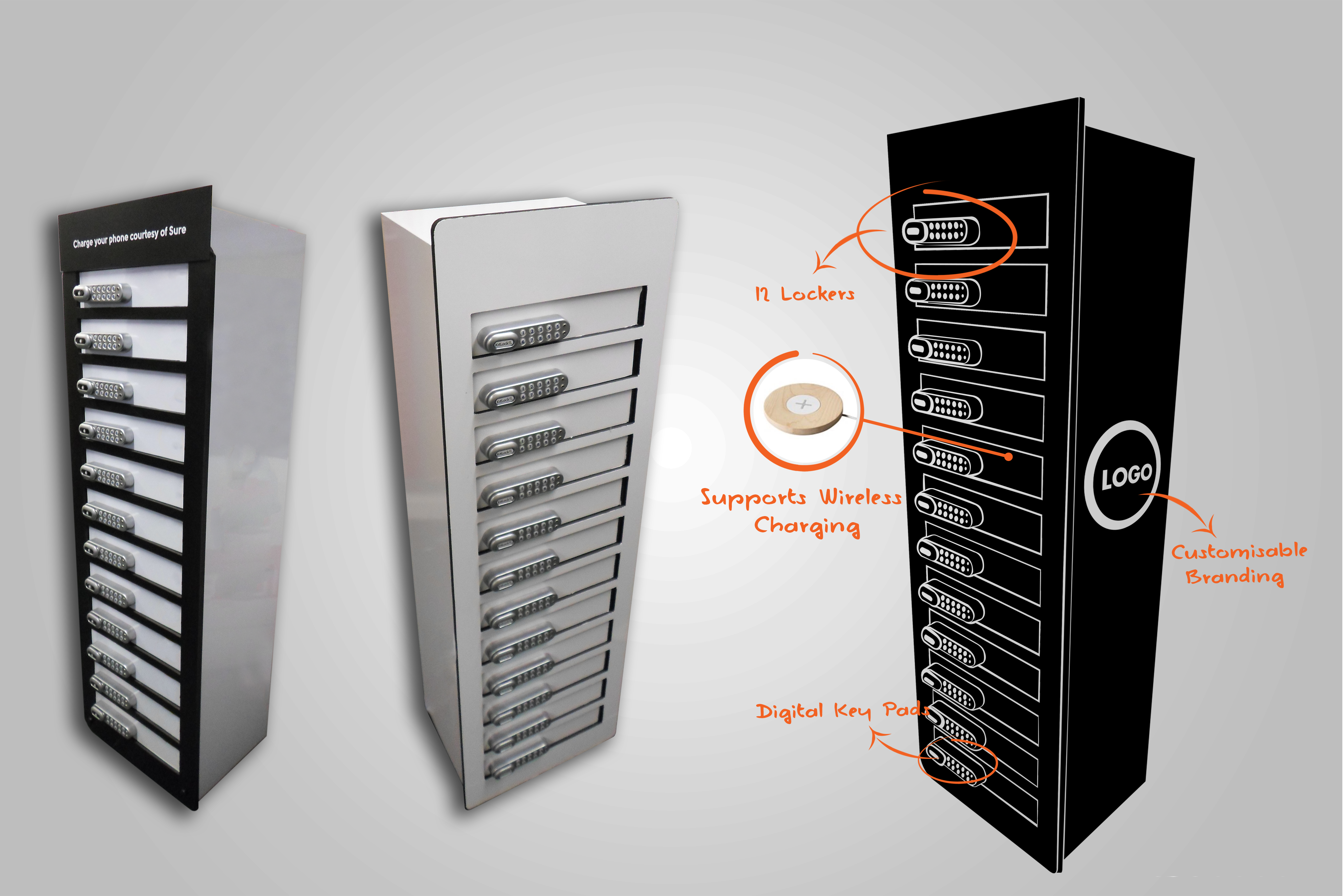
Mobile phone charging locker
Contents
- What Is a Phone Charging Locker?
- What Is a Digital PIN Charging Locker?
- How Digital PIN Locking Works
- Advantages Over Key Lock Systems
- RFID vs PIN vs App-Based Lockers
- Why Businesses Choose PIN Lockers
- Security Features
- Charging Technology
- Fire Safety, Ventilation and Build Quality
- Manufacturing Standards, Quality Control and Warranty
- Software and Smart Locker Management
- Branding, Advertising and Custom Design
- Compliance, Shipping and Support
- Charging Lockers vs the Alternatives
- How to Choose the Right Charging Locker
- Where Businesses Use Digital PIN Charging Lockers
- Return on Investment
- Sustainability and Energy Efficiency
- Frequently Asked Questions
- Request Your Quote
What Is a Phone Charging Locker?
A powerful phone charging locker is a freestanding or wall-mounted unit divided into individual, lockable compartments, each fitted with its own charging connection. A visitor places their phone inside a compartment, locks it, and goes off to enjoy an event, browse a shop floor, sit through an appointment or catch a flight without leaving a charging phone unattended on a café table or babysitting it for forty minutes.
Commercial units typically come in banks of 8, 12, 24 or 48 lockers, built from powder-coated steel rather than moulded plastic, and are engineered to survive years of heavy public use rather than the occasional weekend at a festival.
Quick specification: our 12-locker phone charging unit
| Specification | Detail |
|---|---|
| Number of lockers | 12 |
| Construction | Powder-coated steel cabinet |
| Charging connections per locker | USB-C and Lightning as standard; [confirm exact port configuration for your requirement] |
| Fast charging | 10-port, 1000W GaN (Gallium Nitride) charging hubs that feature PD (Power Delivery) and QC (Quick Charge) deliver 140W USB C charger max speeds Far superior to a standard 65W charger |
| Wireless charging | Optional Qi pad upgrade |
| Lock type | Digital PIN keypad, user-set code per session |
| Admin override | Master code / management panel |
| Dimensions (H × W × D) | approx 1200 by 350 by 350mm |
| Weight | 40-86kg |
| Power supply | Standard UK 13A mains; hardwired option available |
| Indoor/outdoor rating | outdoor-suitable in tents |
| Warranty | 5-10 yrs |
| Colour options | Standard RAL colours, or full custom branding wrap |
| Price | 50% off for a limited time |
[Request a quote →]
What Is a Digital PIN Charging Locker?
A digital PIN charging locker replaces the lock-and-key mechanism with a keypad. The user chooses their own PIN when they lock the compartment, then re-enters the same code to open it again. There’s no key to issue, track or lose, and no wristband, token or card to hand out and collect at the end of the day.
For the operator, that single change removes most of the day-to-day admin of running a charging station: no key inventory to manage, no replacement cost when a key walks off in someone’s pocket, and no queue at a help desk while a lost key gets traced.
How Digital PIN Locking Works
- Choose a free locker. An indicator light or simple display shows which compartments are available.
- Connect the phone. The user plugs in using the built-in cable that matches their device.
- Close the door and set a PIN. A short numeric code, entered on the keypad, seals the compartment.
- Walk away. The locker stays sealed to everyone except whoever knows that code — including the operator’s own staff, unless the master override is used.
- Return and collect. The same PIN reopens the door. The code is cleared the moment the locker empties, ready for the next user.
Behind that simple front-end sits an administrative layer: a master override code, card or management panel that lets staff open any locker in an emergency or at the end of a shift, plus (on most modern units) remote status monitoring so a manager can see which lockers are occupied without walking over to look.
[Book a demonstration →] to see the full sequence in person.
Advantages Over Key Lock Systems
Key-operated lockers still work, but they carry a running cost that rarely shows up until you’ve operated one for a season. Every issued key is something that can be lost, copied or simply not returned. A digital PIN lock removes that cost entirely:
- No keys to cut, issue or replace. There’s no float of spare keys to manage and no locksmith bill when one goes missing.
- No duplication risk. A cut key can be copied without anyone knowing. A PIN is chosen fresh by each user and wiped the moment the locker is emptied, so there’s nothing left in circulation to compromise the next person’s compartment.
- Faster turnover. There’s no handout-and-return desk slowing down entry and exit, which matters at a festival gate or a stadium concourse at half-time.
- Lower total cost of ownership. The keypad hardware costs more upfront than a basic cam lock, but the saving on replacement keys, locksmith call-outs and staff time usually pays that back within the first year of heavy use.
RFID vs PIN vs App-Based Lockers
There are, in practice, four ways to secure a public-access locker: a physical key, an RFID card or fob, a smartphone app, and a digital PIN. Each suits a different situation.
| Consideration | Digital PIN | Key Lock | RFID / Card | Smartphone App |
|---|---|---|---|---|
| Equipment the user needs | None — just memory | Physical key | Issued card or fob | Their own phone, app installed, battery charge |
| Risk if “credential” is lost | None — nothing physical exists | Locksmith call-out, re-keying | Card must be deactivated and reissued | Account recovery process |
| Suitable for one-off, casual visitors | Excellent | Poor (key management overhead) | Poor (requires issuing hardware) | Poor (download friction, one-time users won’t install an app) |
| Suitable for repeat members/staff | Good | Fair | Excellent (integrates with existing access cards) | Good, if they already use the venue’s app |
| Speed for a first-time user | Immediate | Immediate, but requires a handout desk | Requires issuing before first use | Requires app download, account creation |
| Ongoing operating cost | Low | Moderate–high (replacements) | Moderate (card stock, reader maintenance) | Low hardware cost, but support overhead for login issues |
| Hygiene | No shared token exchanged | Key handled by staff and visitor | Card handled by staff and visitor | No physical exchange |
The practical verdict: for high-footfall, one-off public use — the exact situation most charging lockers are bought for — a PIN wins because it needs no issued hardware and no software install. RFID makes more sense in closed-loop environments where cards already exist, such as a gym or a corporate office. App-based locks suit venues that already funnel every visitor through their own app anyway, such as a stadium or festival — though they carry one obvious design flaw worth naming: if the only device that can unlock the compartment is the phone locked inside it, the system fails at the one moment it’s needed most. Digital PIN locks sidestep that problem entirely, since the code lives in the user’s memory, not on a device.
Why Businesses Choose PIN Lockers
Operators consistently land on PIN locking for a handful of practical reasons:
- Genuinely self-service. No staff member has to be present to operate it, which means it can run unattended at a reception desk, a concourse or an unmanned entrance.
- Zero learning curve. Everybody already understands a keypad — there’s no onboarding, no instructions needed, no app to explain.
- Scales without extra headcount. A 12-locker bank and a 48-locker bank need the same level of staff involvement: none, day to day.
- Branding real estate that keys and cards don’t offer. A locker cabinet is a large, static, well-lit surface that sits in a high-dwell-time area — an asset most operators only notice once someone points it out.
- A revenue line, not just a cost line. As covered further down, that same branding surface, plus the option of a small usage fee, can turn a charging locker from pure overhead into something that pays for itself.
Security Features
A well-specified commercial unit is built to resist casual tampering and outright attack, not just polite use:
- Individually compartmentalised doors — a breach of one locker doesn’t expose the other eleven.
- Tamper-resistant steel doors with concealed hinges, so there’s no external leverage point.
- Anchor points for bolting to floor or wall, so the whole cabinet can’t simply be wheeled or carried away.
- Reinforced locking bolts designed to resist physical force, not just casual pulling.
- Logged master override for staff, so any emergency access is recorded rather than untraceable.
- Remote fault and forced-entry alerts on connected models — [confirm whether this is standard or an optional upgrade on your unit].
[Request a quote →]
Phone Charging Station Technology
Fast Charging
Modern commercial lockers use fast-charging protocols (broadly, USB Power Delivery and equivalent standards) to cut a typical charge time from the better part of an hour down to a fraction of that for the first, most useful chunk of battery. In a public setting, that’s the difference between a locker someone can use in the ten minutes before their meeting and one that only suits people staying for the whole event.
USB-C
USB-C is now the default connection for the vast majority of Android phones and, since the iPhone 15 range switched over in 2023, current-generation iPhones too. Its reversible connector matters more in a locker than it does at home — users are plugging in inside a dim compartment, often one-handed, and a connector that only goes in one way causes more fumbling and more complaints than it should.
Lightning
Older iPhone models (iPhone 14 and earlier) still use Apple’s Lightning connector, and plenty of them remain in daily use. A properly specified public charging locker includes both cable types as standard rather than assuming every visitor has upgraded.
Wireless Charging
Qi wireless charging pads are a popular optional upgrade — genuinely convenient, since there’s no cable to align in a low-light compartment, but worth setting expectations around: charging is slower than a wired fast-charge connection, and thick or metal-backed phone cases can interfere with the transfer.
Internal Power Management and Smart Charging
The unglamorous part of a good charging locker is what happens behind the panel: proper current regulation per port, so plugging in all twelve compartments at once doesn’t overload the circuit or slow-charge everyone equally. Decent internal power management detects the connected device and delivers the current it can safely accept, then steps down or cuts off once the battery is full — which protects battery health over hundreds of charge cycles rather than just blasting maximum current regardless of what’s plugged in.
Surge Protection
Built-in surge protection and per-port fusing shield both the phones inside and the unit itself from voltage spikes on the mains supply — a genuinely useful safeguard in older public buildings where the electrical supply isn’t always as clean as a new-build office.
Fire Safety, Ventilation and Build Quality
Fire Safety
Leaving a dozen phones charging unattended in one enclosed cabinet raises the stakes if a single battery or cable develops a fault. A properly engineered unit is designed around that risk rather than around it: thermal cut-offs, flame-retardant internal materials, and per-port fusing so one faulty device can’t take down the whole bank or become a fire risk. [Confirm and state your unit’s specific fire safety testing/certification here once verified.]
Ventilation
Enclosed compartments generate heat, particularly with fast charging running across multiple ports simultaneously. Proper units include passive or active ventilation, with grille placement designed so airflow doesn’t create a security weak point.
Anti-Theft Design
Concealed cable routing (so a cable can’t be cut or pulled from outside), reinforced door edges with no external lever point, and floor or wall anchoring all combine to make the unit itself, and not just its contents, resistant to theft and vandalism.
Powder-Coated Steel Construction
Steel construction, rather than moulded plastic, is the single biggest differentiator between a genuinely commercial-grade unit and a budget import. Steel resists dents and impacts that would crack a plastic housing, doesn’t discolour or become brittle under UV exposure the way outdoor plastic units often do, and takes a wipe-clean powder coat finish that can be colour-matched to a brand palette rather than limited to whatever colour the mould came in.
Manufacturing Standards, Quality Control and Warranty
Manufacturing and Quality Control
When comparing suppliers, ask what quality control actually looks like on their production line: is every unit tested before dispatch, or only a sample batch? Are components sourced from traceable suppliers, or assembled from whatever’s cheapest that quarter? our products are manufactured locally, and QC checks.
Warranty
Reputable commercial units typically carry a multi-year parts-and-labour warranty. Two questions are worth asking of any supplier before you buy: does the warranty cover the electronics separately from the steel cabinet, and what’s the average turnaround time if something does need repairing 5-10 yrs warranty and coverage terms.
Maintenance
| Frequency | Check |
|---|---|
| Daily | Wipe down surfaces, check all doors close and latch properly |
| Weekly | Test keypad responsiveness on a sample of lockers, inspect cables for wear |
| Monthly | Inspect anchor bolts and mounting points, test the master override |
| Annually | Full electrical inspection and PAT testing, deep clean of ventilation grilles |
[Request a quote →]
Software and Smart Locker Management
Digital PIN Management
The system assigns and clears PINs automatically as lockers are used and emptied, so no leftover code is ever left active on a compartment that’s now free.
Lost PIN Recovery
Even the best-designed system needs a fallback for the visitor who’s forgotten their code five minutes after setting it. A reliable master override process — not a workaround, a genuine built-in feature — is one of the things to check before buying, since some budget imports skip it entirely and leave operators with no way into a jammed compartment short of drilling it out.
Emergency Override
A master key, card or code lets authorised staff open any locker regardless of the PIN set inside — essential for end-of-day clearing, lost-PIN situations, and any scenario where a phone genuinely needs retrieving without the original code.
Administrator Controls
A management panel (physical or app-based, depending on the model) that shows door status across the bank, flags faults, and allows a manual PIN reset without needing the original code.
Remote Monitoring
Cloud-connected units can push fault alerts or forced-entry notifications straight to a manager’s phone or dashboard rather than requiring someone to physically check the unit. [Confirm whether this is included as standard or available as an upgrade on your model.]
Analytics
Usage data — busiest times of day, average dwell time, overall occupancy rate — is useful operationally (it tells you whether you need a bigger unit) and useful commercially, since occupancy figures are exactly what a sponsor wants to see before agreeing a branding fee (more on this in the ROI section below).
QR Code Integration
A QR code on the unit’s fascia is a low-cost way to add interactivity without building a full app: linking through to venue information, sponsor content, Wi-Fi login or a quick feedback form while the user waits for their phone to charge.
Branding, Advertising and Custom Design
A phone charging locker sits in a high-footfall, high-dwell-time spot and gets looked at for several minutes at a time — which makes it one of the more underused pieces of advertising real estate most venues already own.
Sponsor Branding
Vinyl-wrapped branding panels are routinely sold as sponsor space at events and conferences — a genuine, established revenue model covered in more detail in the ROI section below.
Digital Advertising and LCD Displays
An integrated LCD screen on the unit’s fascia can rotate sponsor adverts, venue information or safety messaging.
LED Lighting
Illuminated fascia panels, available in brand colours, improve visibility in dim venues — festivals, nightclubs, exhibition halls with low ambient lighting — while doubling as a branding cue.
Custom Colours and Vinyl Wrapping
Cabinets can be powder-coated to standard RAL colour references for a permanent, brand-matched finish, or vinyl-wrapped for shorter-term event branding that can be swapped between bookings.
Corporate Branding
Logo placement, dedicated signage panels and QR code tie-ins let the unit double as a piece of corporate identity rather than a generic grey box in the corner.
OEM and White-Label Manufacturing
For resellers and distributors, units can be supplied unbranded for the buyer’s own branding, or manufactured entirely under the buyer’s own brand name for onward resale.
Bulk Orders
Multi-site roll-outs and volume orders are typically handled with tiered pricing and a dedicated account contact.
[Ask for a custom branding mock-up →]
Compliance, Shipping and Support
CE and UKCA Marking
CE marking indicates a product has been assessed against relevant EU health, safety and environmental requirements; UKCA is the equivalent marking introduced for the Great Britain market after Brexit. Requirements and transition arrangements between the two have shifted more than once in recent years, so rather than quote a specific deadline here that may be out of date by the time you’re reading this, confirm the current position with your compliance adviser or the latest gov.uk guidance, and state clearly on your product page exactly which markings your unit carries.
International Shipping
Units are typically packaged flat or palletised for freight.
Installation and Delivery
Depending on the model, delivery can range from kerbside drop-off to a full white-glove installation service including anchoring the unit to floor or wall on site.
Customer Support and Preventative Maintenance
[Email us for support channels, response times, and any maintenance contract options.]
Phone Charging Lockers vs the Alternatives
vs Power Banks
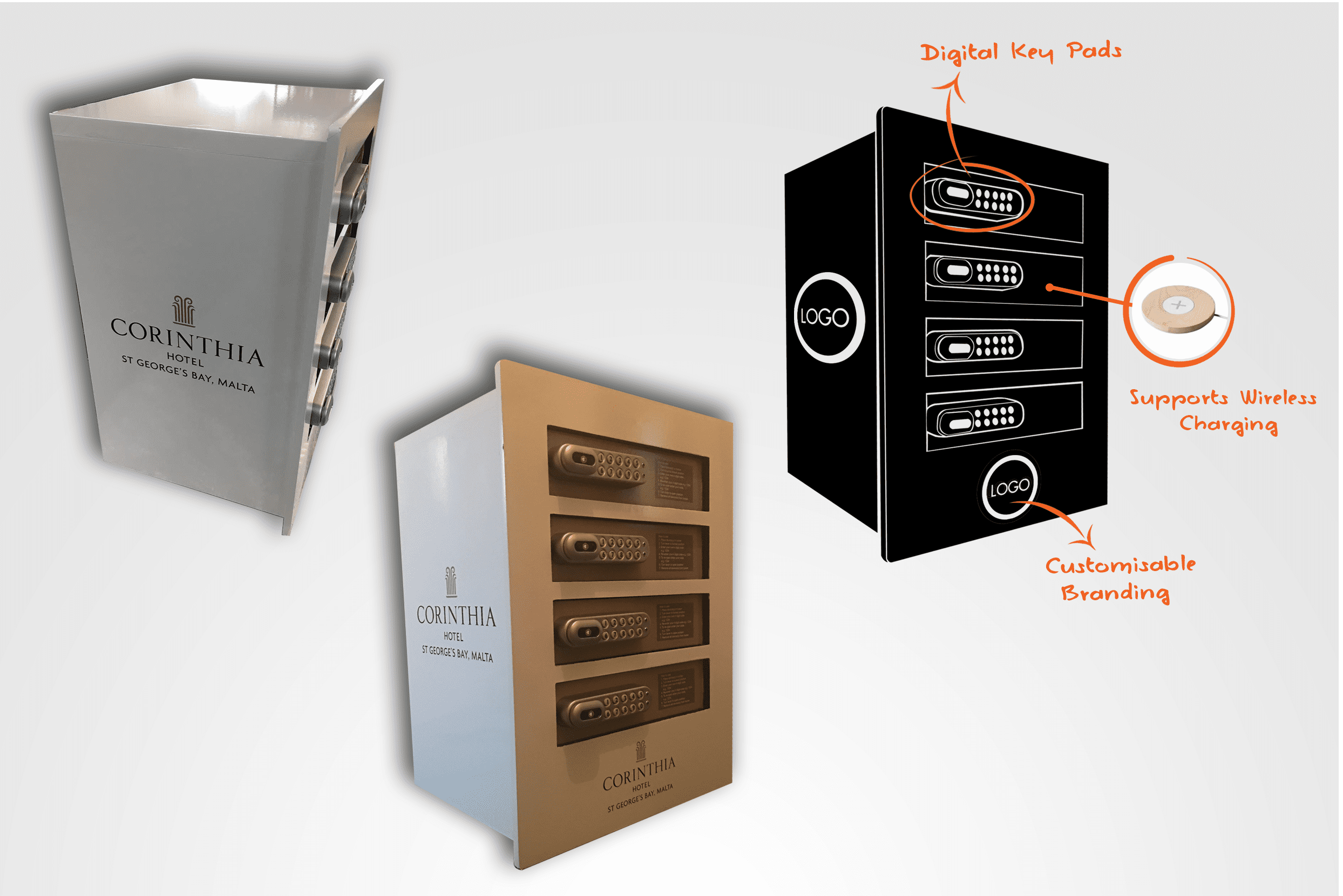
Power banks are cheap and portable, but they’re easily walked off with, run flat themselves, and shift liability for loss or damage onto the venue if handed out and not returned. They offer no branding surface and don’t scale well to high-footfall public venues.
vs Power Charging Tables

Open charging furniture — a table or shelf with exposed cables and no locking mechanism — is cheaper to install but offers no real security at all. The phone sits out in the open, and the user still has to stay with it, which defeats the entire point of a “leave it and go” charging solution.
vs Open (Non-Lockable) Phone Charging Stations
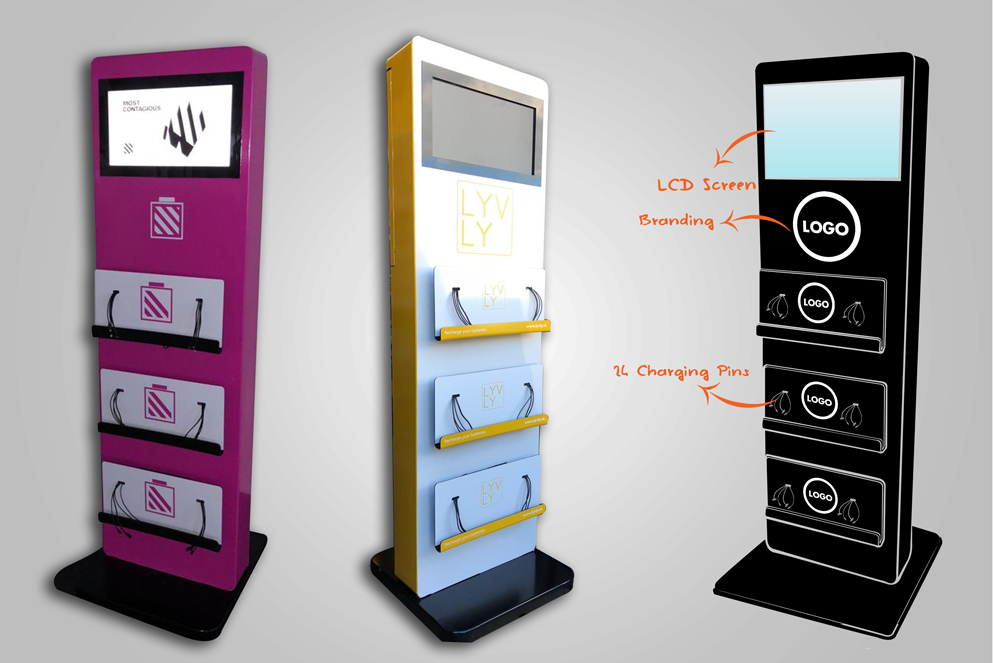
Similar limitation: cables and a shelf, no doors. Reasonable for a low-risk internal office space, but unsuitable anywhere members of the public are passing through.
| Security | Unattended use | Theft/liability risk | Branding potential | Best suited to | |
|---|---|---|---|---|---|
| Digital PIN locker | High | Yes | Low | Excellent | Public venues, events, high footfall |
| Power banks | Low | No | High | None | Small-scale, staffed, low-risk settings |
| Charging tables | None | No | High | Minimal | Internal office use only |
| Open charging stations | None | No | High | Minimal | Low-risk internal spaces |
How to Choose the Right Phone Charging Locker: A Buyer’s Guide
Capacity Options
8 lockers
Suits small receptions, waiting rooms and low-footfall retail spaces where floor space is tight and demand is steady but modest.
12 lockers — our featured unit
The sweet spot for most mid-size venues: cafés, gyms, GP surgeries, boutique retail, small conference rooms. Enough throughput to avoid a queue at peak times, without the footprint of a full-size bank.
24 lockers
For busier venues — larger retail units, mid-size conference centres, leisure facilities — where demand regularly outstrips what a 12-locker unit can handle.
48 lockers
For stadiums, festivals, airports and large exhibition halls, where footfall runs into the thousands over a single day.
Custom configurations
Bespoke locker counts and cabinet dimensions for unusual spaces or specific throughput requirements. [Insert your custom configuration process and lead times.]
Indoor vs Outdoor Models
Outdoor installations need a weatherproof enclosure (an appropriate IP rating), UV-stable coating that won’t fade or become brittle in sunlight, and proper drainage. Indoor units can prioritise finish and branding over weatherproofing, since they’re not exposed to the elements.
Wall-Mounted vs Freestanding
Wall-mounted units save floor space but need a structural wall suitable for anchoring. Freestanding units can be relocated between areas of a venue, or between venues entirely — a better fit for touring events or businesses running charging lockers across multiple sites.
Accessories and Optional Upgrades
Wireless charging pads, integrated LCD screens, castors for portable models, and combination cable heads (USB-C, Lightning, and legacy Micro-USB) to cover every device a visitor might turn up with.
Maintenance Packages
[Outline your maintenance package tiers — e.g., self-maintained with a spare parts kit vs a full-service contract with scheduled visits.]
Warranty Options
[Outline standard vs extended warranty tiers.]
Buyer’s checklist
Before signing off on any supplier, it’s worth asking:
- How many devices can each port fast-charge simultaneously without throttling?
- What’s the actual process if a user forgets their PIN?
- Is the steel gauge and coating rated for outdoor use, if that’s where it’s going?
- Does the warranty cover electronics separately from the cabinet?
- Can the unit be rebranded or recoloured to match our existing brand guidelines?
- What’s the lead time from order to delivery?
- Is installation included, or a separate cost?
- What happens if a fault develops after the warranty period ends?
- Can capacity be expanded later by linking additional banks together?
- Is remote fault monitoring included, or an optional add-on?
[Request a quote →]
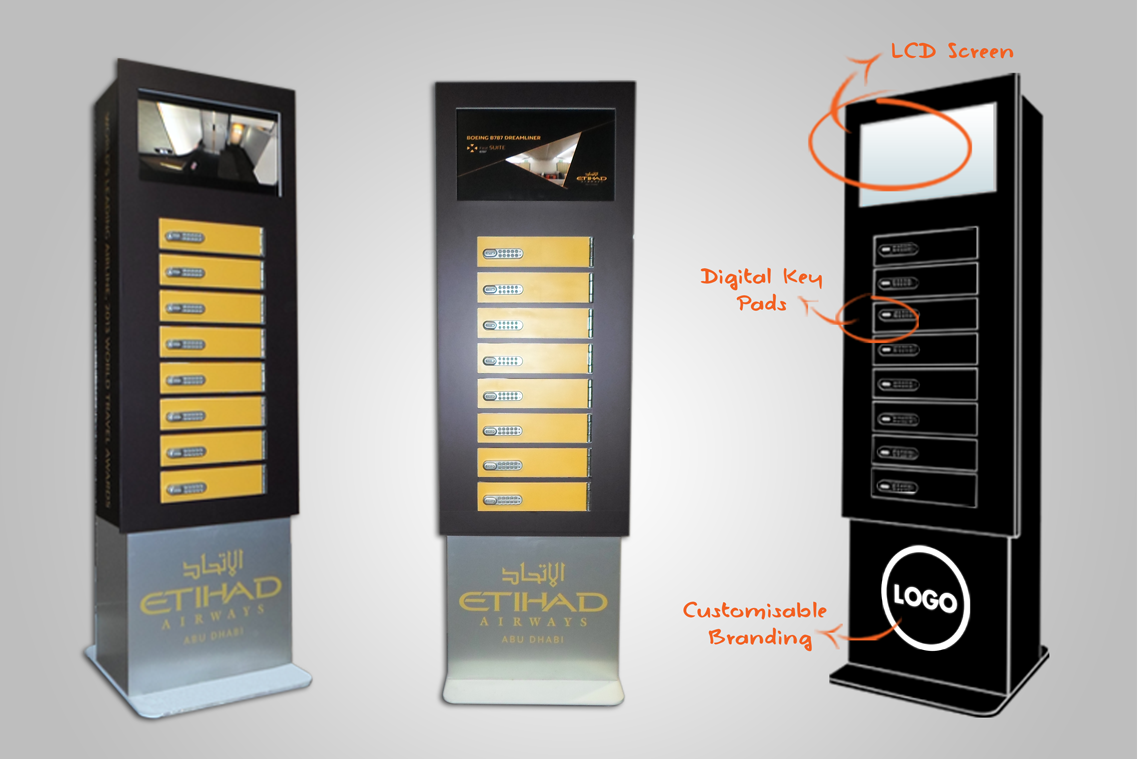
Where Businesses Use Digital PIN Charging Lockers
Events, Exhibitions and Conferences
High footfall over a short, intense window, with delegates relying on their phones for badge scanning, schedules and networking apps. Freestanding units travel well with a touring event circuit, and branding panels are routinely sold as part of a wider event sponsorship package.
Hospitality and Retail
Hotels position charging lockers in lobbies as a guest amenity while luggage or check-in is sorted. Shopping centres place them near food courts specifically to keep shoppers browsing rather than leaving to find a socket. Retail stores use the same logic to extend dwell time on the shop floor.
Healthcare and the Public Sector
In hospital waiting rooms, A&E and outpatient departments, patients can secure a phone during a procedure or appointment where devices aren’t permitted, without handing it to staff who then become responsible for it. Wipe-clean steel surfaces suit infection-control requirements far better than fabric or plastic alternatives. Government buildings, police stations and courts use the same principle to formalise the process of visitors securing personal devices before entering a restricted area.
Education
Universities increasingly need somewhere secure to lock away phones during exams — many exam boards require devices to be physically secured, not just switched off, and a PIN locker solves that far more cleanly than a cardboard box at the front of the hall. Libraries use them to support quiet study zones, and schools and colleges use them to remove a common source of classroom disputes over devices.
Sport, Leisure and Entertainment
Football, cricket and rugby grounds face a concentrated rush at half-time and full-time, and branding on the unit slots naturally into existing matchday sponsorship packages. Theme parks position units near ride entrances alongside loose-article policies, doubling up security and charging in one step. Gyms let members train without carrying a phone, and casinos use them to support strict device policies at the tables.
Transport and Culture
Airports and railway stations serve travellers who need to charge a phone but can’t watch over it while queuing at security or waiting through a delay — exactly the scenario a lockable, walk-away solution is built for. Museums and libraries use them to keep visitors’ phones charged and secure while protecting exhibits and quiet spaces from phone use.
Corporate and Industrial
Offices use charging lockers to support visitor management and clean-desk policies around secure meeting rooms. Manufacturing plants and warehouses, where phones are often restricted on the production floor for safety reasons, find that offering a secure locker — rather than banning phones outright — gets far higher staff compliance than a blanket ban that people quietly ignore.
Return on Investment
Revenue Generation
All our phone charging units are free to use. Some operators charge a small usage fee via a card or contactless reader (where the unit supports payment . Others keep the service free to use and monetise the branding surface instead.
Sponsorship Opportunities
Selling branding space to a local business or event sponsor is a well-established model at festivals and conferences. As an illustrative example only, and not a guarantee: sponsorship of a single 12-locker unit at a two-day conference might realistically fetch somewhere in the region of £750–£1,500, depending on footfall, sponsor demand and the event’s own sponsorship rate card.
Lead Generation
A QR code on the unit can capture a mailing list sign-up, app download or loyalty scheme registration during the few minutes someone’s waiting for their phone to charge — a natural, low-friction moment to ask.
Customer Experience
Charging facilities are one of the more commonly mentioned amenities in venue reviews, and a secure, branded charging locker tends to generate more positive mentions than an open charging table, precisely because it removes the anxiety of leaving a phone unattended.
[Request an ROI estimate for your venue →]
Sustainability and Energy Efficiency
A well-designed unit cuts power to each port once a device is fully charged, rather than leaving it drawing a trickle of standby power all day — the same waste as leaving a charger plugged in at home long after the phone’s full. Powder-coated steel construction is also, in practical terms, a more sustainable choice than injection-moulded plastic housings, which tend to crack, discolour and get replaced (and landfilled) far sooner.
Phone charging lockers Frequently Asked Questions
Buying, Pricing and Ordering
How much do phone charging lockers cost?
Pricing depends on capacity, cable configuration and branding requirements. [Email us for our standard pricing structure.]
Is the 50% off offer available on all models?
[Confirm which models the current promotion applies to.] The offer covers our premium 12-locker Digital PIN Charging Station until [insert end date].
What’s included in the price?
[Email us for what’s included — e.g., unit, standard cabling, delivery, installation — and what’s charged separately.]
Do you offer bulk or multi-site discounts?
Yes — [Email us for pricing structure] for multi-unit and multi-site orders.
Can I hire a unit instead of buying?
[Email us for details: Yes we offer short-term hire is available, and typical terms.]
Security and PIN Access
How does the digital PIN lock work?
The user sets their own PIN when they lock the compartment and re-enters the same code to open it. No key or card is issued, and the code is cleared automatically once the locker is emptied.
What happens if a user forgets their PIN?
Staff can open the compartment using the master override, without needing the original code.
Can staff override a locked compartment?
Yes. A logged master code, card or management panel gives authorised staff access to any locker, for lost-PIN situations or end-of-day clearing.
Is a PIN locker more secure than a key locker?
In practical terms, yes — there’s no physical key that can be copied or go missing, and no leftover credential in circulation once a locker’s emptied.
Does every user get a different PIN each time?
Yes. The PIN is chosen fresh at the point of use and wiped once the compartment is emptied, so it can’t be reused by mistake or exploited by the next person.
Charging and Technical Performance
Which phones and cables are compatible?
Our units include both USB-C and Lightning connections as standard, covering current Android and Apple devices as well as older iPhones still using Lightning. [Confirm your exact cable configuration.]
Does it support fast charging?
Yes — [insert your unit’s specific charging output/wattage].
Can I add wireless charging?
Wireless Qi charging is available as an optional upgrade. [Confirm availability and any compatibility caveats, such as thick or metal-backed cases.]
How many devices can charge at once without slowing down?
All 12 lockers can charge simultaneously; internal power management regulates current per port so usage doesn’t degrade performance across the bank.
What happens during a power cut?
[The doors are battery operated so the unit retains door security without mains power, and the recovery process is to open the unit with your pin code with or without power’s restored.]
Installation, Location and Maintenance
Can the locker be used outdoors?
Yes in a tent
Does it need to be fixed to the floor or wall?
We recommend anchoring the unit for security, using the built-in mounting points.
What power supply does it need?
A standard UK 13A mains socket; a hardwired connection is also available.
How much day-to-day maintenance is required?
Very little — a daily wipe-down and occasional checks (see the maintenance schedule above) are typically all that’s needed between annual electrical inspections.
Can it be moved once installed?
Freestanding units can be relocated; wall-mounted units require reinstallation.
Branding, Customisation and Advertising
Can we brand the locker with our own logo and colours?
Yes — via powder-coated RAL colour matching for a permanent finish, or a vinyl wrap for shorter-term or rotating branding.
Can we sell advertising space on the unit?
Yes — many operators sell branding panels to sponsors, particularly at events and conferences. See the ROI section above for more detail.
What colour options are available?
Standard RAL colours as a baseline, with full custom branding wraps available for a completely bespoke finish.
Can the locker display digital content or adverts?
An optional integrated LCD screen can rotate adverts, venue information or safety messaging.
Is custom branding included in the price or an extra?
yes Free
Warranty, Support and Servicing
What warranty is included?
5-10 yrs but email us for details
What happens if a locker develops a fault?
Email us
Do you provide installation support?
For installation all you need to do is plug into a standard wall socket
Is remote fault monitoring available?
Yes
Do you supply spare parts?
Yes, we repair or replace the units
Ready to order a powerful phone charging locker?
If you are looking to buy phone charging lockers for an event, venue or public space, our premium 12-locker digital PIN charging station is available at 50% off for a limited time, one of the most straightforward ways to add secure, brandable, revenue-generating charging capacity to any high-footfall location.
Save 50% — offer ends soon