
Mobile Phone Charging Station: The Complete UK Guide to Stations, Lockers, Hire, Rental & Buying
Mobile Phone Charging Station: The best way to keep customers connected and coming back.
Powerful Phone Charging Station
A dead phone today is no longer a minor inconvenience but, it’s a genuine operational problem. Tickets, registration passes, event apps, QR-code wayfinding, exhibitor floor plans, networking apps, contactless payments, digital programmes and the event photography attendees post to social media all now live on the smartphone in someone’s pocket. When that phone drops below 10%, so does the attendee’s ability to actually take part in the event you’ve spent months planning.
This is why the mobile phone charging station has moved from “nice-to-have gadget” to core event infrastructure, sitting alongside Wi-Fi, seating and signage as something organisers plan for rather than bolt on as an afterthought. A well-placed phone charging station keeps attendees on-site, keeps them engaged with your event app, keeps them able to scan the next QR code — and, if you use it well, gives a sponsor a physical presence that attendees actually want to interact with rather than walk past.
This guide is written for anyone planning that decision: conference and exhibition organisers, festival producers, venue managers, corporate event teams, exhibitors, brand activation agencies, sponsorship managers, universities, hospitality and retail operators, and anyone comparing whether to buy or hire a lockable phone charging station. It covers what these products actually are, how they work, the different formats available, the security question, event-by-event and industry-by-industry use cases, the features that matter when you’re choosing one, how to plan capacity and placement, how branding and sponsorship work in practice, the buy-vs-hire decision, what affects cost, how to vet a supplier, and the mistakes worth avoiding. Vischarge supplies, sells and hires mobile phone charging stations, phone charging lockers and lockable phone charging stations across the UK and internationally, and this article draws on that operational experience — but it’s written to be useful whether or not you end up working with us.
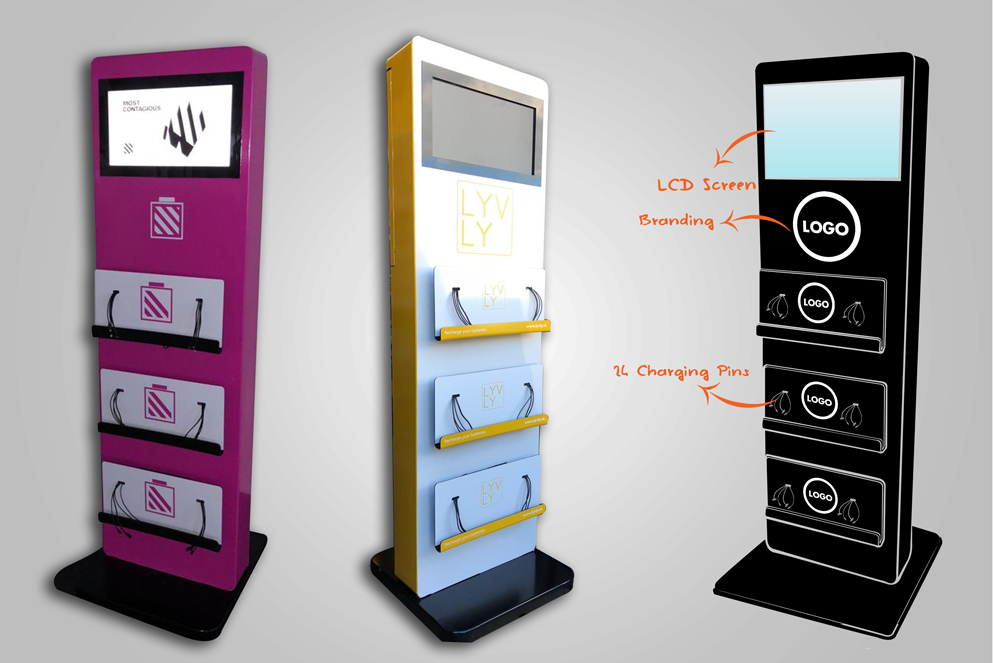
48-pin Mobile phone charging station
What Is a Mobile Phone Charging Station?
A mobile phone charging station is a self-contained unit — floor-standing, tabletop, wall-mounted or portable — that lets multiple people charge smartphones and other devices at the same time, typically via a bank of cables or wireless charging pads built into a single housing. Unlike a domestic multi-port charger, it’s designed for public, unattended or semi-attended use in a commercial or event environment: higher device capacity, more robust construction, and often a lockable compartment for each device.
The terminology in this space is used loosely, so it’s worth being precise:
- Phone charging station / charging unit — the broad umbrella term for any multi-device charging product, open-access or lockable.
- Phone Charging kiosk — usually an open-access, floor-standing unit where cables hang out for anyone to plug into, with no individual security.
- Charging hub — a smaller, often tabletop version, common at exhibition stands and networking tables.
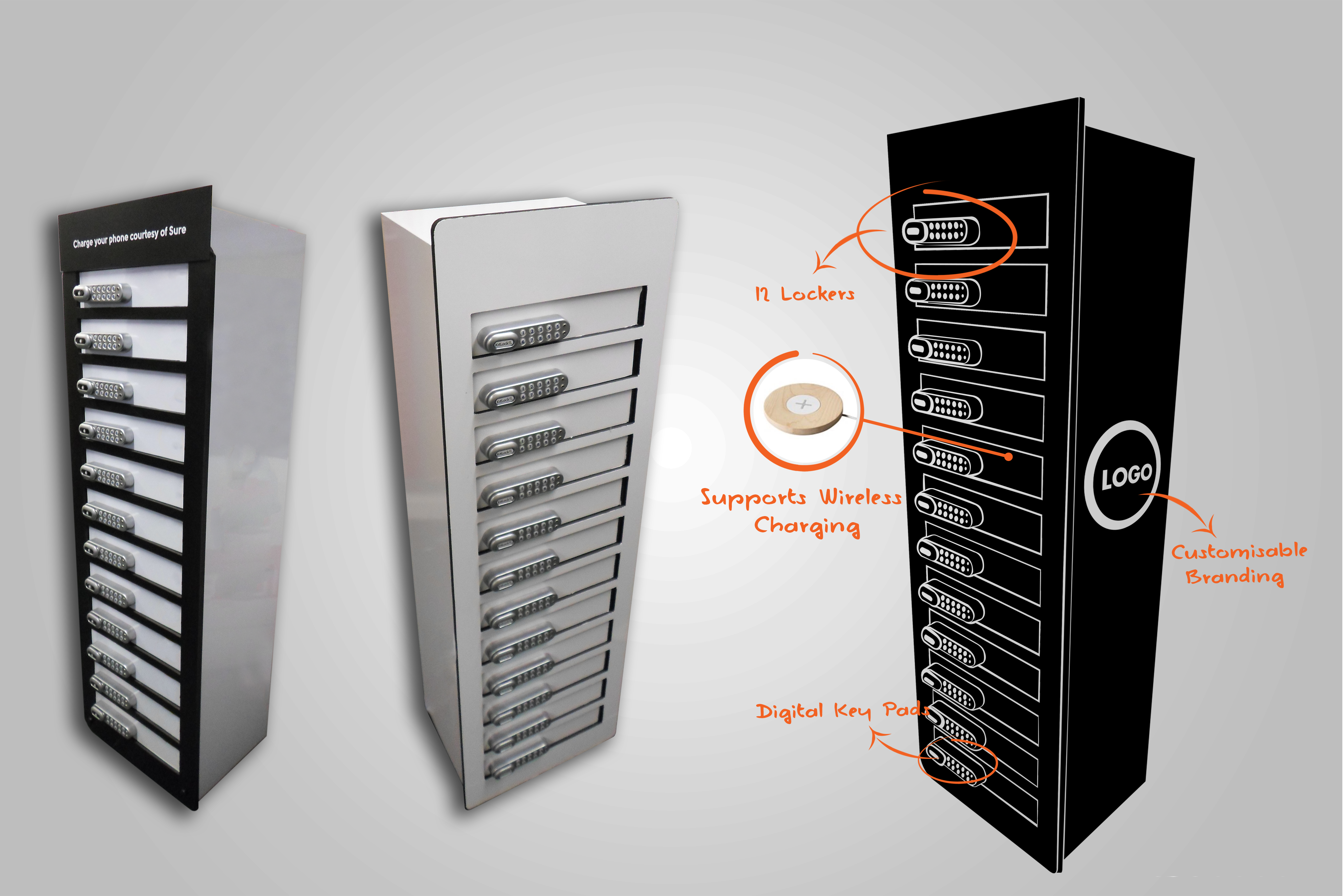
- Phone Charging locker / phone charging locker — a unit divided into individual, lockable compartments, where a phone is placed inside, connected to a cable, and the compartment is locked while charging.
- Lockable phone charging station — functionally the same as a locker, emphasising the security mechanism (PIN lock, key lock or digital lock) as the defining feature.
- Mobile phone charging station — “mobile” here typically refers to the device being charged (a mobile phone), not that the unit itself is wheeled or portable, although portable/wheeled versions do exist for temporary deployments.
The critical distinction for a buyer is not the marketing name but the format: open-access (anyone can plug in and watch their own phone) versus lockable (the phone is placed inside a secured compartment out of the user’s direct line of sight). This distinction runs through almost every decision covered in this guide, and is explored fully in the dedicated comparison section below.
Professional event and commercial charging stations differ from an ordinary wall socket or a row of plug extensions in three practical ways: they’re built to handle continuous, high-volume public use without cable damage or overheating; they’re designed to be branded, so the unit itself becomes part of the event’s visual identity or a sponsor’s activation; and — in the case of lockable formats — they remove the need for a phone owner to stand and watch their device the entire time it charges, freeing them to actually attend the event.
How Does a Phone Charging Station Work?
A phone charging station works by distributing mains power (or, for portable units, battery/generator power) through an internal circuit to multiple charging ports or cables, each capable of charging a device independently. For open units, the user finds a free cable, connects their device, and charges it while remaining nearby. For lockable units, the phone is placed inside a compartment that is then secured, and power is delivered to that compartment until the user returns and unlocks it.
The typical open-station user journey:
- The attendee locates the station (ideally clearly signed and visible from a distance).
- They identify a free cable matching their device’s connector — USB-C, Lightning or Micro-USB.
- They connect their phone and, in most units, see a charge indicator.
- They wait nearby, or step away and return, while the phone charges.
- On modern units they may be able to monitor charge status remotely via an app or simply by returning to check the unit.
- They disconnect and retrieve the phone once sufficiently charged.
- The interaction ends — ideally having taken in whatever branding or messaging surrounds the unit while they waited.
The typical phone charging locker user journey is different, and is the reason lockers are preferred wherever security matters:
- The user selects an available, unlocked compartment (usually indicated by a light or open door).
- They open the compartment.
- They connect their phone to the cable inside.
- They close and lock the compartment — using a PIN they set, a physical key, or a digital/app-based lock depending on the unit.
- They leave the device charging, unattended, and go back to the event.
- They return once ready.
- They unlock the compartment using their PIN, key or code.
- They retrieve the phone, now charged.
The practical difference is simple but important: an open station requires the user to either wait beside their phone or accept the risk of leaving it unattended and in view; a locker removes both problems by physically securing the device while it charges.
Types of Mobile Phone Charging Stations
There is no single “mobile phone charging station” product — there’s a family of formats, each suited to different events, venues and budgets.
Open charging stations. Cables hang from a central unit; users plug in and stay nearby or watch from a short distance. Advantages: lower cost, higher visible footfall around the unit (good for branding exposure), simple to use with no PIN or key to manage. Disadvantages: no security for the device while it charges, which limits use to lower-risk environments or supervised areas.
Lockable phone charging stations / phone charging lockers. Individual compartments, each secured independently. Advantages: the phone is out of sight and secured, so the user can genuinely leave it and enjoy the event; suitable for higher-footfall or lower-supervision environments. Disadvantages: slightly higher cost and a marginally less instant user experience (locking/unlocking takes a few seconds longer than plugging into an open cable).
Floor-standing charging kiosks. Tall, freestanding units, open or lockable, designed to be seen from across a hall. Good where visibility and higher device capacity both matter — main entrances, exhibition halls, registration areas.
Tabletop charging stations. Compact units sitting on an exhibition stand counter, networking table or reception desk. Lower capacity, lower footprint, ideal where floor space is limited or the charging point needs to sit within a stand’s existing furniture.
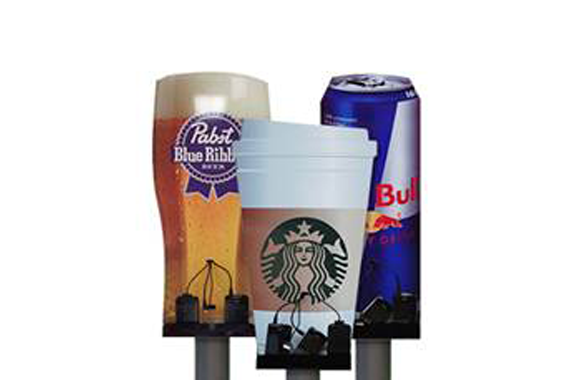
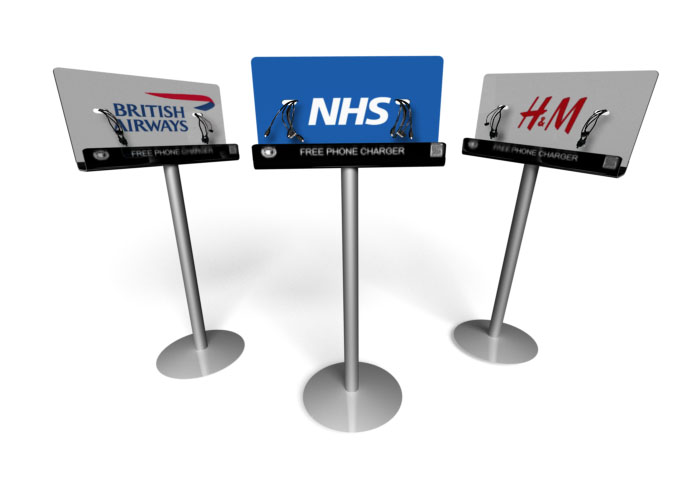
Branded charging stations. Any of the above formats wrapped, printed or configured in a sponsor’s or organiser’s colours, logo and messaging — covered in full in the branding section below.
Wireless charging stations. Pads rather than cables; the user places a compatible phone on the surface. Convenient where devices support the standard, but slower than cabled charging and unsuitable for the many devices (older handsets, cases with metal backs, devices without wireless charging hardware) that don’t support it — best used as a supplementary option alongside cabled bays rather than a sole solution.
Multi-device charging stations. Units built to accommodate phones, tablets and smartwatches side by side, useful at conferences and exhibitions where laptops and tablets are as common as phones.
Portable / mobile charging solutions. Lighter, sometimes battery- or generator-powered units designed for temporary outdoor deployments — festival fields, pop-up activations, locations without easy mains access.
Comparison Table: Phone Charging Station Formats
| Format | Security | Typical Capacity | Footprint | Portability | Branding Surface | Best Suited To | Buy or Hire |
|---|---|---|---|---|---|---|---|
| Open phone charging kiosk | None (visible/unattended risk) | 8–48 devices | Medium–large | Low–medium | Large | Supervised areas, lounges, registration | Both |
| Lockable phone charging locker | High (individual locked compartments) | 4–48 devices | Medium–large | Low–medium | Large | Exhibitions, festivals, high-footfall venues | Both |
| Floor-standing kiosk | Depends on lock config | High | Large | Low | Very large | Entrances, main halls | Both |
| Tabletop station | Low–medium | Low | Small | High | Medium | Exhibition stands, small events | Hire-friendly |
| Wireless charging pad | Low (open) | Low | Small | High | Small–medium | Supplementary/VIP areas | Both |
| Portable/mobile unit | Depends on config | Low–medium | Small–medium | Very high | Medium | Outdoor/temporary sites | Hire-friendly |
Planning an event and unsure which format fits? Get a quote for a mobile phone charging station suited to your venue and audience.
Custom phone charging station
Mobile Phone Charging Station vs Phone Charging Locker
The core difference is visibility and supervision: an open charging station keeps the phone in the user’s sight and reach, while a phone charging locker secures the phone inside a locked compartment the user can walk away from. Neither is universally “better” — the right choice depends on footfall, supervision, dwell time and how comfortable attendees will feel leaving a device unattended.
| Factor | Open Charging Station | Charging Locker |
|---|---|---|
| Security | None — device stays in user’s care | High — device is locked away |
| Convenience | Instant plug-and-go | Slightly more steps (lock/unlock) |
| Visibility | High — good for branding exposure while people wait | Lower — users don’t linger as long |
| Attendee movement | User usually stays nearby | User is free to move around the whole event |
| Dwell time near unit | Higher (people wait beside their phone) | Lower (people leave and return) |
| Capacity efficiency | Can feel congested if many people wait at once | Compartments turn over independently |
| Staff requirement | Minimal | Minimal, unless assisting with lock issues |
| Risk profile | Device left visible if user steps away | Device secured; risk shifts to lock/PIN management |
Decision framework:
- Choose an open charging station if the area is supervised or low-risk (a staffed lounge, a small internal corporate event, an exhibition stand where the exhibitor’s team is present), your priority is instant, frictionless use, and you want maximum visible dwell time around a branded unit.
- Choose a charging locker if the venue is high-footfall, low-supervision, or public-facing (festivals, large exhibitions, conference concourses, shopping centres), attendees will be moving around the wider event rather than staying near the unit, or security and attendee peace of mind matter more than shaving a few seconds off the charging process.
- Choose a combination if your event has mixed zones — for example, an open tabletop unit inside a staffed VIP lounge alongside lockable units in the main, unsupervised concourse.
Need secure, unattended charging for a high-footfall event? Speak to Vischarge about a lockable phone charging station configuration.
Why Events Need Phone Charging Stations
Across virtually every event category, the underlying driver is the same: attendees now depend on their phones to actually participate, and a flat battery removes them from the experience you’ve built. What changes by event type is how that dependency shows up and where the best charging location sits.
- Conferences — delegates run event apps, digital agendas, QR-code registration and LinkedIn networking all day; charging near registration and networking areas keeps them engaged rather than hunting for a plug socket under a desk.
- Exhibitions and trade shows — visitors navigate via floor-plan apps and QR codes at every stand; a charging point becomes a legitimate reason to stop at (or near) a stand for several minutes.
- Festivals — multi-day, often outdoor, with limited access to mains power; charging becomes essential infrastructure rather than a convenience, particularly for camping festivals.
- Corporate events and product launches — brand experience matters as much as function; a well-branded station reinforces the messaging of the day.
- Brand activations — the charging station itself can be the activation, drawing people in for a genuine utility rather than a gimmick.
- University events — high phone dependency among student attendees, and typically tighter budgets, making hire attractive.
- Sporting events and racecourses — very high footfall and long dwell times outdoors, where phones drain quickly from GPS, ticketing apps and photography.
- Shopping centres and retail — a customer-service amenity that increases dwell time and basket size indirectly.
- Hospitality and hotels — a guest-experience touch in lobbies, bars and conference facilities.
- Museums, theatres and visitor attractions — supports app-based guides and ticketing without disrupting the visitor experience.
For every category, the same three questions determine the right solution: how many people, for how long, and how supervised is the space — covered in detail in the capacity and placement sections below.
Phone Charging Stations for Exhibitions
A phone charging station on or near an exhibition stand does more than solve a battery problem — it gives visitors a genuine, low-pressure reason to stop, which is exactly what a stand needs to generate conversations and leads. Exhibition organisers and exhibitors have slightly different goals here, and both are worth addressing.
For exhibition organisers, charging stations placed at key points across the hall (entrances, catering areas, networking zones) increase overall dwell time and visitor satisfaction, which supports exhibitor footfall figures — a genuine selling point when packaging sponsorship for the hall as a whole.
For exhibitors, a branded charging point on the stand:
- Attracts visitors who might otherwise walk past.
- Increases dwell time at the stand itself, giving staff more time for a real conversation.
- Creates a natural moment for lead capture — a QR code on the unit linking to a sign-up form, brochure download or prize draw.
- Turns a functional amenity into a talking point and a photograph opportunity for social media.
Practical planning points specific to exhibitions: position the unit where it doesn’t obstruct visitor flow through the aisle; plan capacity against expected peak-hour footfall rather than total show attendance (see the capacity-planning section below); and if the stand is small, a compact tabletop unit will usually outperform a large floor-standing kiosk that eats into limited space.
Phone Charging Stations for Conferences
Conference delegates are unusually heavy phone users across a single, long day — event apps, digital agendas, speaker QR codes, networking contacts and constant photography of slides. The best-performing locations for a phone charging station at a conference are:
- Registration — the first touchpoint, ideal for a branded unit that also reduces queue-related frustration.
- Networking and break areas — where delegates naturally pause and where a locker format lets them charge while they actually network rather than standing beside a cable.
- Catering areas — high dwell time during lunch and coffee breaks.
- Exhibition zones within the conference — if the conference includes a trade element, treat this the same as the exhibitions section above.
- Lounges and breakout spaces — good for a smaller tabletop or open unit given lower footfall and more supervision.
A single central station is rarely enough for a multi-track conference spread across several floors or rooms — distribute smaller units across the delegate journey rather than concentrating capacity in one place.
Phone Charging Stations for Festivals
Festivals are the most demanding environment for a mobile phone charging station, because they combine very high footfall, multi-day duration, outdoor conditions, and often limited access to conventional mains power — this is where charging genuinely functions as event infrastructure rather than a convenience.
Key planning considerations specific to festivals:
- Duration — a one-day festival has very different capacity needs to a three-day camping event where attendees have no other charging access at all.
- Weather and outdoor conditions — units used outdoors need weatherproof housing and secure cable management; this is a specification question to raise directly with your supplier rather than an assumption to make.
- Crowd flow and queue management — festival crowds move differently to a conference; place units where a queue won’t block a thoroughfare or stage sightline.
- Power infrastructure — confirm early whether the site has mains access, generator capacity, or whether battery/portable units are needed; this affects which product format is viable long before branding or capacity questions arise.
- Security — lockable formats are strongly preferable in general-admission festival areas, given lower supervision and higher footfall than a conference or exhibition.
- VIP and backstage areas — often better suited to smaller, open or tabletop units given lower footfall and higher supervision.
- Food and beverage areas — high natural dwell time makes these strong secondary locations.
- Sponsorship — festivals are typically the strongest sponsorship environment of all the event types covered here, given dwell time and the sheer volume of attendee interactions (see the sponsorship section below).
Note: this guide deliberately avoids quoting specific battery-life or usage statistics for festival attendees, since reliable, independently verified figures for this are not available — capacity should be planned using the methodology in the next section, not assumed industry averages.
Planning a multi-day festival? Request a hire quote for festival phone charging stations with weatherproof and secure configurations.

Mobile phone charging locker
Lockable Phone Charging Stations
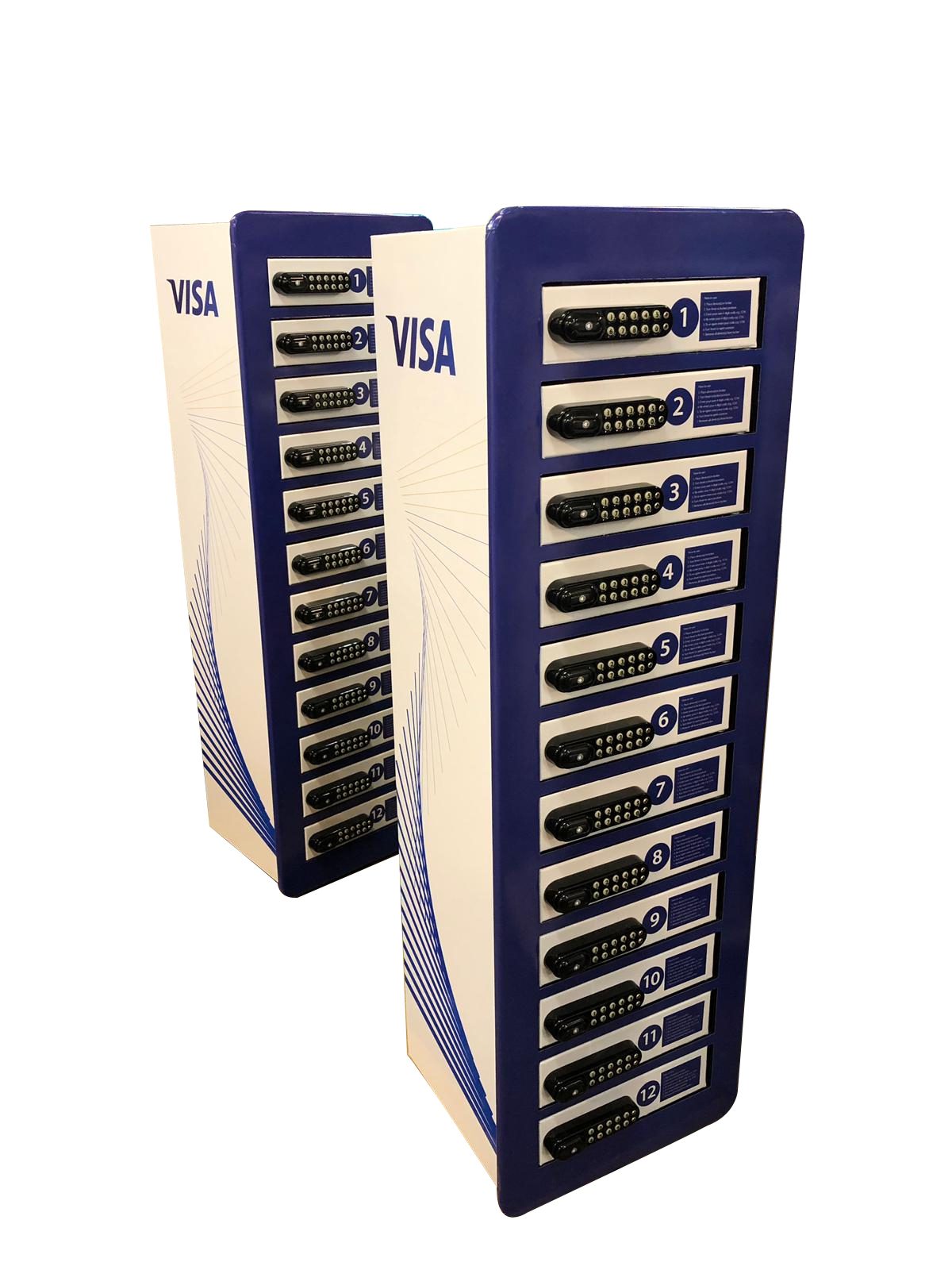
A lockable phone charging station is a charging unit divided into individual compartments, each secured independently while a device charges inside it. What makes a station “lockable” comes down to a few practical design elements worth understanding before you buy or hire:
- Individual compartments — each device charges in its own enclosed space, physically separated from every other user’s device.
- Locking mechanism — most commonly a user-set PIN lock, a physical key lock, or a digital/app-based lock; each has different trade-offs around speed of use, staff overhead if a user forgets their code, and unit cost.
- Charging cable per compartment — typically a multi-connector cable (Lightning, USB-C, Micro-USB) so the compartment isn’t tied to a single device type.
- Configuration and capacity — lockers commonly come in bay counts such as 4, 8, 12, 16, 24, 36 or 48, and the right configuration depends on the capacity planning covered below, not simply “more is better.”
- Branding surface — the front panel and door surfaces of a locker are a significant branding opportunity, covered fully later in this guide.
- Placement — lockers benefit from being visible and easy to find, since (unlike an open station) users need to actively walk back to retrieve their device, so clear positioning and signage matter even more than for open stations.
The practical effect of locking a device away is a genuine change in user behaviour: instead of standing beside a cable for twenty minutes, the attendee locks their phone, walks back into the event, and returns later — which is precisely why lockers tend to outperform open stations at high-footfall, low-supervision events.
Why Security Matters
An unattended phone left on an open charging cable is, in practical terms, a phone anyone nearby could pick up. For most supervised or low-risk environments this is a manageable, low-probability concern; for high-footfall public events it becomes a genuine attendee-confidence issue that affects how comfortable people feel using the facility at all.
Beyond outright theft risk, organisers should also think about:
- Accidental interference — a busy open station where cables get tangled, unplugged or swapped by mistake.
- Staff supervision — whether the location will realistically be staffed or monitored, and for how long.
- Attendee confidence — even where actual risk is low, attendees who don’t feel comfortable leaving a phone unattended simply won’t use the facility, undermining the investment.
Important: this guide does not offer legal advice on liability for lost, stolen or damaged devices. Organisers should clarify their own position — and communicate it clearly to attendees via signage or terms of use — on several points before deployment: who is responsible if a device is lost or damaged while charging; what the venue’s own policies require; whether event insurance covers charging-station use; and what staff should do in the event of a dispute or lock malfunction. A supplier can advise on the equipment’s security features, but responsibility, insurance and venue policy are matters for the organiser (and, where appropriate, their venue and insurer) to confirm directly.
Phone Charging Station Features to Look For
A practical checklist for anyone comparing units, whether buying or hiring:
Charging connections. Confirm the unit supports the connector mix your audience actually uses. USB-C compatibility matters increasingly given the shift across Android and, more recently, newer iPhone models — a unit without decent USB-C provision will feel dated quickly. Lightning connectivity remains relevant for the large installed base of older, still-compatible Apple devices — don’t assume it’s obsolete. Micro-USB retains some legacy relevance for older devices, cameras and accessories, and is worth including rather than excluding on the assumption it’s no longer needed.
Wireless charging. Useful as a supplementary option for compatible devices, but slower than cabled charging and unusable for devices without wireless hardware — best specified alongside cabled bays, not instead of them.
Number of charging bays. Should be driven by the capacity planning methodology below, not by an arbitrary “biggest unit available” decision — oversized units waste budget and floor space, undersized units create queues and complaints.
Security. For lockable units, understand exactly which lock mechanism is used and what happens operationally if a user forgets a PIN or loses a key.
Build quality. Commercial and event environments involve continuous public use, transport, setup and breakdown — ask specifically how the unit is constructed and what it’s rated to withstand, rather than relying on marketing language alone.
Branding. Confirm what branding surfaces are available (wraps, vinyl, printed panels, screens) and the lead time required to produce them for your event date.
Cable management. Poorly organised or low-quality cables are one of the most common causes of user frustration and premature wear — ask how cables are secured, routed and replaced.
Power and charging performance. Ask about real-world charging performance for the connector types you need, rather than relying solely on headline wattage figures, which can vary significantly by device and cable condition.
Ease of use. The unit should be usable by someone who has never seen it before, with no instructions beyond simple signage — test this assumption before committing to a format for a large public event.
Maintenance. Ask what routine maintenance is required (cable checks, lock servicing, cleaning) and who is responsible for it under a hire or purchase agreement.
How Many Phone Charging Stations Do You Need?
There is no universally reliable ratio (such as “one station per 100 attendees”) that applies across every event type, and this guide won’t invent one. Instead, use the following methodology, built around the variables that actually drive demand:
- Total attendance — your starting point, but not the deciding figure on its own.
- Peak simultaneous demand — the number of people likely to want to charge at the same time, which is almost always a fraction of total attendance and depends on event rhythm (a single lunch break creates a sharper peak than a steady all-day flow).
- Event duration — a multi-day festival creates repeat demand across many hours; a two-hour evening reception creates a single, short window of demand.
- Attendee demographics and behaviour — audiences that are heavy app/social-media users (younger demographics, tech and marketing audiences) will generally show higher charging demand than audiences with lower phone dependency.
- Venue size and layout — a single large hall may need fewer, larger units than a venue spread across multiple rooms or floors, which needs distributed smaller units.
- Number of bays per unit — your total required capacity divided by bays-per-unit gives you the number of units needed.
- Average charging dwell time — how long a typical device stays connected before being retrieved, which determines how quickly bays turn over.
- Expected repeat usage — whether the same attendees are likely to use the facility more than once across the event (common at festivals, rare at a half-day conference).
- Availability of other power sources — venues with abundant accessible sockets reduce reliance on dedicated stations; venues with none increase it substantially.
Worked example (illustrative only — assumptions clearly labelled):
Assume a one-day conference with 800 total attendees, where 25% of attendees are estimated to want to charge at some point (a planning assumption, not a verified statistic) = 200 potential users across the day. If those 200 uses are spread across a 7-hour event rather than concentrated in one break, and each charge session occupies a bay for roughly 30 minutes, a single bay could realistically serve around 14 users across the day under even usage — but real demand clusters around breaks, so organisers typically plan for 2–3x the “even spread” figure during peak windows as a safety margin. In this illustrative scenario, that points toward a total of roughly 24–36 charging bays split across two or three station locations (registration, networking area, catering area) rather than one large single-location unit — but the right number for any specific event should be confirmed with a supplier who can factor in your venue, audience and format choice directly.
Not sure how many bays your event needs? Talk to Vischarge about capacity planning for your specific venue and attendee numbers.
Where Should a Phone Charging Station Be Placed?
Placement should be led by visibility and genuine convenience — not simply “wherever there happens to be a socket,” which is one of the most common planning mistakes covered later in this guide.
Strong locations by area:
- Entrance — high visibility, first impression, good branding exposure, but be mindful of not creating congestion right at the point where crowds are funnelling in.
- Registration — natural dwell point, ideal for lockable units so attendees aren’t delayed once they’ve collected their badge.
- Exhibition hall — distribute rather than centralise, positioned to support (not obstruct) aisle flow.
- Networking areas and lounges — high dwell time, good candidate for a mix of open (supervised) and lockable formats.
- Catering areas — very high natural dwell time during breaks; a strong secondary or tertiary location.
- Bar and hospitality areas — similar logic; long dwell time, relaxed pace.
- Breakout rooms — smaller-scale, tabletop-appropriate placement.
- Sponsor and VIP areas — a natural fit for a fully branded unit tied to a specific sponsorship package.
- Near seating — convenient, but check the unit won’t obstruct sightlines or emergency egress routes.
- High-footfall corridors — good visibility, but only where a queue or cluster of users won’t create a bottleneck.
The two things to actively avoid: positioning a unit purely because a power socket happens to be nearby (often leading to poor visibility and low usage), and clustering all capacity into one spot when attendee flow through the venue is genuinely distributed across several zones.
Branded Phone Charging Stations
A charging station is one of the few pieces of event infrastructure attendees actively want to stand near for several minutes at a time — which makes it genuinely effective physical brand media, rather than advertising attendees are trying to avoid. Because the branding is attached to something useful, it tends to be far better received than a standalone advertising panel.
Common branding elements:
- Logo placement across the front panel, compartment doors and side panels.
- Vinyl wrapping or printed panels matched to brand or campaign colours.
- Messaging — a short campaign line, event tagline, or sponsor call to action.
- QR codes linking to a landing page, sign-up form, app download or competition entry.
- Screen-based content where the unit includes an LCD display, for rotating messaging or sponsor content.
- Photo and social-sharing moments — a genuinely well-designed branded unit becomes something attendees photograph and share, extending reach beyond the room.
The reason utility-based branding tends to outperform passive advertising is simple: the attendee is standing at the unit because they need it, not because they’ve been stopped by it — so the messaging is seen during a moment of genuine, voluntary attention rather than being tuned out.
Want your logo, colours and messaging on a fully branded charging station? Discuss branded configuration options with Vischarge.
Phone Charging Stations as a Sponsorship Asset
For event organisers, a charging station isn’t just an attendee amenity — it can be packaged as a genuine sponsorship product with a defined commercial value, separate from the general event sponsorship package.
Elements that can be built into a sponsorship offer:
- Naming rights to a “charging zone” or “charging lounge.”
- Branded charging units placed in high-footfall or high-dwell locations.
- Sponsor logos and colours across the unit itself.
- QR codes linking to sponsor landing pages, lead-capture forms or product sampling offers.
- Measurable interactions — QR scans and landing-page conversions give a sponsor something closer to a real engagement metric than passive banner exposure.
A simple ROI framework, not a guaranteed formula:
Potential sponsorship value = audience exposure + engagement (dwell time, QR interactions) + lead opportunities + brand association with a genuinely useful amenity
The actual value of any sponsorship package depends heavily on the specific event, audience size, dwell time and how the sponsorship is activated and promoted — there is no fixed multiplier that applies across events, and any figure quoted to a prospective sponsor should be grounded in your own event’s attendance and engagement data rather than an industry-wide assumption.
Lockable phone charging station
Buying a Mobile Phone Charging Station
Buying makes commercial sense once a charging station stops being a one-off event need and becomes recurring infrastructure. Typical buyers include:
- Permanent venues — conference centres, exhibition halls, stadiums, museums and visitor attractions with a constant flow of visitors.
- Organisations running an annual event programme — where the same unit is used across multiple events each year rather than hired repeatedly.
- Agencies and exhibition companies — that deploy charging stations across many client events and benefit from owning a flexible equipment stock.
- Universities — with ongoing campus events, open days and student union activity.
- Hospitality businesses — hotels, bars and venues wanting a permanent guest-experience fixture.
- Corporate offices — for staff and visitor use in receptions, breakout areas and meeting floors.
- Visitor attractions — where footfall is continuous rather than event-based.
Vischarge customers can purchase lockable phone charging stations outright, alongside open, tabletop and floor-standing formats, with full custom branding available. Buying suits organisations that want a long-term asset, full control over configuration and branding, and lower cost-per-use across many events or a long deployment period, in exchange for the upfront cost and the responsibility for storage and transport between uses.
Ready to buy? View Vischarge’s lockable phone charging station range or request a purchase quote.
Hire or Rent a Phone Charging Station
Hiring suits organisations whose need is temporary, occasional, or tied to a specific event rather than ongoing infrastructure. Typical scenarios: one-off conferences and exhibitions, temporary brand activations, festivals, and any sponsorship campaign built around a single event window rather than a recurring programme.
| Buy | Hire | |
|---|---|---|
| Commitment | Long-term asset | Short-term solution |
| Best for | Recurring events, permanent venues | One-off or occasional events |
| Control | Full control over configuration | Configured per booking |
| Cost structure | Upfront investment, lower cost-per-use over time | Spread cost, no ownership overhead |
| Storage/logistics | Buyer responsible for storage and transport | Usually delivered, collected and supported by supplier |
| Flexibility | Fixed asset | Easy to scale up/down between events |
Vischarge offers event hire and rental for phone charging stations and lockers across the UK and Europe, alongside the purchase option — so the right commercial route depends on how often you’ll actually use the equipment, not a fixed rule either way.
Planning a single event? Get a hire quote for your event dates.
Mobile Phone Charging Station Cost
Cost varies significantly by configuration, and this guide won’t invent specific prices — genuine costs depend on the factors below and should be confirmed directly with a supplier for your exact requirements. What consistently affects price:
- Station type — open vs lockable, tabletop vs floor-standing.
- Number of bays/lockers — capacity scales cost.
- Locker configuration and security mechanism — PIN, key or digital locks vary in unit cost.
- Charging technology — wired-only vs wired-plus-wireless configurations.
- Branding and customisation — the extent of bespoke wrapping, printing or screen-based content.
- Delivery, installation and on-site support — particularly relevant for hire, and for larger or multi-location purchase deployments.
- Servicing and maintenance arrangements — whether ongoing support is included or arranged separately.
- Hire duration — for rental, cost typically scales with the length of the booking.
- Event location — logistics cost can vary by venue and region.
Because these variables combine differently for every organisation, the most reliable way to understand cost for your specific event or venue is to request a quotation with your actual requirements — capacity, format, branding and dates — rather than relying on a generic published price. Request a quote from Vischarge with your event details.
How to Choose a Phone Charging Station Supplier
A practical procurement checklist — questions worth asking any supplier before committing, whether buying or hiring:
- Do you manufacture or supply the equipment directly?
- Can the station be purchased outright, not just hired?
- Do you offer hire and rental as well as purchase?
- Are lockable options available, and what lock mechanisms do you offer?
- Which devices and connector types are supported?
- What charging connections are included (USB-C, Lightning, Micro-USB, wireless)?
- Can the unit be fully branded, and what’s the lead time for custom branding?
- What capacity options are available, and can you help plan the right configuration for my event?
- What happens operationally if a cable fails during an event?
- What support is provided on the day of the event?
- What are the delivery arrangements and lead times?
- Is installation included or available as an add-on?
- Is ongoing maintenance available, and what does it cover?
- Can the equipment be used internationally, and does that affect power compatibility?
- What’s the process if something goes wrong with a unit mid-event?
- What documentation (user guides, safety information) is supplied with the unit?
- What warranty or service arrangements apply to purchased units?
A supplier who can answer these clearly and specifically — rather than with generic marketing language — is a good sign you’re dealing with a genuine specialist rather than a reseller with limited operational knowledge of event deployment.
Mobile Phone Charging Stations for Different Industries
- Events and corporate functions — general attendee amenity and brand touchpoint across the full event lifecycle.
- Exhibitions — lead generation and stand dwell-time tool, covered fully above.
- Conferences — delegate experience infrastructure across registration, networking and breakout areas.
- Festivals — essential multi-day infrastructure, particularly for camping and outdoor events.
- Universities — campus events, open days, student union activity, typically hire-led given budget cycles.
- Shopping centres — customer amenity that supports longer visits and repeat footfall.
- Hotels — lobby, bar and conference-facility guest experience.
- Restaurants and bars — a differentiator in hospitality venues where guests dwell for extended periods.
- Stadiums and sports venues — very high footfall, long outdoor dwell times, strong sponsorship potential.
- Museums and visitor attractions — supports app-based guides without disrupting the visitor experience.
- Corporate offices — staff and visitor amenity in receptions and breakout spaces.
- Airports and travel environments — extremely high dependency on phone charge for tickets, boarding passes and travel apps.
- Retail — instore amenity supporting dwell time and customer experience.
- Brand activation agencies — charging stations as a standalone activation concept or as a component within a larger campaign.
Each of these represents a genuinely different deployment pattern — the “right” charging solution for a stadium concourse (high capacity, weatherproof, lockable, heavy branding) looks nothing like the right solution for a boutique hotel lobby (small, elegant, tabletop, minimal branding) — which is why the format and capacity questions above should always come before any purchasing decision.
Mobile Phone Charging Station UK
The UK events market spans a wide geographic footprint, from London’s major exhibition and conference venues (ExCeL, Olympia, QEII Centre, Alexandra Palace and others) through to significant regional event economies in Birmingham, Manchester, Glasgow, Edinburgh, Liverpool, Leeds, Bristol, Cardiff, Belfast, Newcastle, Nottingham, Sheffield and Southampton. A UK-wide supplier needs to support very different venue types across this footprint — from purpose-built exhibition halls with strong existing power infrastructure, to historic or converted venues where power access and floor space are more constrained, to outdoor festival sites with no permanent infrastructure at all.
What this means practically for buyers: confirm early whether your supplier can deliver, install and support equipment at your specific venue and city, what typical lead times look like for your event date, and whether branding production timelines fit your event schedule. Vischarge serves customers across the UK and internationally, with UK contact points across several major cities — worth confirming directly for your specific event location and date.
International Phone Charging Stations
For organisations running events across multiple countries, or for UK-based organisers hosting an international audience, a few additional considerations apply beyond the domestic planning above:
- Venue requirements — confirm power and space specifications with the venue directly, as these vary by country and venue type.
- Power infrastructure and plug standards — electrical standards differ internationally; this is a technical question to confirm directly with your supplier for the specific country of deployment rather than assume.
- Transport and logistics — international delivery timelines are typically longer than domestic ones and should be planned well in advance of the event date.
- Local requirements — some venues or countries may have specific compliance or safety documentation requirements; confirm with the venue and supplier rather than assuming UK requirements transfer directly.
- Branding consistency — if deploying the same campaign across multiple countries, confirm production timelines and any regional adaptation needed well ahead of each event.
This guide does not make specific electrical or regulatory claims for individual countries, since these vary and change — always confirm directly with your venue and supplier for the country of deployment.
Phone Charging Station Safety
Responsible, general guidance — not a substitute for professional electrical advice, which should always be sought for installation or any electrical fault:
- Cable inspection — check cables regularly for fraying, exposed wiring or damaged connectors, and remove any damaged cable from use immediately.
- Overheating — units should have adequate ventilation and should never be covered, wrapped or enclosed in a way that blocks airflow.
- Overloaded equipment — don’t exceed the manufacturer’s stated device capacity or attempt to run additional equipment from the same circuit without confirming capacity.
- Damaged devices — a small minority of user devices may already have damaged charging ports or batteries; staff should be aware this can occasionally cause charging issues unrelated to the station itself.
- Placement — keep units away from water sources, direct exposure to rain (unless the unit is specifically rated for outdoor/weatherproof use), and clear of fire exits or emergency egress routes.
- Liquid exposure — particularly relevant at festivals and bars; confirm weatherproof or spill-resistant specification with your supplier for these environments.
- Event staff checks — a simple visual check at the start of each event day catches most issues before they affect attendees.
- Manufacturer instructions — always follow the specific instructions supplied with your unit; this guide provides general awareness, not a substitute for those instructions.
Never attempt DIY electrical repairs on a charging unit — any electrical fault should be referred to a qualified electrician or the supplier directly.
Phone Charging Station Maintenance
A practical pre-event and ongoing maintenance checklist:
- Cable inspection — check every cable for wear before each deployment.
- Lock inspection — for lockable units, test every lock mechanism ahead of the event, not just a sample.
- Cleaning — wipe down surfaces and compartments between events, particularly high-touch areas.
- Signage — confirm instructional signage is present, legible and correctly branded for the event.
- Power checks — test the unit is drawing power correctly and every bay is functioning before doors open.
- Physical damage review — check for transport damage after delivery and before setup.
- Display/software checks — where a unit includes an LCD screen or digital lock system, confirm it’s running the correct content and functioning correctly.
- Pre-event testing — plug in a test device at every bay if time allows, rather than assuming full functionality.
- Post-event inspection — check for damage or missing components before the unit is packed down or returned.
- Spare cables — keep spares on hand for events of any significant size, since cable failure is the most common on-the-day issue.
- Support arrangements — know who to contact, and how quickly, if an issue arises during a live event — confirm this with your supplier before the event, not during it.
Attendee Experience
A technically capable charging station can still fail in practice if the attendee experience is poor. What actually makes a station succeed:
- Easy to find — clear signage and sensible placement, not tucked away where only a fraction of attendees notice it.
- Easy to understand — a first-time user should know what to do without instructions.
- Easy to use — minimal friction, whether that’s a straightforward cable connection or a simple PIN-lock process.
- Fast enough — charging performance that meaningfully improves battery level within a realistic dwell time.
- Secure — genuine peace of mind for the user, particularly for lockable formats.
- Accessible — usable by attendees with a range of physical abilities; consider height, reach and control design when specifying a unit.
- Clearly labelled — connector types and instructions visible at a glance.
- Well maintained — no dead bays, damaged cables or broken locks discovered mid-event.
- Sufficient capacity — no queues that discourage use altogether.
- Convenient location — positioned where attendees are already moving, not somewhere they have to go out of their way to find.
A charging station with impressive specifications but poor placement, confusing instructions, or insufficient capacity will underperform a simpler unit that’s easy to find and use — the user journey matters as much as the hardware.
Common Mistakes
Practical mistakes worth avoiding, based on how charging stations are typically deployed poorly:
- Sizing capacity purely on total attendance, without considering peak simultaneous demand.
- Ignoring peak demand windows — treating an all-day event as having even, predictable usage when demand actually clusters around breaks.
- Using open, unsecured charging where security genuinely matters — a false economy if it undermines attendee confidence and usage.
- Hiding the station — placing it somewhere low-visibility purely because a socket happened to be nearby.
- Inadequate signage — even a well-placed unit underperforms if attendees don’t notice it.
- Insufficient charging cables or connector variety — leaving a proportion of attendees unable to use the unit at all.
- Poor cable management — tangled, damaged or missing cables that create frustration and reduce usable capacity.
- No maintenance plan — assuming a unit will run trouble-free across a multi-day event without checks.
- Ignoring accessibility — specifying a unit without considering ease of use for all attendees.
- Failing to consider power requirements — particularly at outdoor or older venues where mains access isn’t guaranteed.
- Relying on assumptions about charging speed — rather than confirming real-world performance with the supplier.
- Forgetting branding opportunities — treating the unit as pure utility when it could also be doing commercial work for the event or a sponsor.
- Choosing solely on price — the cheapest unit is rarely the best value if it underperforms on capacity, security or reliability.
- Failing to plan installation and delivery timelines, particularly for larger or bespoke-branded units.
- Not testing before the event — discovering a fault on the day rather than during setup.
Mobile Phone Charging Station ROI
Return on a charging station investment rarely comes from a single, easily measured line item — it’s usually a combination of several benefits:
- Attendee satisfaction — a well-executed amenity that reduces a genuine point of friction.
- Dwell time — attendees who stay longer near a stand, zone or venue area.
- Sponsor revenue — where the station is packaged as a sponsorship asset.
- Lead generation — through QR-code interactions tied to the unit.
- Brand exposure — repeated, voluntary attention from attendees using the unit.
- Repeat attendance — a positive experience that supports return visitors to a recurring event.
- Venue differentiation — a tangible amenity that distinguishes one venue or event from a competitor’s.
- Additional commercial opportunities — data capture, sampling, or cross-promotion tied to the unit’s QR code or screen.
Illustrative calculation (hypothetical, not an actual Vischarge result): if a sponsor pays for naming rights and branding on a charging zone at a 2,000-person exhibition, and the units generate roughly 300 QR-code scans across the event (a hypothetical, not measured, assumption), even a modest onward conversion rate from that traffic could represent a meaningful number of qualified leads relative to the sponsorship cost — but the actual figures depend entirely on your event’s attendance, QR-code placement, and how compelling the linked offer is, and should be modelled using your own data rather than assumed from this example.
Case-Study Style Scenarios
The following are illustrative, hypothetical scenarios intended to demonstrate planning logic — not actual client results.
Scenario 1: 500-person conference. Audience: business delegates across a single day. Likely charging problem: moderate, concentrated demand around registration and lunch. Recommended solution: two mid-sized lockable stations (registration and networking area). Placement: registration and the main networking/catering zone. Capacity: roughly 16–24 bays split across both locations. Branding: light event branding, potential single-sponsor package on the networking-area unit.
Scenario 2: 2,000-person exhibition. Audience: mixed trade visitors across one or two days. Likely charging problem: high, distributed demand across a large hall. Recommended solution: multiple lockable floor-standing units distributed across the hall, plus tabletop units on selected exhibitor stands. Placement: entrance, central hall, catering area, and individual stands. Capacity: distributed across several locations rather than one large central unit. Branding: strong sponsorship opportunity for a “charging zone” package.
Scenario 3: 10,000-person festival. Audience: general admission, multi-day, outdoor. Likely charging problem: very high, sustained demand with limited alternative power access. Recommended solution: multiple weatherproof, lockable units distributed across main areas, camping zones and VIP/backstage. Placement: main arena approaches, food and beverage areas, camping access points. Capacity: significant, planned around peak daily demand rather than total attendance. Branding: major sponsorship opportunity given dwell time and footfall.
Scenario 4: Exhibition stand activation. Audience: stand visitors at a trade show. Likely charging problem: attracting and holding visitor attention. Recommended solution: a single branded tabletop or small lockable unit as a lead-generation tool. Placement: stand frontage, positioned to draw passing footfall without blocking the aisle. Capacity: small, typically 4–12 bays. Branding: fully branded to the exhibitor, with a QR code tied to lead capture.
Scenario 5: Permanent venue. Audience: continuous visitor or guest footfall (e.g. a conference centre or hotel). Likely charging problem: ongoing, variable demand across many different events over time. Recommended solution: purchased (rather than hired) lockable units suited to the venue’s typical event mix. Placement: fixed locations identified through observed visitor flow. Capacity: sized to the venue’s typical peak event size, with flexibility to supplement with hired units for unusually large bookings. Branding: neutral venue branding as standard, with the option to re-brand per event or sponsor.
Buyer’s Checklist
A consolidated planning checklist to work through before contacting a supplier:
- Event date
- Venue
- Expected attendance
- Peak attendance / peak demand window
- Charging requirement (approximate number of bays)
- Open vs secure (lockable) format
- Number of lockers/bays per location
- Charging connections required (USB-C, Lightning, Micro-USB, wireless)
- Branding requirements and lead time
- Placement locations across the venue
- Power availability at the venue
- Delivery requirements
- Installation requirements
- Maintenance and on-the-day support needs
- Insurance/venue policy requirements
- Hire vs purchase decision
- Budget
- Sponsorship packaging (if applicable)
- Support arrangements during the event
- Post-event collection/storage arrangements

Phone and laptop charging table
Phone Charging Station FAQ
What is a mobile phone charging station? A mobile phone charging station is a unit that lets multiple people charge smartphones and other devices at once, in an open-access or lockable format, designed for public or commercial use rather than domestic charging.
What is a phone charging station? The same product category — “phone charging station” and “mobile phone charging station” are used interchangeably across the market to describe multi-device charging units for events, venues and businesses.
How does a phone charging station work? Users connect a device to a cable (or place it on a wireless pad) built into the unit, which is powered from the mains or, for portable units, from a battery or generator; lockable versions secure the device inside a compartment while it charges.
Are phone charging stations secure? Open stations offer no built-in security — the device remains in the user’s care. Lockable phone charging stations secure each device in an individually locked compartment, which is why they’re generally preferred for high-footfall or low-supervision events.
What is a lockable phone charging station? A charging unit divided into individually secured compartments, typically using a PIN, key or digital lock, so a device can be left charging without the user needing to remain nearby.
What is a phone charging locker? Functionally the same as a lockable phone charging station — an individually secured compartment for each device, distinct from an open charging kiosk.
Can I buy a phone charging station? Yes. Vischarge customers can purchase open, tabletop, floor-standing and lockable phone charging stations outright, in addition to hire and rental options.
Can I buy a lockable phone charging station? Yes — lockable units are available to purchase as well as hire, with configuration and branding options available for buyers.
Can I hire a phone charging station? Yes. Hire and rental is available for one-off events, temporary activations and short-term deployments, alongside the purchase option.
How much does a phone charging station cost? Cost depends on format, capacity, security mechanism, branding and hire duration or purchase configuration — there’s no single fixed price, and the most reliable figure comes from a quotation based on your specific requirements.
How many phones can a charging station charge? This depends entirely on the unit’s bay count, which commonly ranges from around 4 to 48 devices simultaneously depending on the format and configuration chosen.
Which phones are compatible? Most professional charging stations support the common connector types in current use — USB-C, Lightning and Micro-USB — plus wireless charging on compatible units; confirm the exact connector mix with your supplier against your expected audience.
Do charging stations support USB-C? Yes, USB-C support is standard on current professional units and is increasingly important given the wider shift toward USB-C across Android and newer devices.
Do charging stations support iPhones? Yes — via Lightning connectors for older-generation compatible iPhones and USB-C for newer models, alongside wireless charging where the unit supports it.
Do phone charging lockers protect phones? Lockers physically secure a device inside a locked compartment while it charges, which significantly reduces the risk associated with leaving a device unattended compared with an open charging cable.
Are phone charging stations suitable for festivals? Yes — festivals are one of the strongest use cases, given multi-day duration, high footfall and often limited alternative access to power; weatherproof, lockable formats are typically preferred outdoors.
Are phone charging stations suitable for exhibitions? Yes — both as a hall-wide organiser amenity and as a stand-level tool for exhibitors to increase dwell time and generate leads.
Are charging stations suitable for conferences? Yes — particularly at registration, networking and catering areas, where delegate dwell time and phone dependency are both high.
Can a charging station be branded? Yes — branding surfaces typically include the front panel, compartment doors and side panels, with options ranging from simple logo placement to full custom vinyl wrapping.
Can a charging station be used for sponsorship? Yes — charging stations can be packaged as a standalone sponsorship asset, including naming rights, branded units and QR-code-driven engagement, separate from general event sponsorship.
Where should a phone charging station be placed? In visible, naturally high-dwell locations along the attendee journey — such as entrances, registration, networking and catering areas — rather than wherever a power socket happens to be available.
How many charging stations does an event need? This depends on total attendance, peak simultaneous demand, event duration, venue layout and bays per unit — see the capacity-planning methodology above for a full worked approach.
Should I buy or hire a phone charging station? Buying suits recurring events or permanent venues where the unit will be used repeatedly; hiring suits one-off events, temporary activations or occasional use — see the buy vs hire comparison above.
What should I look for when choosing a supplier? Manufacturing/supply capability, purchase and hire options, lockable formats, connector compatibility, branding lead times, support arrangements and maintenance — see the full procurement checklist above.
Can Vischarge supply charging stations in the UK? Yes — Vischarge supplies, sells and hires mobile phone charging stations and phone charging lockers across the UK, with contact points across several major UK cities.
Can I purchase a Vischarge lockable phone charging station? Yes — lockable phone charging stations are available to purchase directly from Vischarge, alongside hire and rental options.
Why Choose Vischarge?
Vischarge supplies mobile phone charging stations, phone charging stations, phone charging lockers and lockable phone charging stations for events, exhibitions, conferences, festivals, venues and businesses across the UK, with additional operations in Europe, the US and Canada. The core of the offer is straightforward: customers can either purchase a station or locker outright — including the lockable format — or hire/rent equipment for a specific event or campaign, with support for delivery, branding and configuration either way.
Practically, this means:
- A product range spanning open, tabletop, floor-standing, wireless-capable and lockable formats, so the format can be matched to the event rather than forcing one product type to fit every scenario.
- Full custom branding, covering logo placement, colour matching and vinyl wrapping, for organisers and sponsors who want the unit to work as brand media as well as a utility.
- Both purchase and hire routes, so the commercial decision can be based on how often the equipment will actually be used, not a one-size-fits-all model.
- UK-wide and international coverage, with contact points across several major UK cities as well as European, US, Canadian and other international operations.
- Event-industry-specific experience, reflected throughout this guide’s practical planning detail on capacity, placement, security and branding.
Vischarge does not claim to be a universal “only” solution, and this guide has deliberately avoided unverifiable superlatives — the right choice for any given event depends on the planning factors covered throughout this article, and the team is available to talk through your specific requirements directly.
M16 Mobile Phone Charging Station
Final Buying Guide
A quick decision summary to close the loop on everything covered above:
- If you need a simple event charging point → an open tabletop or floor-standing station, suited to supervised or lower-risk areas.
- If you need secure, unattended charging → a lockable phone charging station or phone charging locker.
- If you need a branded sponsor activation → a fully branded unit with QR-code integration, positioned as a standalone sponsorship asset.
- If you’re planning a one-off event → hire is typically the more cost-effective route.
- If you run events regularly → purchase typically delivers better long-term value.
- If you’re equipping a permanent venue → purchase, with installation and maintenance planning built in from the start.
Ready to choose your mobile phone charging station?
Whether you’re comparing open versus lockable formats, working out how many bays your event needs, deciding between buying and hiring, or planning a branded sponsorship activation, Vischarge can help you determine the right charging station, locker configuration, branding and deployment plan for your event or venue. Get in touch with Vischarge to discuss your requirements and request a quote.