
Hospitality Phone Charging Stations: Sponsorship & VIP
Hospitality Phone Charging Lockers: Sponsorship & VIP
Hospitality Phone Charging Stations: The Definitive Guide to Sponsorship, VIP Guest Experience and Branded Mobile Charging Solutions
A comprehensive, practical guide for hotels, restaurants, bars, stadiums, conference venues, festivals and every hospitality business that wants happier guests, stronger sponsor relationships and a smarter-looking venue.
Contents
- Why Hospitality Venues Need Phone Charging Stations
- Types of Charging Stations: Open Stations vs Phone Charging Lockers
- VIP Areas and Premium Guest Experiences
- Sponsorship Opportunities: Turning a Charging Station into a Marketing Asset
- Limited-Time Offer: Free Branded Hospitality Charging Station
- Branding: Making the Most of the Space
- Charging Technology Explained
- Safety, Standards and the “Your Phone, Your Responsibility” Disclaimer
- Charging Stations by Industry
- Marketing and Commercial Benefits
- Buyer’s Guide: How to Choose the Right Station
- Frequently Asked Questions
- Illustrative Case Studies
- Conclusion and Next Steps

Mobile phone charging locker with LCD screen and digital pin Locks
Hospitality Sponsorship Opportunities: How Branded Phone Charging Stations Elevate VIP Guest Experience
Introduction
Walk through the lobby of almost any hotel, exhibition hall or stadium concourse today and you’ll see the same small drama playing out over and over. Someone glances at their phone, sees the battery icon has turned red, and their mood visibly changes. They start scanning the room for a plug socket. They ask a member of staff if there’s “anywhere to charge”. They sit on the floor next to a skirting board, cable trailing across a walkway, looking faintly apologetic about it.
It’s a minor moment, but it happens constantly, and it says something important about modern hospitality: a phone with charge left in it isn’t a luxury for guests any more, it’s closer to a basic expectation, in the same category as decent Wi-Fi or a clean toilet. When a venue quietly removes that anxiety — with a proper mobile phone charging station, in a spot guests can actually find — it removes a small but real source of friction from the visit. And where friction is removed, there’s usually a commercial opportunity sitting right behind it.
That’s really what this guide is about. Not just “what is a phone charging station”, but how hospitality businesses — hotels, restaurants, bars, pubs, nightclubs, casinos, stadiums, arenas, conference and exhibition venues, festivals, racecourses, golf clubs, wedding venues, holiday parks, universities, shopping centres, airports, healthcare settings and corporate offices — can use charging infrastructure as a guest-experience tool, a sponsorship platform and a piece of branded marketing that pays for itself many times over.
Throughout this guide we’ll draw on UK charging station terminology and technology, including insight from VisCharge, a UK-based specialist in phone charging kiosks, lockers and event charging solutions, headquartered at 16 Hanover Square, Mayfair, London, with additional UK contact points covering Liverpool, Manchester, Glasgow, Birmingham and Cardiff. We’ll cover open charging stations and secure phone charging lockers, VIP and hospitality suite applications, sponsor branding, wireless and fast-charging technology, safety considerations, and a sector-by-sector breakdown of how charging stations are used across hospitality and events.
If you’re weighing up whether a charging station is right for your venue, working out whether to go for an open station or a lockable one, or thinking about how sponsorship branding could offset the cost, this guide should answer the questions you actually have not just the ones a search engine expects you to ask.
1. Why Hospitality Venues Need Phone Charging Stations
The rise of “battery anxiety”
Why do you need a powerful phone charging station?
Battery anxiety is a genuinely useful term for something most of us feel several times a week: the low-grade stress of watching a battery percentage drop with no charger in sight. Researchers have written about “nomophobia” — the fear of being without a mobile phone — and while the terminology can sound a little dramatic, the underlying behaviour is real and easy to observe in any hospitality setting. Guests check their phones constantly: for directions, for an event app, to take photographs, to post on social media, to check in with family, to pay for things using a contactless wallet, or to scan a QR code on a menu.
A dead phone at a wedding means no photos and no easy way to call a taxi at the end of the night. A dead phone at a conference means missing the app-based agenda and the networking contacts made that day. A dead phone at a festival means no way to find friends in a crowd of forty thousand people. None of these are catastrophes, but each is the kind of small negative experience that colours how someone remembers a venue, an event or a brand.
What this means for guest satisfaction
Hospitality has always been about removing friction — that’s the whole discipline. A charging station is a small, visible, low-cost way to demonstrate that a venue has thought about a guest’s practical needs, not just the big-ticket experience items. It sits alongside things like clear signage, comfortable seating and accessible toilets: not glamorous on their own, but noticeably absent when missing.
Several second-order benefits tend to follow directly from solving battery anxiety at a venue:
- Increased dwell time. A guest who isn’t rationing their battery is more likely to stay, browse, order another drink or linger at a stand. In hospitality and retail more broadly, dwell time correlates closely with spend.
- Better online reviews. Guests rarely leave a five-star review purely because of a charging point, but they will mention in a review, in passing, that “there was even somewhere to charge your phone” — and they’re considerably more likely to complain publicly about the lack of one, particularly at conferences and festivals where phones are essential tools rather than optional accessories.
- Repeat visits. Convenience compounds. A guest who remembers that a particular hotel bar or exhibition hall solved a practical problem for them is more likely to think of that venue favourably next time.
- Competitive advantage. In markets where venues are broadly comparable — city-centre hotels, exhibition centres, festival sites — small differentiators matter. A visible, well-branded charging station signals a level of operational thoughtfulness that guests notice, even if only subconsciously.
A practical, not just cosmetic, solution
It’s worth being honest about the limits here too. A phone charging station won’t rescue a poor event or a badly run venue. But it removes one entirely avoidable irritant, and in an industry built on managing dozens of small guest-experience details at once, that’s a meaningful contribution — especially when, as we’ll cover shortly, the station itself can be sponsor-funded and can generate its own marketing value rather than sitting on the balance sheet as a pure cost.
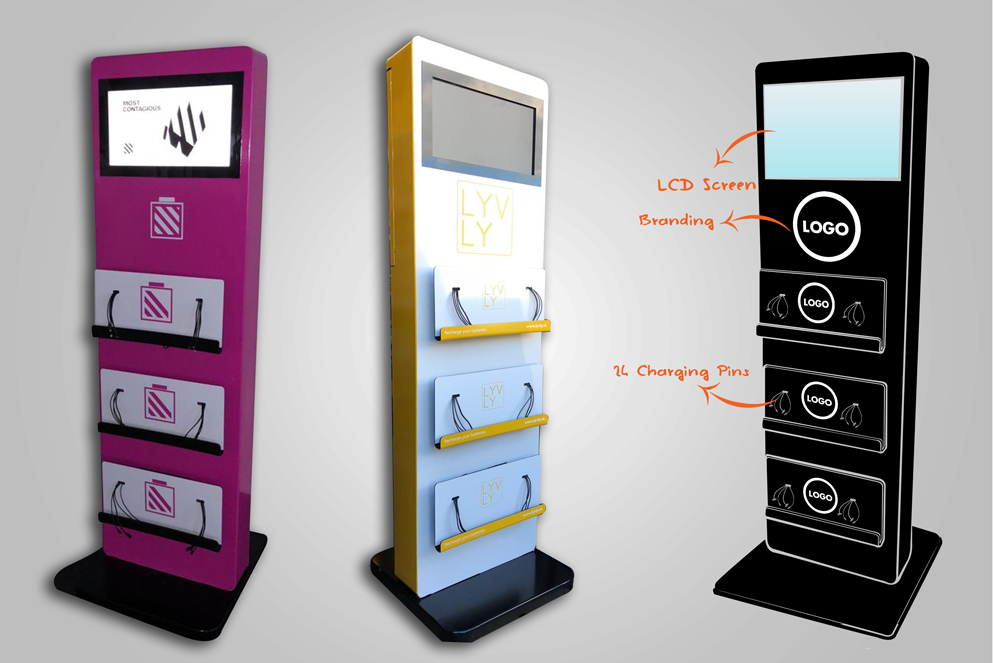
48-pin Mobile phone charging station
2. Types of Phone Charging Stations: Open Phone Charging Stations vs Phone Charging Lockers
Not every venue needs the same kind of charging solution, and one of the most common questions hospitality buyers ask is simply: open station, or lockers? The right answer depends on footfall, supervision and how the space is actually used.
Open Phone Charging Stations
An open phone charging station is exactly what it sounds like: a stand, table or wall-mounted unit with multiple charging cables (typically covering Lightning, USB-C and Micro USB) that guests can walk up to, plug in and charge their own device without locking it away. Guests usually stay close to their phone, or leave it charging in plain sight while remaining nearby.
Open stations tend to work best in:
- Reception areas and front-of-house desks
- VIP lounges and hospitality suites, where the environment is naturally monitored
- Restaurants and bars, particularly at the bar itself or on a dedicated table
- Hotel lobbies and business centres
- Corporate events and meeting rooms
The appeal of an open station is speed and simplicity — no PIN to remember, no locker to queue for — and the unit can double as a genuine piece of branded furniture (a “power table” or charging console) rather than looking like security infrastructure.
The branding disclaimer: “Your Phone, Your Responsibility”
Because an open station doesn’t physically secure the device, reputable operators — including VisCharge — display a clear disclaimer on or near the unit, typically worded along the lines of:
Disclaimer: Your Phone, Your Responsibility.
This isn’t just a legal formality. It does two jobs at once. First, it sets a clear, honest expectation with the guest: the venue is providing the convenience of charging, but the guest retains responsibility for their own device, just as they would if they’d plugged it into a socket at their own table. Second, because the disclaimer sits directly on the branded unit, it becomes part of the design itself — a small, professional, trust-building piece of copy that sits comfortably alongside sponsor or venue branding rather than looking like an afterthought sticker. Venues that get this right treat the disclaimer as part of the unit’s visual identity, not a bolt-on warning label.
Phone Charging Lockers
A phone charging locker is a secure, individual compartment — usually one of a bank of 8, 12, 16, 24 or more — where a guest places their phone, closes the door, and sets a PIN code (or uses a keypad system) to lock it. The phone charges inside the locker, out of sight and physically secured, until the guest returns and re-enters their code to retrieve it.
Lockers are the natural choice for:
- Events and exhibitions where guests need to walk away from the charging point (to visit a stand, watch a stage, or move between conference rooms)
- Stadiums and arenas, where guests are often standing, moving through crowds, or don’t want to carry a charging phone through a match or performance
- Shopping centres, where dwell time can run to hours and personal security matters
- Universities and libraries, where students may want to charge a device unattended for an extended period
- Any high-footfall public venue where a phone left on an open table would be genuinely at risk
Open Stations vs Lockers: A Comparison
| Factor | Open Charging Station | Phone Charging Locker |
|---|---|---|
| Best suited to | Monitored, lower-footfall areas (VIP lounges, reception, restaurants) | High-footfall, unsupervised or semi-supervised areas (events, stadiums, shopping centres) |
| Guest experience | Instant — plug in, no PIN needed | Slightly slower — set a PIN, retrieve later |
| Security | Relies on guest supervision and venue disclaimer | Physically secured compartment with PIN/code protection |
| Ideal dwell time | Short to medium (guest stays nearby) | Medium to long (guest can leave the area entirely) |
| Branding surface | Large visible charging unit, ideal for prominent sponsor branding | Individual locker fronts plus overall unit — good for repeated brand impressions |
| Typical venues | Hotels, restaurants, bars, VIP suites, corporate hospitality | Stadiums, festivals, exhibitions, shopping centres, universities |
Which one should you choose?
As a rule of thumb: if your charging point sits somewhere your guests will naturally stay close by — a bar, a VIP lounge, a reception desk — an open station usually offers the better guest experience, because it removes any friction around PIN codes. If your charging point serves a space where guests need to move around freely and can’t realistically stay with their phone — an exhibition floor, a festival site, a stadium concourse — a locker system is almost always the safer and more practical choice, because it protects both the guest’s device and the venue’s liability position.
Many larger venues, particularly stadiums, exhibition centres and multi-purpose hospitality venues, run both: open stations in VIP and hospitality areas, and locker banks in general admission or high-traffic public zones.
3. VIP Areas and Premium Guest Experiences
If there’s one part of a venue where a charging station stops being “a nice extra” and starts being close to an expectation, it’s the VIP or premium hospitality area.
Why premium guests expect premium charging facilities
Guests who have paid for — or been invited into — a VIP lounge, an executive box, a hospitality suite or a private members’ area have, by definition, already been told, implicitly or explicitly, that this space is a step above the standard offering. Every visible detail in that space either reinforces that promise or quietly undermines it. A guest in a high-value hospitality box who has to ask a member of staff to borrow a charger, or who ends up crouched by a skirting board next to a plug socket, is having an experience that doesn’t match the space around them.
By contrast, a discreet, well-branded charging station or power table in a VIP lounge does something subtle but important: it tells the guest that the operator has thought about their needs before they had to ask. That’s the entire premise of premium hospitality.
VIP and premium settings where charging matters most
- VIP lounges and executive lounges — airport lounges, members’ clubs and premium event areas, where guests expect a level of service closer to a high-end hotel than a public concourse
- Hospitality suites at sporting events — corporate boxes at stadiums and racecourses, where clients are being entertained and every detail reflects on the host company as much as the venue
- Corporate hospitality — client entertainment days, product launches and executive briefings, where a charging station doubles as a talking point and a practical courtesy
- Music festival VIP and backstage areas — artist hospitality, VIP viewing platforms and premium camping areas, where phone connectivity is essential for both guests and event logistics
- Airport lounges — a near-universal expectation now, given how much travellers rely on their phones for boarding passes, itineraries and communication
- Private members’ clubs — spaces where personal service and attention to detail form the entire value proposition
Design considerations for VIP charging
VIP charging solutions are rarely just a standard station dropped into the room. The most successful implementations tend to:
- Match the material finish and colour palette of the surrounding furniture, so the unit reads as bespoke rather than off-the-shelf
- Favour wireless charging where possible, since it removes visible cables entirely and suits the understated aesthetic most premium spaces are going for
- Use subtle branding — venue logo or a single premium sponsor — rather than dense multi-sponsor advertising, which can feel out of place in an exclusive setting
- Be positioned discreetly but accessibly: side tables, bar counters or a dedicated power table rather than a stand-out kiosk in the middle of the room
VIP charging is a guest-experience signal, not just a utility
The commercial logic is straightforward: guests who spend the most, or who are being hosted by a sponsor or corporate client, are the guests whose experience matters most to word-of-mouth reputation and repeat bookings. A charging station in a VIP space is a relatively small investment against the value of that guest relationship, and — as we’ll come to next — it can also become a genuinely valuable piece of sponsor real estate in its own right.
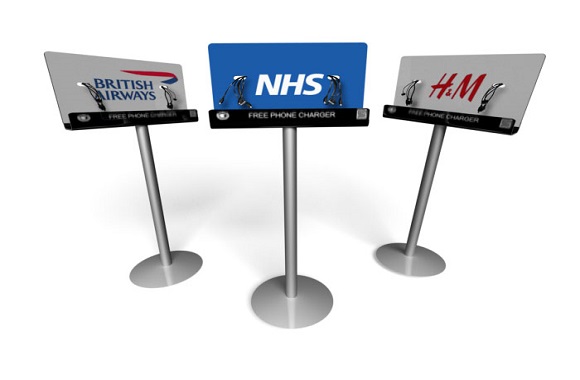
16pin cable mobile phone charging station
4. Sponsorship Opportunities: Turning a Charging Station into a Marketing Asset
This is where phone charging stations move from being a guest-experience nicety to being a genuinely interesting commercial tool for hospitality venues, event organisers and brand sponsors alike.
Why a charging station is valuable advertising space
Think about what a guest actually does at a charging station: they stop, they wait, and — because their phone is either out of reach in a locker or sitting in front of them charging — they look up and around rather than down at a screen. For a brief but genuine window, typically several minutes at a time, the guest’s attention is available in a way it rarely is anywhere else in a venue. A charging station earns “dwell attention” in a way that a static banner or a passing poster simply doesn’t.
That makes it an unusually good piece of sponsorship inventory:
- High-intent audience. People at a charging station are self-selected as engaged attendees who plan to stay at the venue or event for a while longer.
- Repeated impressions. Unlike a single glance at a poster, a guest at a locker bank or open station looks at the branding multiple times: on arrival, while charging, and on collection.
- Positive association. The brand isn’t interrupting the guest experience — it’s directly enabling something the guest actually wants (a charged phone), which creates a much warmer association than a typical advertisement.
- Shareability. Guests photograph and post about clever or generous venue amenities, particularly at events and festivals, giving sponsors an organic social media presence alongside the physical branding.
Types of sponsor branding on charging stations
- Digital branding — where the unit includes a screen (such as an LCD-equipped station) that can display rotating sponsor content, event information, or a QR code linking through to a sponsor’s website, offer or digital business card
- Vinyl branding — full-colour vinyl wraps applied to the body of the unit, locker doors or side panels, giving a complete, durable branded finish
- Locker-front branding — where multiple lockers each carry different messaging, useful for multi-sponsor events or for repeating a single sponsor’s message across a bank of units
- QR code integration — increasingly common at exhibitions and conferences, where a QR code on the charging station links through to a sponsor’s digital business card, product page or lead-capture form, turning a charging pause into a genuine marketing touchpoint
Sponsorship models venues and organisers typically consider
| Model | How it works | Best suited to |
|---|---|---|
| Single sponsor, full branding | One sponsor takes the entire unit or bank of units, with exclusive branding | High-value corporate sponsors, headline event partners |
| Multi-sponsor, shared branding | Several sponsors share branding across different lockers or rotating screen content | Exhibitions and conferences with multiple exhibitors or partners |
| Venue-branded with sponsor overlay | The venue’s own branding forms the base design, with a sponsor logo added as a partnership | Hotels, stadiums and venues that want to retain their own identity while generating sponsorship income |
| Event-specific branding | Charging stations branded for a single event only (festival, conference, one-off exhibition) | Short-term events and festivals |
Revenue and value generation
For venues and event organisers, sponsor-branded phone charging stations open up a genuine revenue line or cost-offset opportunity: sponsorship income, or an in-kind sponsorship deal, can fund the hire or purchase of equipment that the venue would otherwise be paying for outright, while giving the sponsoring brand a high-visibility, well-regarded presence at the event. For brand sponsors, it’s an unusually cost-effective form of experiential marketing compared with traditional stand space or print advertising, because the branding sits inside a genuinely useful piece of guest infrastructure rather than competing for attention against it.
5. Limited-Time Offer: Free Branded Hospitality Charging Station
Limited-Time Offer
Receive a FREE Hospitality Phone Charging Station with Sponsor Branding when you place a qualifying order.
- Professional design and application of your sponsor or venue branding
- Sponsor logo and venue branding included as part of the package
- A genuine marketing opportunity for your venue or your sponsorship partner
- Available for a limited time only, subject to qualifying order criteria
[Placeholder: exact qualifying order value, offer duration and full terms to be confirmed directly with VisCharge]
Contact VisCharge directly to check current eligibility and full terms and conditions before proceeding. Call 02038071064 or email contact@vischarge.co.uk to discuss your hospitality venue’s requirements.
This kind of offer works precisely because it removes the two biggest objections hospitality buyers usually raise about charging stations — “what does it cost” and “who’s going to sort out the branding” — by folding professional branding into the deal itself. It’s worth treating any promotional page like this as a living document: dates, qualifying spend and exact terms should always be confirmed directly with VisCharge before publication, rather than assumed or invented.
6. Branding: Making the Most of the Space
A phone charging station is, in visual terms, a blank branded surface that guests will stand in front of for several minutes at a time — which makes the branding execution worth getting right.
What good charging station branding typically includes
- Full-colour branding across the main body of the unit, using the venue’s or sponsor’s actual brand colours and typography rather than a generic template
- Corporate and sponsor logos, clearly placed at eye level where guests will naturally look while their phone charges
- Venue branding, particularly useful for hotels, stadiums and shopping centres that want the unit to reinforce their own identity even when it also carries sponsor content
- Event branding, for one-off conferences, exhibitions and festivals, where the unit becomes part of the overall event dressing
- Promotional campaign messaging, such as a seasonal offer, a QR code to a competition, or a call to action tied to a specific marketing push
Branding layout ideas
- Hero panel + supporting strip — a large primary logo or message on the main face of the unit, with a smaller supporting strip carrying a website URL, hashtag or QR code
- Locker-door rotation — a different message or sponsor on each locker front across a bank of units, useful for multi-partner events
- Screen-based rotation — for LCD-equipped units, rotating digital content that can be updated between events without any physical reprinting
- Wrap-around vinyl — branding that continues around the visible sides of the unit, so the station reads as fully “on-brand” from any angle in the room
Return on investment
Because a charging station is functional rather than purely decorative, guests interact with the branding voluntarily and repeatedly — a meaningfully different dynamic to a static banner that guests may walk past once without registering it at all. Venues and sponsors evaluating return on investment should weigh this “dwell-time” branding value alongside more traditional exposure metrics like footfall and estimated impressions, since the quality of attention at a charging station tends to be higher, even where the raw impression count is lower than a large-format banner.
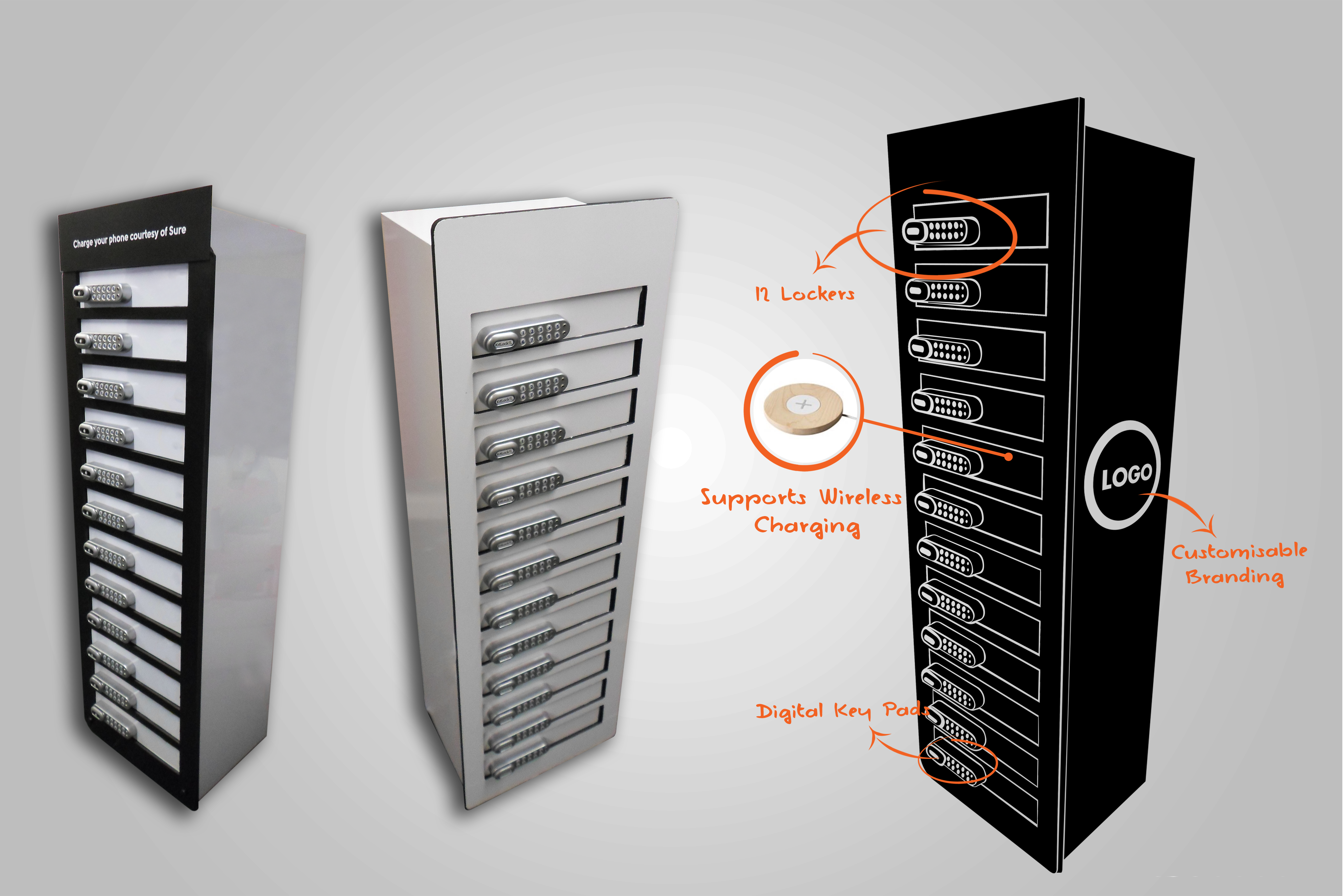
Mobile phone charging locker
7. Phone Charging Technology Explained
Guests don’t need to understand the engineering behind a charging station, but venue buyers absolutely should, because the technology determines both the guest experience and the practical running of the unit.
Wireless Charging (Qi)
Wireless charging, based on the Qi standard, allows a compatible phone to charge simply by being placed on a charging pad or surface — no cable required. For hospitality applications, this has two clear advantages. First, it’s inherently tidier: no trailing cables to manage, tangle or replace, which matters in premium or design-led spaces such as VIP lounges and boutique hotel lobbies. Second, it’s genuinely convenient for guests with the latest smartphones that support wireless charging natively, since there’s nothing to plug in and nothing to remember to unplug.
The trade-off is that wireless charging is typically slower than a direct cable connection, and it only works with phones (and compatible cases) that support the Qi standard. For that reason, wireless charging tends to be used as a premium, design-focused option in VIP and hospitality suite settings, or as one option among several on a multi-format station, rather than the sole charging method at a high-turnover public locker bank.
Fast Charging
Fast charging uses higher-wattage charging protocols — commonly delivered via USB-C — to top up a phone’s battery significantly quicker than a standard charging cable. For a guest with fifteen minutes at a bar or twenty minutes between conference sessions, the difference between a slow trickle charge and genuine fast charging can be the difference between “still not enough battery for tonight” and “back to a comfortable level of charge”. Smart charging and power management systems within the unit also help protect connected devices, regulating current delivery so that multiple phones charging simultaneously don’t compete poorly for available power.
Multi-Cable Compatibility
A charging station is only as useful as its cable compatibility, and hospitality venues serve an unpredictable mix of devices on any given day. A well-specified station should include:
- Lightning connectors, for Apple iPhone models that still use this connector
- USB Type-C, now standard across current iPhone models and the vast majority of Android devices
- Micro USB, still relevant for older Android handsets and a range of accessories
This combination — commonly supplied as a fast-charging cable cord covering Lightning, USB-C and Micro USB — ensures genuinely universal compatibility across the phones guests are likely to bring into a venue, including iPhones and Android devices from manufacturers such as Samsung, Google, Huawei, Motorola, Sony, Nokia, Oppo and Xiaomi. Some stations also offer portable wireless magnetic charging cables compatible with Apple Watch and other smartwatch devices, which is a useful addition for VIP and corporate hospitality settings where guests are more likely to be wearing a smartwatch alongside their phone.
Why this matters for hospitality venues specifically
Hospitality venues can’t control what phones their guests are carrying, and a station that only charges one connector type will disappoint roughly half the room. Universal, multi-cable compatibility — paired with fast charging where possible and wireless options in premium areas — is what allows a single piece of equipment to genuinely serve an entire venue’s guest base, rather than a subset of it.
Charging Technology at a Glance
| Technology | Best for | Key benefit |
|---|---|---|
| Wireless (Qi) charging | VIP lounges, premium and design-led spaces | No cables, tidy aesthetic, works with latest compatible smartphones |
| Fast charging (USB-C) | High-turnover areas, bars, conference breaks | Meaningful charge in a short window |
| Multi-cable (Lightning / USB-C / Micro USB) | General hospitality use across all guests | Universal device compatibility |
| Smartwatch/magnetic charging cables | VIP and corporate hospitality | Covers Apple Watch and similar wearables |
8. Safety, Standards and the “Your Phone, Your Responsibility” Disclaimer
Safe charging as a baseline expectation
Any equipment plugged into mains electricity and used by members of the public needs to meet appropriate UK electrical safety standards, and charging stations are no exception. For commercial use in hospitality venues, that means equipment that has been properly tested and certified, with sensible cable management so that leads aren’t left as trip hazards across walkways, and internal power management that prevents overloading when multiple devices are charging at once.
Good practice for venues includes:
- Positioning charging stations away from high-traffic pinch points, so cables and queuing guests don’t create a hazard
- Ensuring units are serviced and checked as part of routine venue maintenance, in the same way as any other electrical equipment
- Using equipment from a supplier who can speak knowledgeably about the electrical standards their units meet
- Keeping cable runs tidy and secured, particularly in outdoor or temporary event settings such as festivals and exhibitions
Guest safety and venue responsibility
Safety at a charging station isn’t only about the electrics — it’s also about managing guest expectations around device security. This is precisely why the disclaimer matters so much on open stations.
Disclaimer Your Phone, Your Responsibility.
Displaying this notice clearly on open (non-locking) charging stations does two things for a venue. Practically, it sets out — in plain, unambiguous language — that while the venue is providing charging as a courtesy or paid service, it is not acting as a bailee or security guard for the device itself. Reputationally, it signals that the venue has thought this through and is being straightforward with guests, rather than leaving the question unaddressed and open to dispute if a device goes missing.
For venues that want a physically secured alternative, phone charging lockers remove much of this concern altogether, since the device sits inside a locked, PIN-protected compartment for the duration of the charge — which is exactly why lockers tend to be the preferred option for busier, less supervised public areas.
9. Phone Charging Stations by Industry
Different hospitality and event sectors use charging stations in noticeably different ways. Here’s how the benefits play out across the venues this guide is written for.
Hotels
Hotel guests are often travelling, tired, and reliant on their phone for everything from boarding passes to hotel Wi-Fi login codes. A charging station in the lobby, business centre or bar gives guests somewhere reliable to top up without hunting for a spare socket behind a lamp. For hotel groups, a branded unit also reinforces brand identity in a space every guest passes through multiple times a day.
Restaurants
A charging point at the bar or on a dedicated table gives guests a reason to linger — and a lingering guest at a restaurant or bar is very often an additional round of drinks or a dessert. It also solves a genuinely common request from front-of-house staff: “is there anywhere I can charge my phone while I wait for a table?”
Bars, Pubs and Nightclubs
Late nights and heavy phone use (photos, social media, ordering taxis) make bars, pubs and nightclubs a natural fit for charging stations, particularly lockers in nightclub settings where guests want their phone secured while they’re on the dance floor rather than sitting exposed on a table.
Casinos
Casino guests often stay for extended periods, and a dead phone can genuinely disrupt the experience — no way to call a taxi, check messages, or simply take a break to catch up on the outside world. A discreetly placed charging station, particularly in VIP gaming areas, fits naturally into the overall guest-experience proposition casinos are built around.
Stadiums and Arenas
High footfall, long dwell times and heavy phone use (photos, social media, match updates, ticketing apps) make stadiums and arenas one of the strongest use cases for phone charging lockers in particular, since fans want their hands free to watch the game rather than holding a charging phone. Sponsor-branded units in concourse areas also tap into exactly the kind of matchday sponsorship activity clubs and sponsors already invest heavily in elsewhere in the stadium.
Conference Venues
Conference attendees rely on their phones for agendas, networking apps, and increasingly for QR-code-based lead capture at exhibitor stands — a dead phone genuinely disrupts a delegate’s ability to participate. Charging stations positioned near breakout areas or exhibition floors are one of the most consistently requested amenities at professional conferences.
Exhibition Venues
Exhibitors and visitors alike depend on phones throughout an exhibition day, from digital business cards to stand directions. A well-positioned, sponsor-branded charging locker bank becomes both a practical service and — as covered in Section 4 — a genuine piece of sponsorship inventory that exhibition organisers can sell alongside traditional stand space.
Festivals
Festival sites present some of the toughest conditions for phone battery life: long days, patchy signal that drains batteries faster, camera and social media use, and no easy access to a plug socket at a campsite. Secure phone charging lockers are close to essential at multi-day festivals, and branded units offer festival sponsors a highly visible, genuinely welcomed presence on-site.
Racecourses and Golf Clubs
Racecourse hospitality boxes and golf club members’ lounges share the same premium-guest logic covered in Section 3: guests expect a level of amenity that matches the price of admission or membership, and a charging point in a hospitality suite or clubhouse bar quietly reinforces that standard.
Wedding Venues
A charging station tucked discreetly near the bar at a wedding reception solves one of the most common minor frustrations of a long event — guests wanting to keep taking photos, but running low on battery well before the night is over.
Holiday Parks
Guests on holiday parks are often out and about all day, relying on their phones for park apps, maps and photos, with limited opportunity to return to their accommodation to charge. A central charging point at reception or the on-site clubhouse fills a genuine gap.
Universities and Colleges
Students spend long hours in libraries, student unions and common areas, frequently without easy access to a socket near their preferred seat. Phone charging lockers are a practical, well-used addition to student spaces, and can also serve as advertising space for student union partners and local sponsors.
Shopping Centres
Shoppers with a dying phone battery cut their visit short. A charging locker bank extends dwell time — and, by extension, spend — in exactly the way covered in Section 1, while giving centre management another retail-partner sponsorship opportunity.
Airports
Airports are perhaps the original home of phone charging anxiety, with travellers relying entirely on their phone for boarding passes and itineraries. Charging stations and lockers in both general terminal areas and premium lounges are now close to a baseline expectation for passengers.
Healthcare Settings
Patients and visitors in hospitals and healthcare facilities often face long waits, and a dead phone removes their main source of distraction, communication and reassurance during a stressful time. A well-placed charging station is a small but genuinely welcome piece of patient-experience infrastructure.
Corporate Offices
For businesses hosting client meetings, briefings or events on-site, a charging station in reception or a meeting suite is a simple, professional courtesy that reflects well on the host organisation — and can double as an internal branding touchpoint for staff and visitors alike.
10. Marketing and Commercial Benefits
Pulling together the themes from earlier sections, here’s the fuller commercial case for hospitality venues, event organisers and marketing agencies considering charging station infrastructure:
- Increased customer engagement — guests interact directly and voluntarily with a charging station, unlike passive advertising
- Longer dwell time — guests without battery anxiety stay longer, browse more and spend more
- Increased spending — longer dwell time consistently correlates with higher average spend in hospitality and retail settings
- Social media opportunities — well-designed, well-branded charging stations are the kind of amenity guests photograph and share
- Better customer satisfaction — solving a genuine, common frustration builds goodwill that shows up in reviews and repeat visits
- Premium guest experience — particularly in VIP and hospitality suite settings, as covered in Section 3
- Sponsorship income — charging stations can be sold or offered as sponsorship inventory, as covered in Section 4
- Advertising revenue and brand exposure — for sponsors, a well-placed unit delivers sustained, positive-association exposure
- Return on investment — particularly strong when sponsorship income offsets some or all of the equipment cost, as with offers like the one outlined in Section 5
11. Buyer’s Guide: How to Choose the Right Phone Charging Station
Key questions to ask before buying or hiring
- What’s the primary location? Reception, VIP lounge, exhibition floor, stadium concourse — this determines open station vs locker, as covered in Section 2.
- What’s the expected footfall and dwell time? Higher footfall and longer dwell time generally favour lockers; lower footfall, supervised spaces favour open stations.
- Is this for permanent installation or a one-off event? Permanent venues (hotels, stadiums, shopping centres) may prefer a purchased unit; one-off conferences, exhibitions and festivals are typically better served by hire or lease options.
- Do you want sponsorship branding built in? If so, involve your sponsorship or marketing team early, so branding artwork and any sponsor sign-off can be arranged well ahead of installation.
- What device compatibility do you need? Confirm Lightning, USB-C, Micro USB and, if relevant, wireless and smartwatch charging support.
- Do you need remote monitoring or cashless payment options? Larger, multi-site operators may want usage data and monetisation options built into the unit.
- What power source is available? Permanent venues typically use mains power; outdoor festivals and temporary event sites may need generator-powered units.
Buy, hire or lease?
| Option | Best suited to | Key consideration |
|---|---|---|
| Purchase | Hotels, stadiums, shopping centres, permanent venues | Higher upfront cost, no ongoing hire fees, full control over branding |
| Hire/rental | One-off conferences, exhibitions, corporate events | Lower upfront commitment, ideal for short-term or single-event branding |
| Lease | Multi-event organisers, venues wanting flexibility | Spreads cost over time, can be updated as sponsors change |
Expert tips
- Position units where guests naturally pause anyway — near a bar, registration desk or seating area — rather than off to one side where they’ll be missed.
- If running a multi-sponsor event, agree branding placement and screen rotation timings well in advance to avoid last-minute design changes.
- For outdoor or temporary events, confirm power supply requirements (mains vs generator) as early as possible in event planning.
- Always display the “Your Phone, Your Responsibility” disclaimer clearly on open stations — it protects both guest expectations and the venue’s position.
Key Takeaways
- Battery anxiety is a real, common source of guest frustration that a charging station directly addresses.
- Open stations suit supervised, shorter-dwell spaces; lockers suit high-footfall, longer-dwell or unsupervised spaces.
- VIP and premium areas benefit disproportionately from discreet, well-finished charging solutions.
- Charging stations are genuinely valuable sponsorship inventory, not just a guest amenity.
- Universal multi-cable and wireless compatibility ensures the widest possible guest coverage.
- Safety and clear disclaimers matter as much as the technology itself.

Phone and laptop charging table
12. Frequently Asked Questions
General Questions
1. What is a hospitality phone charging station? A hospitality phone charging station is a dedicated unit — either an open charging point or a secure locker system — installed in a hotel, restaurant, bar, stadium, conference venue or similar setting so guests can charge their mobile phones safely and conveniently during their visit.
2. Why do hospitality venues need phone charging stations? Guests increasingly rely on their phones throughout a visit, for everything from payments to photos to event apps. A charging station removes battery anxiety, extends dwell time, supports better reviews and gives venues a genuine sponsorship opportunity.
3. What’s the difference between a phone charging station and a phone charging locker? An open charging station lets guests plug in and stay nearby while their phone charges in view. A phone charging locker is a secured, PIN-protected individual compartment, allowing guests to leave the area entirely while their phone charges safely inside.
4. Are phone charging stations free to use for guests? This depends entirely on how the venue chooses to operate the unit. Some venues offer charging as a free guest amenity; others use cashless payment integration to monetise usage. Either model is common in UK hospitality settings.
5. How many phones can a typical charging station or locker bank hold? This varies by unit size, with locker banks commonly available in configurations such as 8, 12, 16 or 24 individual compartments, and open stations typically offering multiple simultaneous charging cables from a single console.
6. Do charging stations work with all phone brands? A well-specified station with Lightning, USB-C and Micro USB compatibility will charge the vast majority of smartphones on the market, including iPhone, Samsung, Google Pixel, Huawei, Motorola, Sony, Nokia, Oppo and Xiaomi devices.
7. What is “battery anxiety” and why does it matter to hospitality venues? Battery anxiety describes the stress guests feel when their phone battery runs low with no charger available. It matters to venues because it directly affects guest mood, dwell time and how positively (or negatively) a visit is remembered.
8. Can a charging station improve customer reviews? Indirectly, yes. While guests rarely leave a review purely because of a charging point, its absence is a common source of complaint, particularly at events and conferences, while its presence is often mentioned positively in passing.
Open Stations vs Lockers
9. Which is better for a hotel lobby, an open station or a locker? An open station is usually preferable in a supervised hotel lobby, since guests tend to remain nearby and value the speed and simplicity of plugging straight in without a PIN code.
10. Which is better for a stadium concourse? Phone charging lockers are generally the better fit for stadium concourses, since fans want their hands free to watch the match rather than staying beside an open charging point.
11. Is an open charging station safe to use? Open stations are safe from an electrical standpoint when properly installed and maintained, but they don’t physically secure the device — which is why the “Your Phone, Your Responsibility” disclaimer is displayed, making guest responsibility clear.
12. What does the “Your Phone, Your Responsibility” disclaimer mean? It’s a clear notice, typically displayed on open charging stations, explaining that while the venue provides the charging facility, the guest retains responsibility for their own device, in the same way they would with a socket at their table.
13. Are phone charging lockers PIN protected? Yes, phone charging lockers typically use an individual PIN code or keypad system set by the guest, so only they can open their compartment to retrieve their device.
14. What happens if a guest forgets their locker PIN? Most locker systems allow venue staff to access a master override or reset function, though the exact process depends on the specific unit and operator — worth confirming with your supplier during setup.
15. Can lockers be used outdoors at festivals? Yes, lockers are widely used at outdoor festivals, though venues should confirm the unit’s weatherproofing and power supply requirements (mains or generator) with their supplier in advance.
16. How long does it typically take to charge a phone at a station? This depends on the phone, its existing battery level, and whether the unit offers fast charging. A fast-charging USB-C connection can deliver a meaningful top-up in as little as fifteen to thirty minutes.
VIP and Premium Areas
17. Why do VIP areas need their own charging solution? Guests in VIP lounges, hospitality suites and executive areas expect a standard of service that matches the premium nature of the space. A discreet, well-branded charging station reinforces that standard rather than undermining it.
18. What’s the best type of charging station for a VIP lounge? Wireless charging pads or a bespoke, finish-matched power table are popular choices for VIP lounges, since they minimise visible cabling and blend into premium interior design.
19. Can VIP charging stations be custom designed to match the room? Yes, branding and finish can typically be tailored to match a venue’s existing colour palette and materials, so the unit reads as bespoke furniture rather than an off-the-shelf kiosk.
20. Do airport lounges use phone charging stations? Airport lounges are one of the most common settings for premium charging solutions, given how heavily travellers rely on their phones for boarding passes, itineraries and communication.
21. Are wireless charging stations suitable for corporate hospitality boxes? Yes, wireless charging is particularly well suited to corporate hospitality boxes, where a clean, cable-free aesthetic matters and guests’ phones are often compatible with the Qi wireless standard.
Sponsorship and Branding
22. Can a phone charging station be branded with a sponsor’s logo? Yes, full-colour vinyl branding, locker-front branding and digital screen branding are all commonly used to apply sponsor logos and messaging to charging stations.
23. How does charging station sponsorship work? A sponsor pays for, or contributes to, the cost of the unit in exchange for prominent branding on the station itself, giving them a genuinely welcomed presence in front of an engaged, self-selected audience.
24. Why are charging stations considered good sponsorship inventory? Because guests actively pause at a charging station for several minutes, they engage with the branding repeatedly and voluntarily — a very different dynamic to a passing glance at a static banner.
25. Can multiple sponsors share branding on one charging station? Yes, particularly at exhibitions and conferences, where locker-front branding or rotating screen content allows several sponsors or exhibitors to share visibility across a single bank of units.
26. What’s the difference between vinyl branding and digital branding? Vinyl branding is a physical, printed wrap applied to the unit, ideal for a single fixed design. Digital branding uses an on-unit screen to display rotating content, useful when messaging needs to change between events or sponsors.
27. Can a QR code be added to a charging station? Yes, QR codes are commonly added to charging stations, linking through to a sponsor’s website, digital business card, offer page or lead-capture form.
28. How much does sponsor branding typically cost? Costs vary depending on the size of the unit, the branding format (vinyl vs digital) and the scope of the design work involved. Contact VisCharge directly for a specific quote based on your requirements.
29. Can event organisers sell charging station branding as part of a sponsorship package? Yes, many conference, exhibition and festival organisers already include charging station branding as one of several sponsorship tiers on offer to exhibitors and partners.
30. Does charging station branding help with brand recognition? Repeated, voluntary engagement with a branded, useful piece of infrastructure supports brand recall in a way that’s generally more positive than traditional passive advertising formats.
The Limited-Time Offer
31. What is the free branded charging station offer? VisCharge has offered a free hospitality phone charging station with sponsor branding included, available for a limited time to venues placing a qualifying order — contact VisCharge directly to check current eligibility and terms.
32. What counts as a “qualifying order” for the free station offer? Exact qualifying criteria are set by VisCharge and may change over time. Contact VisCharge directly on 02038071064 or via contact@vischarge.co.uk to confirm current terms before proceeding.
33. Is professional branding design included in the offer? Yes, professional branding design and application, including sponsor logo and venue branding, forms part of the offer as described — full details should be confirmed with VisCharge.
34. How long will the offer be available? This is a limited-time promotion. Availability and duration should be confirmed directly with VisCharge, as promotional terms are subject to change.
Charging Technology
35. What is wireless (Qi) charging? Qi is the industry-standard wireless charging protocol that allows compatible smartphones to charge simply by resting on a charging pad, without needing a cable.
36. Does wireless charging work with all smartphones? No — wireless charging only works with phones (or phones in compatible cases) that support the Qi standard. Most recent flagship smartphones support it, but not every device does.
37. What is fast charging and why does it matter in hospitality? Fast charging delivers a higher-wattage charge, typically via USB-C, allowing a phone to reach a usable battery level much more quickly — valuable when guests only have a short window to charge.
38. What connector types should a hospitality charging station support? A well-specified station should support Lightning, USB-C and Micro USB as a minimum, to cover the full range of iPhone and Android devices guests are likely to bring into the venue.
39. Can charging stations charge an Apple Watch or other smartwatch? Some units offer portable wireless magnetic charging cables compatible with Apple Watch and similar devices, which is a useful addition for VIP and corporate hospitality settings.
40. Is USB-C now the standard connector for most phones? USB-C is now standard across current-generation iPhone models and the large majority of Android devices, though Lightning and Micro USB compatibility remains useful for older handsets.
41. Do charging stations support cashless payment? Some units offer optional cashless, contactless payment integration, allowing venues to monetise charging directly if they choose to run a paid model rather than offering it free of charge.
42. Can venues remotely monitor how their charging stations are being used? Some units support remote monitoring and management, giving operators real-time visibility of usage and performance — particularly useful for larger, multi-site hospitality groups.
Safety and Standards
43. Are commercial phone charging stations safe to install in a hospitality venue? Yes, provided the equipment meets appropriate UK electrical safety standards and is installed, maintained and serviced correctly, as with any commercial electrical equipment.
44. Who is responsible if a phone is damaged while charging at an open station? Open stations display a “Your Phone, Your Responsibility” disclaimer, making clear that while the venue provides the charging facility, the guest retains responsibility for their own device.
45. Are phone charging lockers more secure than open stations? Yes, because the device is physically secured behind a PIN-protected locker door, phone charging lockers offer a materially higher level of device security than an open station.
46. How should cables be managed to avoid trip hazards? Charging stations should be positioned away from high-traffic pinch points, with cables kept tidy and secured, particularly in temporary outdoor event settings such as festivals and exhibitions.
47. Do charging stations need regular maintenance? Yes, as with any commercial electrical equipment, charging stations should be included in routine venue maintenance and safety checks.
Industry-Specific Questions
48. Do hotels really need a dedicated charging station if guests have chargers in their rooms? Yes — a charging point in the lobby, business centre or bar serves guests who are between their room and another part of the hotel, or who have simply left their charger upstairs.
49. Are phone charging stations common at UK conferences and exhibitions? Yes, charging points — particularly locker-based systems — are now a widely expected amenity at UK conferences and exhibitions, given how heavily delegates rely on event apps and QR-code networking.
50. Why are phone charging lockers popular at music festivals? Multi-day festivals combine long days, heavy phone use and limited access to power at campsites, making secure, PIN-protected lockers close to essential festival infrastructure.
51. Do stadiums use charging stations in general admission areas as well as hospitality boxes? Many stadiums run both: open or premium stations in hospitality suites, and secure locker banks in general concourse areas, matching the solution to the level of supervision available.
52. Are charging stations suitable for shopping centres? Yes, shopping centres are a strong use case, since a charging locker helps extend shopper dwell time and offers management another retail-partner sponsorship opportunity.
53. Do universities use phone charging lockers? Yes, phone charging lockers are a practical addition to university libraries, student unions and common areas, where students often want to charge a device unattended for extended periods.
54. Are charging stations appropriate for healthcare settings? Yes, charging points in hospital waiting areas and visitor spaces are a genuinely welcomed piece of patient-experience infrastructure, given how long waits can be and how much patients and visitors rely on their phones.
55. Do wedding venues typically offer phone charging? Increasingly, yes — a discreetly placed charging station near the bar solves a common minor frustration at long wedding receptions, where guests want to keep taking photos throughout the evening.
56. Are charging stations useful in corporate office reception areas? Yes, for businesses hosting client meetings or events, a reception-area charging station is a simple, professional courtesy that reflects well on the host organisation.
57. Do racecourses and golf clubs use charging stations in hospitality areas? Yes, racecourse hospitality boxes and golf club members’ lounges commonly include charging facilities as part of the broader premium guest experience guests expect at that level of admission or membership.
58. Are charging lockers suitable for holiday parks? Yes, a central charging point at reception or the on-site clubhouse is useful for guests who are out and about all day and can’t easily return to their accommodation to charge.
59. Do casinos offer phone charging facilities? Some casinos include discreet charging points, particularly in VIP gaming areas, recognising that guests often stay for extended periods and value the option to top up their phone without leaving the floor.
60. Are nightclubs a good fit for phone charging lockers? Yes, lockers work particularly well in nightclubs, allowing guests to secure their phone while dancing rather than leaving it exposed on an open charging table.
Buying, Hiring and Choosing a Supplier
61. Should a venue buy or hire a phone charging station? Permanent venues such as hotels and shopping centres often prefer to purchase, while one-off conferences, exhibitions and corporate events are typically better served by hire or lease options.
62. How do I choose between VisCharge’s different product options? Consider your venue type, expected footfall, whether guests will stay nearby or need to move around, and whether you want sponsor branding — then discuss these requirements directly with VisCharge.
63. Does VisCharge offer event hire as well as permanent installation? Yes, VisCharge offers event hire and lease options in addition to purchase, suitable for conferences, exhibitions and other short-term events.
64. Can charging stations be powered by a generator at outdoor events? Yes, portable generator options exist for outdoor or temporary event sites without reliable mains power access — worth confirming power requirements with your supplier ahead of the event.
65. What areas of the UK does VisCharge cover? VisCharge provides phone charging station services across London and other major UK cities including Manchester, Birmingham, Liverpool, Glasgow and Cardiff.
66. Does VisCharge operate outside the UK? Yes, VisCharge also has a presence in the US, Canada, Ireland, Germany, France, Switzerland, the UAE and South Africa, in addition to its UK operations.
67. How do I get a quote for a hospitality phone charging station? Contact VisCharge directly on 02038071064 or via contact@vischarge.co.uk to discuss your venue’s requirements and receive a tailored quote.
68. Can VisCharge design custom branding for my venue or sponsor? Yes, custom branding — including logos, colours and promotional messaging — is a core part of VisCharge’s offering, alongside the underlying charging hardware.
69. What’s included in a typical charging station package? This varies by product and agreement, but commonly includes the unit itself, charging cables, branding application and, in many cases, delivery and setup — confirm exact inclusions with VisCharge directly.
70. Do charging stations come with a warranty or service contract? Service and warranty terms vary by product and agreement type. Confirm the specific terms for your chosen unit directly with VisCharge before purchase or hire.
Marketing, ROI and Strategy
71. How does a phone charging station improve dwell time? By removing the pressure to leave and find a charger elsewhere, guests are free to stay, browse and spend longer at the venue than they otherwise would.
72. Can charging stations genuinely generate revenue for a venue? Yes, through sponsorship deals, paid cashless charging models, or increased guest spend resulting from longer dwell time — often in combination.
73. What’s the best way to measure ROI on a charging station? Venues can look at a combination of estimated footfall past the unit, sponsorship income generated, and any measurable change in dwell time or average spend before and after installation.
74. Are branded charging stations good for social media exposure? Yes, distinctive, well-designed units are the kind of visible amenity guests photograph and share, giving sponsors and venues organic exposure alongside the physical branding.
75. Is a phone charging station a worthwhile investment for a small independent venue? For smaller venues, hire options or sponsor-funded branding — such as the offer outlined in Section 5 — can make a charging station a low-risk, high-goodwill addition without a significant upfront outlay.
76. Who should a hospitality venue contact to discuss a phone charging station? VisCharge, on 02038071064 or contact@vischarge.co.uk, can advise on the right type of station, branding options and hire, lease or purchase terms for your specific venue.
13. Illustrative Case Studies
The following are illustrative examples designed to show how hospitality phone charging stations are typically applied in practice. They are not verified VisCharge client case studies — venues interested in real project examples should ask VisCharge directly for current references.
Illustrative Example: A City-Centre Hotel Lobby
A busy city-centre hotel introduces an open, wireless-capable charging station at its lobby seating area, branded with the hotel’s own logo. Guests waiting for taxis, checking in early or working between meetings use the unit throughout the day. Front-of-house staff report fewer requests to “borrow a charger from behind the desk”, and the unit becomes a small but consistent feature in online reviews praising the hotel’s attention to guest comfort.
Illustrative Example: A Stadium Concourse Sponsorship Partnership
A football stadium partners with a regional sponsor to install a bank of branded phone charging lockers across its main concourse. The sponsor’s logo appears on every locker door, with a QR code linking through to a matchday offer. Fans use the lockers throughout the build-up to kick-off and at half-time, giving the sponsor sustained, positive-association visibility across a full matchday, alongside the club’s existing pitch-side and programme advertising.
Illustrative Example: A Multi-Day Music Festival
A mid-sized UK music festival installs several banks of PIN-protected phone charging lockers across its site, positioned near main stages and food vendor areas. With patchy signal draining batteries faster than usual and no power available at campsites, the lockers become one of the festival’s most consistently used amenities, and the festival’s headline sponsor takes exclusive branding across the units as part of its wider on-site sponsorship package.
Illustrative Example: A Restaurant Group’s Bar Area
An independent restaurant group installs a table-top charging station at the bar of its flagship site. Guests waiting for a table use the extra ten to fifteen minutes to charge their phone rather than stepping outside, and the restaurant notices a small but noticeable uptick in additional drink orders during that waiting window.
Illustrative Example: A Corporate Hospitality Suite at a Racecourse
A racecourse hospitality operator adds a discreet wireless power table to its premium suites, finished to match the existing furniture. Corporate clients hosting guests in the suite no longer need to ask staff for a charging cable, and the operator receives positive feedback specifically citing the “little touches” that made the day feel well organised.
Illustrative Example: A Shopping Centre Locker Bank
A regional shopping centre installs a 24-unit phone charging locker bank near its central food court, sponsored by a mobile phone retailer with a store in the centre. Shoppers use the lockers during longer visits, and the sponsoring retailer benefits from consistent footfall past its branded units throughout the trading day.
14. How Hospitality Venues Use Phone Charging Stations for VIP Experience and Sponsor Branding and Your Next Steps
A phone charging station is a small piece of equipment that does a genuinely outsized amount of work for a hospitality venue. It removes a real, common source of guest frustration. It quietly signals that a venue has thought about the practical details of a visit, not just the headline experience. In VIP and premium areas, it reinforces exactly the standard of care guests are paying for. And, perhaps most usefully for venues weighing up the investment, it doubles as a genuinely effective, well-liked piece of sponsorship inventory — one that engages guests voluntarily, repeatedly, and in a far warmer context than traditional advertising ever manages.
Whether you’re a hotel looking to smarten up your lobby, a stadium wanting to offer sponsors a new form of matchday inventory, a festival organiser planning for tens of thousands of phones with nowhere to charge, or a conference venue trying to keep delegates connected between sessions, the right charging solution — open station or secure locker, purchased, hired or leased — is very much a solvable, practical decision once you know what to look for.
If you’re ready to discuss hospitality phone charging stations, sponsorship branding or VIP charging solutions for your venue, get in touch with VisCharge directly:
- Phone: 02038071064
- Email: contact@vischarge.co.uk
- Address: Vischarge® UK, 16 Hanover Square, Mayfair, London, W1S 1HT
VisCharge’s team can talk through the right type of unit for your venue, current sponsorship branding options, and — while it remains available — the current terms of the free branded hospitality charging station offer outlined in Section 5.