
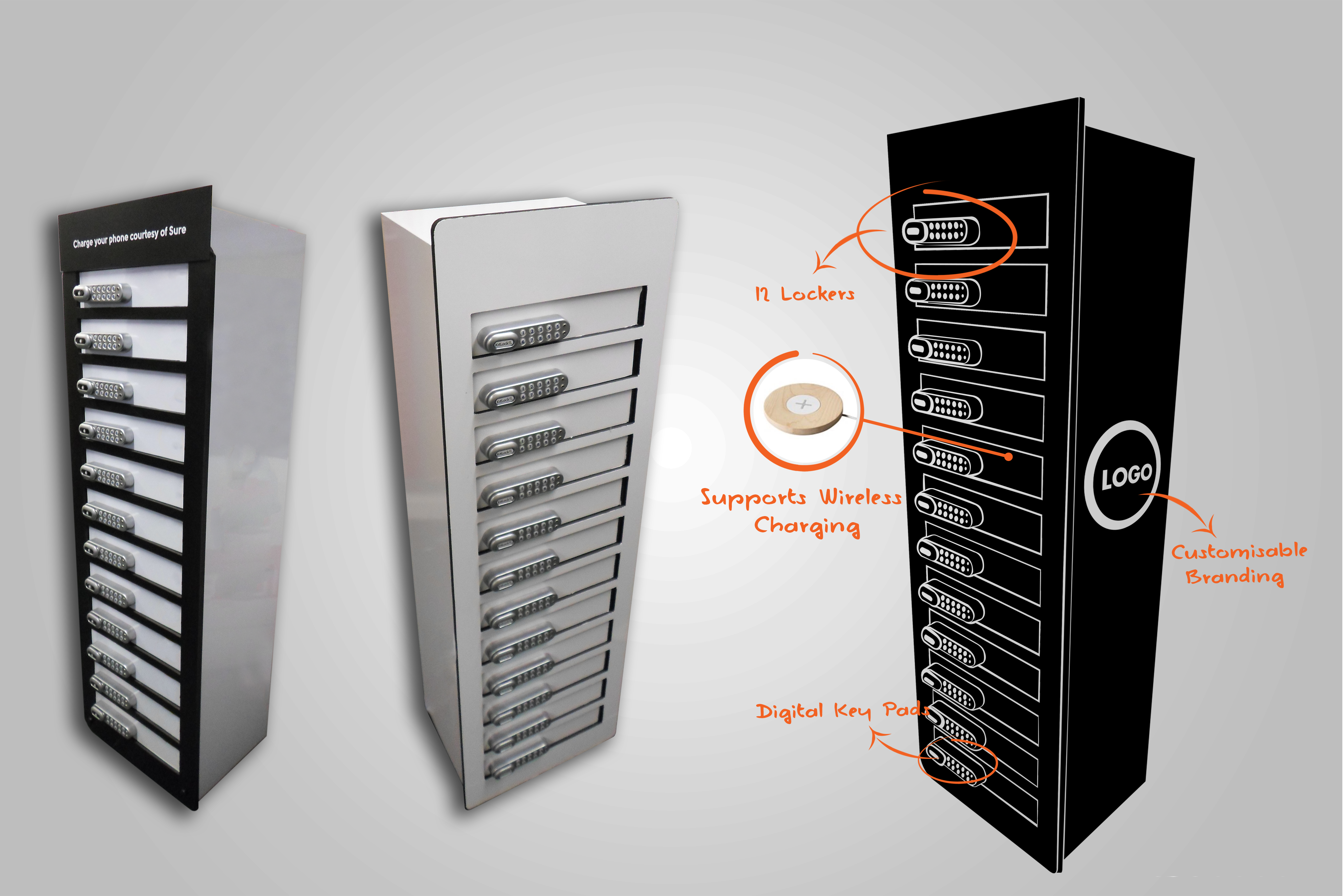
Bespoke Phone Charging Lockers with Custom Finishes
Vischarge Custom phone charging lockers
Commercial investigation by business buyers seeking phone charging lockers made to specification, with a custom finish and a low minimum order, alongside practical guidance on scoping a corporate project.
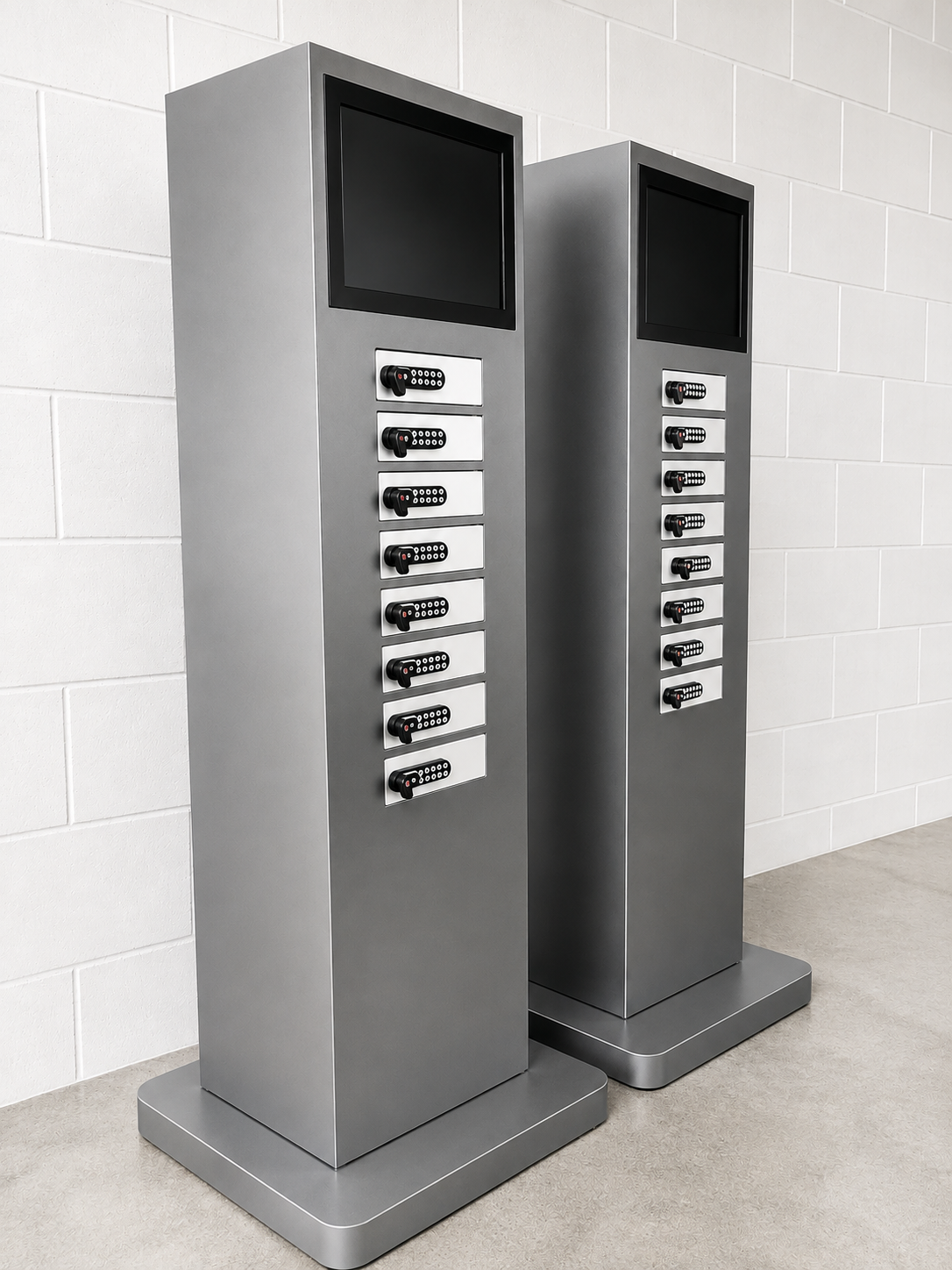
Organisations looking for phone storage and charging equipment often need more than a standard cabinet in a standard colour. The unit may need to suit a corporate identity, fit a defined space or work within the procedures of a particular department. Vischarge can design and manufacture bespoke phone charging lockers to customer requirements, with custom finishes, made-to-measure manufacture and a minimum order of two lockers. The achievable design, finish and technical specification depend on feasibility and should be confirmed for each project.
That small minimum order is relevant to large companies as well as smaller teams. A multinational may need only two lockers for a pilot, visitor facility, restricted-access area or specialist department before deciding whether any wider rollout is appropriate. The starting point is a clear conversation about the site, intended users, appearance, dimensions and charging requirements.
What are bespoke phone charging lockers?
Bespoke phone charging lockers are storage units designed or finished around a customer’s stated requirements rather than selected solely from a standard appearance or configuration. They combine designated compartments for mobile phones with a charging arrangement, with the precise features dependent on the model and the agreed specification.
For a corporate buyer, “bespoke” can refer to different levels of design input. A standard product may be available in a fixed configuration and finish. A customised product may retain that core configuration while adding a selected colour, branding element or other agreed change. A more extensively bespoke solution may involve a made-to-measure size, finish or layout. These descriptions are useful distinctions, not a guarantee that every requested change can be manufactured.
The first question is therefore not simply, “Can this be customised?” It is, “Which aspects need to be different, and are those changes practical for the intended application?” The answer may depend on the available product design, manufacturing capability, the proposed finish, charging and access requirements, the site and the quantity.
Vischarge’s public UK site presents phone charging lockers and a route to enquire about them. For the made-to-order proposition described here, the key points are custom finishes, made-to-measure manufacture and a minimum order of two, subject to confirmation of the project specification and feasibility.
Custom finishes to complement corporate branding
A charging locker is a functional item, but its appearance still matters. It may sit in a reception area, a staff facility, a training centre or a workplace where several teams share responsibility for the environment. A finish selected to complement the organisation’s visual identity can help the equipment feel considered and coordinated rather than like an unrelated addition.
Start with the brand and the setting
Corporate colours are a useful starting point, but they are not the whole brief. A buyer should consider where the locker will be seen, what is already in the room and whether the design needs to meet formal brand guidelines. A colour that works on a screen or in a brand manual may appear different on a physical surface, under site lighting or beside existing furniture.
It is also worth distinguishing between “in the brand palette” and “an exact brand match”. A particular reference may or may not be achievable in the selected finish and material. Buyers should provide colour references and ask Vischarge to confirm available options, matching tolerances and any approval process. Do not treat a colour reference as a promise of an exact physical match until the supplier has agreed it.
The same care applies to logos, wordmarks and graphic elements. If branding is part of the requirement, identify where it should appear and provide approved artwork in the format requested by the supplier. Confirm whether the desired treatment is compatible with the unit, whether a proof or sample can be reviewed and what the final approval point will be. The method, materials and scope of branding should be confirmed for the individual order.
Consider the environment, not just the colour
The surrounding interior can guide the choice. A corporate office might call for a restrained finish that sits comfortably beside desks and meeting-room furniture. A reception area may need a more visible presence, while an employee facility may prioritise a practical appearance that remains coherent with the rest of the site. For a company with multiple workplace brands or building styles, different approved finishes may be appropriate at different locations, subject to manufacturing feasibility.
High-use facilities deserve a practical review. Ask how the proposed finish is expected to be cleaned and maintained, whether it is appropriate for the location and what care instructions apply. These questions do not imply that a particular finish is more durable or easier to clean; those claims need product-specific evidence. In healthcare, laboratories and industrial settings, cleaning agents and environmental conditions may affect finish suitability, so confirm compatibility before approval.
Approve the physical result before production
A disciplined approval process reduces the risk of a mismatch between the expectation and the delivered product. Depending on the project, the parties may agree drawings, colour references, finish samples, artwork proofs or a written specification. Availability of samples or drawings is not assumed: ask whether they can be provided and what they show. A screen rendering can help communicate intent, but should not automatically be treated as proof of an exact colour or material result.
Before production, the buyer should record the approved appearance and any tolerances or exclusions that matter. This is especially useful when several departments must sign off, or when a procurement team is coordinating facilities, brand, security and health and safety input. Confirm with Vischarge which finishes and approval materials are available for the proposed order.
Made-to-measure manufacture: a solution designed around your requirements
Made-to-measure manufacture can be useful when a standard size, appearance or arrangement does not fit the intended space or operational brief. It allows the customer to describe the site and requirements before the final proposal is agreed. It does not mean every requested dimension or modification will be technically possible, commercially sensible or suitable for the intended use.
Start with the location. Record the available footprint and height, the route by which equipment will reach the room, nearby power provision and any space that must remain clear. Dimensions should be measured at the actual installation location, accounting for doors, circulation, furniture and access for users or maintenance. Where the site is still being designed, mark which measurements are confirmed and which are provisional.
Then describe who will use the lockers and how. The expected users may be employees, visitors, contractors or a defined group. Consider how many devices may need to be stored at once, what kinds of devices are expected and whether the lockers will be used throughout the day or at particular shift changes. These observations help shape the discussion but do not establish capacity; the proposed configuration must be confirmed by the supplier.
Charging should be specified separately from storage. Buyers should list device types and charging needs, power availability and any electrical or IT approvals that apply. Do not assume a connector, charging speed, power output or cable arrangement. Those details vary by configuration and need to be confirmed against the actual product specification.
Finally, identify operational constraints. These can include access preferences, cleaning routines, inspection responsibilities, accessibility considerations and site-specific rules. A complete brief gives the supplier a basis to assess the request and tell the buyer which elements can be met, which need adjustment and what remains to be agreed.
A made-to-measure product is therefore best understood as a design and specification process, not an unrestricted promise. Written agreement on dimensions, finish, charging functionality, access and other material details helps ensure that the customer and supplier are working to the same expectations.
Why a minimum order of two phone charging lockers matters
The minimum order of two makes a bespoke discussion accessible without requiring an organisation to commit to a large estate-wide order at the outset. This is particularly relevant to enterprise buyers, whose procurement programmes may be large overall but whose immediate need is local and tightly defined.
A department may want to assess a new arrangement in one facility. A visitor reception team may need a small number of units for a specific location. A pilot may help facilities managers understand user behaviour and operational responsibilities before they consider any next stage. A restricted-access workplace or a site with a particular identity may have a distinct requirement that does not justify a broad standard order.
Two lockers can also support a limited rollout in which stakeholders evaluate appearance, usability, location and day-to-day ownership. A pilot should have clear evaluation questions. For example: does the location work for users; are instructions understandable; do the access arrangements fit local policy; and can the responsible team manage cleaning and inspection? These are questions for the organisation to assess. They are not claims about the performance of a particular product.
The low minimum does not mean a buyer must commission for every site before exploring a bespoke solution. Nor does it guarantee that future phases will have the same price, configuration, delivery terms or specification. Those details should be discussed with Vischarge when the initial enquiry is made. If the organisation anticipates a possible rollout, it is sensible to explain that context early and ask how the initial specification could relate to later requirements, without assuming the same design will suit every location.
For a multinational, the ability to start small can make internal governance more manageable. A local facilities team can scope its need, while central procurement, brand, security and technical stakeholders review the proposed specification. The organisation can then decide whether to proceed beyond the initial quantity based on its own approval process and the supplier’s confirmed capability.
Benefits for multinational organisations
Large organisations rarely have a single, uniform workplace. Their buildings may differ in age, layout, workforce, visitor profile and operational policy. Bespoke phone charging lockers provide a way to discuss those differences while maintaining a considered approach to the equipment’s appearance and use.
Coordinate standards without ignoring local needs
A multinational may want a consistent underlying specification across sites, while allowing a different finish or dimension where local conditions require it. Another may have multiple brands, acquired businesses or buildings with distinct interiors. In either case, the useful exercise is to separate what must remain standard from what can vary.
A specification matrix can help. It might identify a common set of requirements for charging, access and ownership, alongside site-specific fields for dimensions, finish and operating procedures. Each variation should be reviewed rather than assumed to be interchangeable. Whether the same core product can accommodate those variations is a feasibility question for Vischarge.
Give procurement a defined basis for comparison
Procurement teams need a written scope to compare proposals meaningfully. If a request says only “branded charging lockers”, suppliers may interpret it differently. Adding quantity, dimensions, colour reference, charging needs, access preferences, location and delivery requirements makes the enquiry more actionable.
It also helps procurement distinguish product cost from project requirements that may affect cost or timing. Bespoke finishes or non-standard dimensions may have different implications from a standard configuration. No price or lead time should be assumed before Vischarge reviews the request and provides a quotation.
Bring the right stakeholders into the process
Facilities management may own the location and day-to-day procedures. Corporate real estate or workplace design may review the footprint and appearance. Brand teams may approve colours and artwork. IT or information security teams may advise on phone policies and device handling. Health and safety, electrical or site teams may need to review the location and applicable approvals.
The appropriate reviewers depend on the organisation and the site. A charging locker does not itself determine an organisation’s information security, privacy or regulatory position. It is one part of a wider process, and internal policies remain the organisation’s responsibility.
Plan for phased requirements carefully
A two-unit order can be a starting point for a defined project. If further sites are under consideration, buyers should document the anticipated rollout as a planning assumption, not as a guaranteed order or commitment. Ask whether a common finish, configuration or approval process could be used across later phases, and confirm any commercial and technical terms directly with the supplier.
Sector-specific applications
Phone policies differ between organisations and even between departments on the same site. The following are potential settings for consideration, not evidence that a particular configuration is suitable for every environment. Each organisation must confirm its own policy, site conditions and technical requirements.
Healthcare and healthcare facilities
Potential locations include administrative offices, staff facilities, selected employee spaces and other non-clinical areas where a local policy calls for phone storage and charging. A bespoke finish may help equipment sit within a hospital group’s workplace standards or a staff area’s interior scheme.
Healthcare buyers should review infection prevention and cleaning requirements before selecting any product. Ask which surfaces and materials are proposed, what cleaning agents may be used and whether the supplier can provide information relevant to the site’s cleaning regime. The answer must be specific to the proposed product. Consider privacy, accessibility, shift patterns and operational continuity as well.
Do not assume that a phone charging locker is appropriate for a clinical, sterile or controlled environment. Such settings may have requirements that go beyond finish or dimensions. The responsible healthcare teams must decide whether the product and location are suitable, and any relevant evidence should be confirmed before purchase.
Finance and banking
Banks, insurers and other financial institutions may consider lockers for corporate offices, staff facilities, training areas or designated restricted-access locations where internal procedures limit personal phone use. The exact use case depends on the organisation’s rules and the sensitivity of the environment.
Security, compliance and information security teams should review the proposed storage arrangements. Consider who can use the locker, who administers access, what happens when a user cannot retrieve a device and how the process fits existing policies. A locker does not guarantee regulatory compliance, protect information on a phone or replace controls required by the organisation. Those conclusions cannot be inferred from the product alone.
Custom appearance may still matter in a customer-facing office or a consistent corporate environment. Specify the desired finish separately from the access and operational requirements, and ensure the relevant internal owners approve both.
Insurance
Insurance groups may have use cases in corporate workplaces, claims administration environments, training facilities and designated staff or visitor areas. Phone storage may be relevant where a local policy applies, but requirements should be established by the organisation rather than presumed across all teams.
A custom finish can help maintain a coherent look across departments or offices. For a multi-location organisation, document which parts of the specification are common and which are site-specific. Confirm whether the desired finish and any dimensional variation are feasible, and how approvals will be captured for each location.
Oil and gas
Possible applications may include administrative buildings, staff welfare facilities, training areas and designated phone-restricted locations. The operating environment is central to the decision. Conditions at a refinery, offshore facility or other industrial site may be materially different from those in a standard office.
Before specifying equipment for an industrial site, obtain review from the relevant engineering, electrical, fire safety, operations and site-approval teams. Hazardous-area classification and any need for equipment with specific approvals must be addressed using appropriate technical evidence. Do not assume that a standard or bespoke charging locker is suitable for an explosive atmosphere, hazardous area or demanding environmental condition. Suitability must be independently verified for the exact product and location.
Technology companies
Technology businesses may consider bespoke charging lockers in corporate campuses, research offices, visitor areas, meeting facilities or selected workplaces with a defined phone policy. Not every technology company restricts personal devices, so the business purpose and intended users should be clear before a specification is prepared.
A custom finish may complement a contemporary interior or corporate colour palette. At the same time, IT and security teams may have views on device handling, access and charging. Treat visual design and technical approval as related but distinct workstreams, and confirm that the final proposal meets the relevant internal requirements.
Pharmaceutical, biotechnology and research organisations
Potential applications include offices, training facilities, staff areas and other designated locations where an organisation’s mobile device policy applies. In laboratories and production facilities, local hygiene, cleaning and access rules may determine whether equipment can be used and where it can be placed.
Buyers should consult the teams responsible for quality, health and safety, facilities and site operations. Cleaning compatibility, controlled-environment requirements and procedures for devices entering or leaving a space need to be considered. No general statement about bespoke lockers establishes suitability for a cleanroom, laboratory or regulated production area. That must be confirmed against the product evidence and the site’s own requirements.
Where might bespoke phone charging lockers be installed?
Depending on the organisation’s policy and the product specification, possible locations include corporate offices, reception areas, employee facilities, training centres, meeting areas and administration spaces at manufacturing or operational sites. A unit may also be considered for a designated visitor area or a specific department with a clear use case.
Location should follow the intended workflow. Buyers should identify who will approach the locker, whether the area is supervised, how users will learn the process and who is responsible for resolving problems. Consider circulation space, accessibility, nearby power, visibility and the route for moving equipment into the building. The proposed location may need approval from facilities, electrical, security or health and safety teams.
The site also informs the specification. A unit intended for an indoor reception area may face different cleaning and appearance expectations from one in a staff changing area. No claim about weather resistance, fire performance, security rating or installation method should be inferred without product-specific confirmation.
Security, charging and operational considerations
Before commissioning, define the problem the equipment is intended to solve. “Secure phone storage” can mean different things to different organisations. Some may need a convenient place for employees to charge devices; others may operate a phone restriction in a specific area. The product should be assessed against the organisation’s threat model and operating procedures, not treated as a substitute for them.
Start by estimating the number and types of devices that need to be accommodated at one time. Confirm whether the requirement covers phones only or other devices too. Do not assume the selected unit’s capacity or compartment dimensions; request the relevant product details and check them against actual devices and cases where necessary.
Charging needs should be stated in terms of device compatibility, expected use and available site power. Ask the supplier to identify the charging method, connector types, electrical input and any relevant power information for the proposed configuration. Confirm cable management and electrical arrangements, including any site approval required. The buyer should not infer connector availability or charging performance from a general product description.
Access is another distinct decision. Organisations may prefer a key, code or another arrangement, if available on the proposed model. Confirm how users obtain access, what happens when access is forgotten and who is authorised to retrieve a device. The selected mechanism should fit local staffing and user procedures. Do not assume that a particular lock or management feature is included.
Review physical security against the actual risk. Consider the locker’s location, who can approach it, how responsibilities are assigned and whether the organisation needs additional controls. A storage compartment should not be described as theft-proof or assigned a security rating without evidence. Likewise, any data protection or information security conclusion belongs to the organisation’s wider risk assessment.
Ask whether ventilation or thermal management is relevant to the proposed charging arrangement and what information is available for review. Set out cleaning, inspection and maintenance responsibilities. Provide clear user instructions and consider accessibility for the intended users. Confirm any applicable electrical safety requirements, site approvals and ownership arrangements before ordering.
These are procurement questions, not a list of features promised by Vischarge. The final product specification, available options and associated documentation should be confirmed directly for the order.
How to commission bespoke phone charging lockers from Vischarge
A structured enquiry makes it easier to assess feasibility and obtain a useful quotation. The following is a recommended buyer journey; the precise process should be agreed directly with Vischarge.
1.Describe the application and site. Explain what the lockers are for, where they will be located, who will use them and whether the site has restrictions.
2.Confirm quantity and dimensions. State the initial quantity, noting that the minimum order is two, and provide the space available or desired dimensions. Distinguish measured facts from early estimates.
3.Set out finish requirements. Share corporate colour references, brand guidance, interior images or other relevant materials. Identify whether the aim is to complement a palette or achieve a specific match.
4.Specify charging functionality. List device types, charging needs and relevant site power information. Ask the supplier to confirm the options and exact technical details available.
5.Explain access and operational needs. Describe access preferences, expected usage, cleaning routines, ownership and any security or accessibility considerations.
6.Identify approvals and design evidence. Ask whether drawings, samples, artwork proofs or a proposed specification can be provided and what can be reviewed before production.
7.Request and assess a quotation. Confirm the price, final scope, exclusions and lead time in writing. Where the buyer has a required delivery window, state it at the outset and ask whether it can be met.
8.Approve the agreed specification. Ensure the final written record captures the dimensions, finish, charging arrangement, access details and any other material requirement before production begins.
For organisations with potential later phases, describe the possibility without treating it as an order commitment. Ask how the initial design could relate to future requirements and whether any assumptions should be recorded. Confirm future pricing, availability and delivery terms separately.
What should a corporate buyer include in a specification?
A written specification reduces ambiguity and helps suppliers respond to the same brief. It also makes internal review easier because procurement, facilities, brand and technical stakeholders can comment on a shared document.
| Specification item | What to record |
| Quantity | Initial order quantity, including any phased or pilot context. The stated minimum is two lockers. |
| Site and location | Building, room or area; intended users; indoor or other environmental context; any access restrictions. |
| Dimensions | Available footprint and desired external dimensions, with measurements marked as confirmed or provisional. |
| Finish and appearance | Colour references, brand guidance, interior requirements, artwork needs and approval stakeholders. |
| Device types | The devices expected to be stored, including any relevant size or case considerations. |
| Charging requirements | Intended charging needs, device compatibility and site power information to be confirmed with the supplier. |
| Access preferences | Desired user access approach and internal rules for administration or retrieval, subject to available options. |
| Expected usage | Approximate user groups, busy periods and operating pattern. Avoid treating an estimate as confirmed capacity. |
| Cleaning and maintenance | Cleaning regime, permitted products, inspection ownership and any relevant site-specific requirements. |
| Site restrictions | Electrical, fire, security, accessibility, environmental or other local requirements requiring review. |
| Approvals | Named internal owners for brand, facilities, IT/security, health and safety, engineering or compliance review. |
| Delivery requirements | Destination, access constraints, preferred timing and any receiving arrangements to be agreed. |
| Budget | Approved range or procurement constraints, if available, to help scope the quotation. |
A specification should distinguish “must have” requirements from preferences. For example, the dimensions may be fixed by the room, while a particular finish may be an ideal rather than a mandatory match. This helps the supplier identify where an alternative could be discussed if the original request is not feasible.
Bespoke versus standard phone charging lockers
Neither standard nor bespoke equipment is automatically the better choice. The decision depends on the available product, the site and the level of customisation the project genuinely needs.
| Consideration | Standard product | Bespoke or made-to-measure request |
| Appearance and colour | Usually follows the options defined for the standard model. | A custom finish or appearance may be discussed, subject to available options and feasibility. |
| Corporate environment | May be suitable where the standard appearance works with the space and brand. | Offers scope to discuss alignment with corporate colours, interiors or a specific project. |
| Dimensions | Uses the dimensions of the selected product. | Dimensions can be part of the request, but the desired measurements must be confirmed as feasible. |
| Design input | Typically focused on choosing among existing configurations. | May involve discussion of finish, dimensions or other requirements and an agreed specification. |
| Minimum quantity | Depends on the product and supplier terms. | The proposition described here has a minimum order of two lockers. Confirm order terms directly. |
| Specification and approval | May require fewer project-specific decisions. | May call for clearer drawings, references, approvals or written sign-off. Confirm what is available. |
| Cost and lead time | May be simpler to quote, depending on stock and availability. | Custom work can affect cost and timing; obtain a project-specific quotation and lead time. |
A standard locker may be appropriate when a suitable model already meets operational and appearance requirements. A bespoke request is worth exploring when the appearance, dimensions or project context cannot be addressed adequately by the standard options. The comparison should be based on confirmed specifications, not an assumption that bespoke means better, cheaper or faster.
Vischarge Custom phone charging lockers Frequently asked questions
Can Vischarge manufacture custom phone charging lockers?
Vischarge can discuss bespoke phone charging lockers with custom finishes and made-to-measure requirements. The final scope depends on design and manufacturing feasibility, so buyers should submit their dimensions, appearance requirements and technical needs for confirmation. The official UK website also presents phone charging lockers and an enquiry route.
What is the minimum order for bespoke phone charging lockers?
The minimum order for the bespoke proposition described here is two lockers. This enables an organisation to discuss a small initial requirement rather than committing to an estate-wide quantity. Confirm the specification and commercial terms with Vischarge before proceeding.
Can phone charging lockers be finished in our corporate colours?
Customers can discuss a finish intended to suit corporate colours and branding. Provide colour references and ask Vischarge which finishes are available, how closely a reference can be matched and whether a sample or other approval material is possible. Exact colour matching should not be assumed until agreed.
Are the lockers made to measure?
The proposition is made-to-measure manufacture around customer requirements. The dimensions and other requested changes remain subject to feasibility. Provide the space measurements and intended use, and obtain confirmation of the final dimensions in the agreed specification.
Can we order just two bespoke phone charging lockers?
Yes. The minimum order quantity is two. A pair may suit a pilot, one department or a defined facility. Confirm that the proposed finish and specification can be produced at that quantity and request a project-specific quotation.
Can a bespoke finish match our existing interior design?
A finish can be discussed in relation to the existing interior design. Useful inputs include photographs, finish references, colour codes and information about adjacent furniture. A visual reference does not guarantee an exact match; available finishes, tolerances and any sample or proof process must be confirmed.
What information is required to obtain a quotation?
Provide quantity, site, desired dimensions, finish and colour references, device types, charging needs, access preferences, expected usage, cleaning requirements, site restrictions, approvals, delivery requirements and budget if available. A clear written brief helps Vischarge assess the request and identify any details that need further discussion.
Can bespoke phone charging lockers be used across multiple corporate sites?
They may be specified for projects involving more than one site, but the fit of a common design must be assessed against each location. Dimensions, interiors, operating policies and technical approvals can vary. Discuss the intended rollout with Vischarge and confirm pricing, availability, delivery arrangements and any site-specific changes separately.
How do we choose the right charging and locking requirements?
Start with the devices, user group, operating procedures, site power and the organisation’s security assessment. Ask Vischarge to confirm which charging and access options are available on the proposed model. Do not assume a connector, charging output, lock type or security capability without written product information.
Are bespoke phone charging lockers suitable for healthcare environments?
Suitability depends on the location and the exact product specification. Healthcare buyers should consult infection prevention, facilities, cleaning, accessibility and operational stakeholders. Confirm materials and cleaning compatibility before purchase. No general claim should be taken to mean that a locker is suitable for clinical or sterile environments.
Can lockers be specified for financial or restricted-access workplaces?
A buyer can discuss a locker for a financial or restricted-access workplace, but internal security and compliance teams must assess the use case and access arrangements. A locker does not by itself guarantee regulatory compliance, data protection or information security. Confirm the proposed design against the organisation’s policies.
What affects the cost and lead time of a bespoke order?
The requested quantity, finish, dimensions, technical specification, approvals and delivery requirements may affect the quotation and timing. The actual impact is project-specific. Vischarge should confirm price, scope and lead time in writing; no standard price or delivery window is assumed here.
Can we request a sample, drawing or proposed specification before production?
Ask Vischarge whether a sample, drawing, finish reference, artwork proof or proposed specification is available for the particular project. These items may help stakeholders approve the design, but their availability and what they demonstrate should be confirmed before relying on them as a production check.
How do we start an enquiry with Vischarge?
Contact Vischarge through its official UK contact page or the published contact details there. Include the initial quantity, site, dimensions, preferred finish and charging requirements so the supplier can assess feasibility and prepare the next steps.
Specify a bespoke solution with Vischarge
Vischarge offers a route to bespoke phone charging lockers with custom finishes, made-to-measure requirements and a minimum order of two. For procurement, facilities and workplace teams, that means a small initial project can be considered without first commissioning equipment across an entire estate.
The most useful enquiry explains where the lockers will be used, who they are for, what dimensions and finish are needed, and which charging, access and operational requirements must be met. Those details allow the proposed design, technical scope, price and lead time to be confirmed rather than assumed.
To discuss custom phone charging lockers, visit the Vischarge UK contact page and outline the requirement. Ask the supplier to confirm feasibility, available finishes and the final specification before placing an order.