
Are Phone Charging Lockers Worth Paying For in 2027? Hire vs Buy Guide
Are Phone Charging Lockers Worth Paying For in 2027? The Complete Guide to Hiring, Renting, Buying and Owning Phone Charging Lockers.
The Best Event Phone Charging Lockers in 2027
Table of Contents Phone Charging Lockers
- What Are Phone Charging Lockers and How Do They Work?
- Why Are Phone Charging Lockers in Demand in 2027?
- Are Phone Charging Lockers Worth Paying For? The Main Benefits
- The Disadvantages and Hidden Costs of Phone Charging Lockers
- Event Phone Charging Locker Hire Explained
- Phone Charging Locker Rental: Is Short-Term or Long-Term Rental Better?
- Buying Phone Charging Lockers: Is Purchasing Worth It?
- Phone Charging Locker Hire vs Rental vs Buying
- How Much Do Phone Charging Lockers Cost in 2027?
- How to Calculate the Return on Investment of Phone Charging Lockers
- How Many Phone Charging Lockers Does an Event Need?
- Which Events Benefit Most from Phone Charging Locker Hire?
- Phone Charging Lockers vs Other Charging Solutions
- Important Features to Look for When Buying or Hiring Phone Charging Lockers
- Security, Safety, and Reliability Considerations
- How to Choose a Phone Charging Locker Hire Company or Supplier
- Common Mistakes to Avoid When Hiring or Buying Charging Lockers
- Are Phone Charging Lockers a Good Investment for Small Businesses?
- The Future of Phone Charging Lockers in 2027 and Beyond
- Frequently Asked Questions About Phone Charging Lockers
- Final Verdict: Are Phone Charging Lockers Worth Paying For in 2027?
Are Phone Charging Lockers Worth Paying For in 2027?
The short answer is: sometimes yes, sometimes no. And the difference between a smart investment and an expensive mistake usually comes down to three things — how often you will use them, how much your visitors actually need them, and whether you hire or buy.
If you run a multi-day festival where thousands of people are sleeping on-site with no access to a plug socket, charging lockers are almost certainly worth paying for. If you organise a single corporate conference in a venue that already has power sockets at every seat, they probably are not.
The value of phone charging lockers depends entirely on context. A venue that hosts events forty weekends a year will look at ownership very differently from an organiser putting on one summer festival. A shopping centre with steady footfall and a desire to keep customers on-site longer has a different calculation again from a bar that simply wants to stop people asking staff to plug their phones in behind the counter.
In 2027, the market offers three main commercial routes. You can hire phone charging lockers for individual events, paying a supplier to deliver, set up, support and collect the equipment. You can rent them for a defined period, which suits seasonal operations or trial installations. Or you can buy phone charging lockers outright for permanent or high-frequency use.
Who benefits most from each? Event hire suits one-off festivals, exhibitions and conferences where the equipment disappears after the event. Rental suits venues with a predictable busy season or businesses testing demand before committing. Purchase makes sense for venues that will use the lockers week in, week out, and want control over branding, placement and long-term costs.
This guide unpacks all of that. It covers how the technology works, what you should expect to pay, how to calculate whether the numbers stack up, and the practical questions worth asking before you sign anything. By the end, you should have a clear picture of whether phone charging lockers are worth paying for in your specific situation — and which commercial route gives you the best value.
What Are Phone Charging Lockers and How Do They Work?
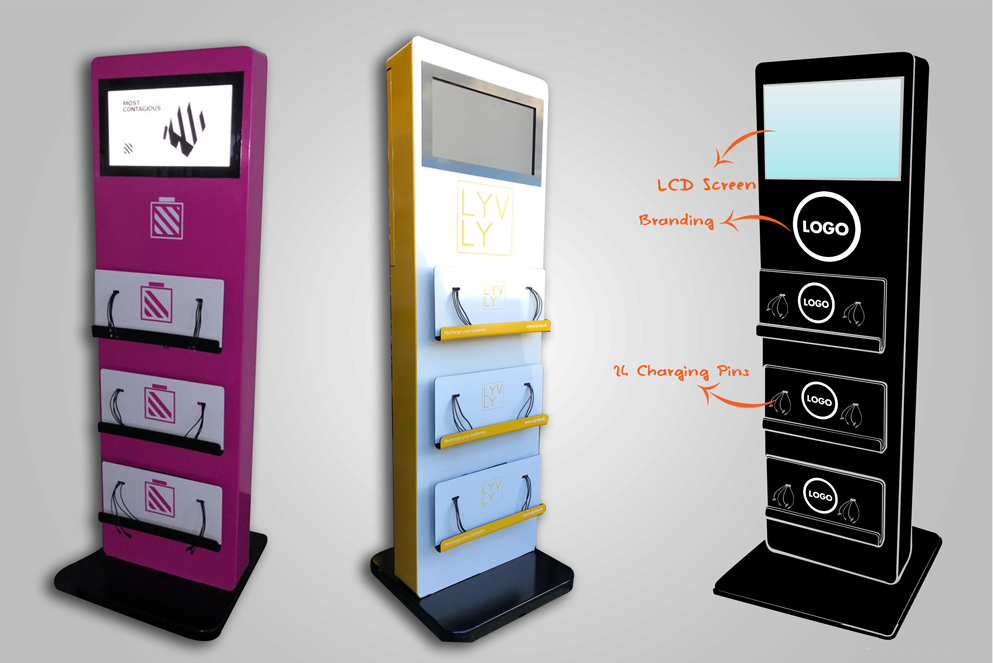
A phone charging locker is a secure cabinet divided into individual compartments, each containing a charging connection and a lock. A user places their phone inside, connects it to the cable or socket, closes the door and locks it. They keep the key, PIN code or access wristband, go away, and return later to a charged device.
That basic description hides quite a lot of variation. Not all charging lockers are built the same, and the differences matter when you are comparing suppliers or deciding whether to buy.
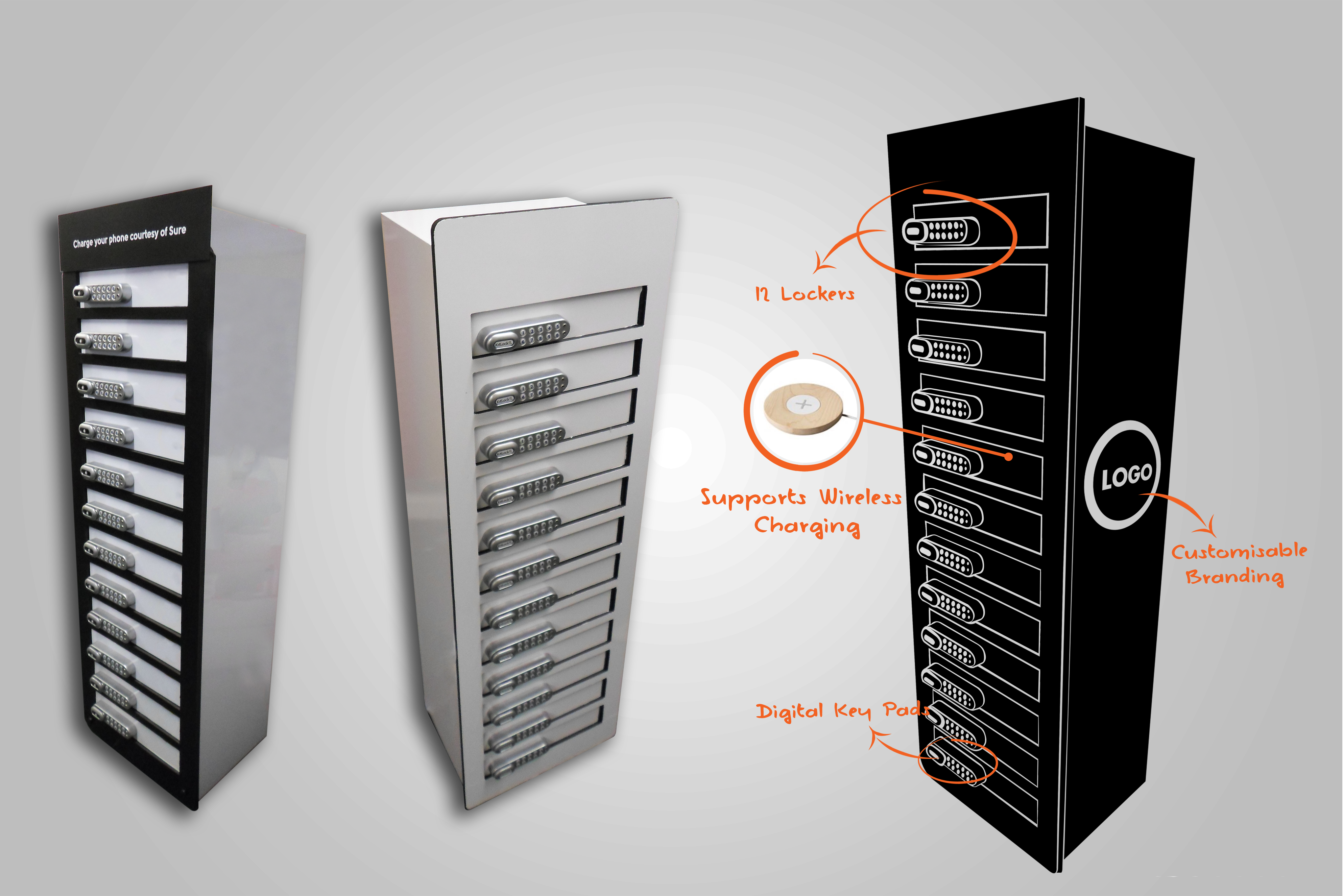
Compartments and capacity. Charging lockers range from small units with eight or ten doors to larger banks with twenty or more compartments. Some are tall floor-standing cabinets; others are low-level units designed for countertops or wall mounting. Compartment sizes vary too. Standard festival lockers might be around 150mm × 150mm × 300mm, while larger compartments can accommodate tablets or even small laptops . If your visitors carry nothing bigger than a smartphone, a compact unit is fine. If you expect tablets or multiple devices per person, size up.
Charging connections. Inside each compartment you will typically find one of three arrangements: a standard UK three-pin socket (so users plug in their own charger), built-in charging cables with multiple connector types (Lightning, USB-C and Micro-USB), or a combination of both. Some units include USB-C fast-charge ports alongside a three-pin socket . The best choice depends on your audience. Built-in cables remove the need for visitors to remember their charger, but they can wear out and need replacing. Three-pin sockets are more flexible but useless to anyone who has forgotten their cable.
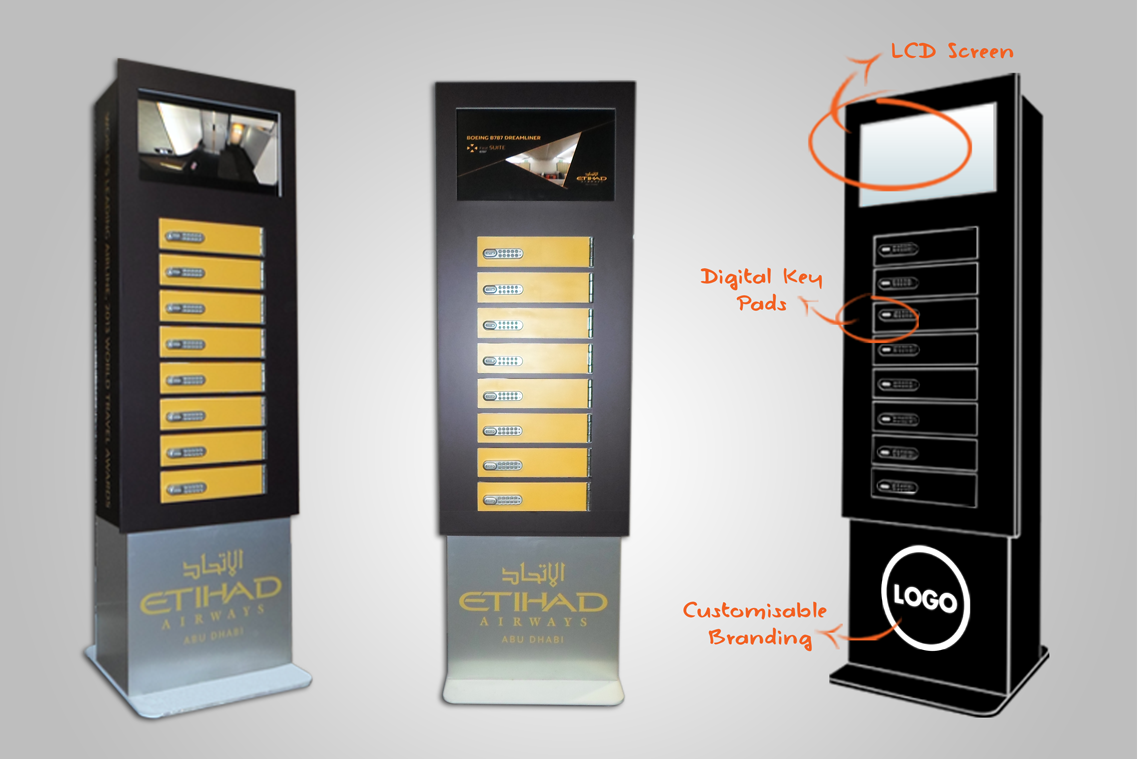
Locking and access. Key locks are the simplest and cheapest option. Cam locks with master keys allow staff to override a forgotten key or a stuck door. PIN-code systems let users set their own code, removing the key-handling problem entirely. Wristband or RFID access is common at festivals, where a wristband can be scanned to open the locker and reused throughout the event . For high-traffic public venues, PIN or digital access is generally more practical than physical keys.
Power and ventilation. Charging lockers need a mains power supply, typically 230–250V AC . Each compartment draws a small amount of current, but the total load adds up. A twenty-door locker charging twenty phones simultaneously will draw more than a ten-door unit. Ventilation is essential: phones generate heat while charging, and a sealed metal box traps it. Reputable units have perforated doors, ventilated compartments or fan-assisted airflow . If a supplier cannot explain how their lockers manage heat, ask why.
What a charging locker is not. It is not the same as an open charging station, where phones sit on a shelf or hang from cables in public view. It is not a power bank rental service, where users take a battery away and return it later. And it is not a simple wall socket. The defining feature of a locker is secure, individual storage during charging. That security is what justifies the cost — and what creates the operational responsibilities.
Why Are Phone Charging Lockers in Demand in 2027?
Phones have become the operational backbone of modern events and venues. They are the ticket, the payment method, the map, the camera, the communication channel and the social media tool. When a phone dies, the visitor experience degrades quickly.
At a festival, a dead phone means no way to contact friends, no digital ticket for re-entry, no contactless payment for food or drinks, and no photos of the headline act. At a conference, it means no access to the event app, no networking contact details, and no way to follow the live stream in the overflow room. At a shopping centre, it means no loyalty app, no click-and-collect code, and no mobile payment.
Battery anxiety is not a niche concern. It is a predictable feature of any event where people are away from their normal charging routine for several hours, particularly multi-day events where they may also be camping or staying in accommodation without easy access to a socket.
What has changed by 2027 is not the underlying need — people have needed charged phones at events for years — but the sophistication of the solutions and the willingness of venues to treat charging as a service rather than an inconvenience. Festival lockers now commonly include USB-C fast charging and can be pre-booked before the event . Commercial lockers for venues are available with branding, remote monitoring and integrated payment systems . The equipment has matured.
It is worth being cautious about claims of explosive market growth. The search results for this guide include supplier marketing materials and event booking pages, but no independently verified market statistics showing the size or growth rate of the UK charging locker market. Treat any specific growth figure with scepticism unless it comes from a named research firm with a published methodology. The demand is real; the exact numbers are harder to pin down.
Are Phone Charging Lockers Worth Paying For? The Main Benefits
The benefits of charging lockers are straightforward in principle but uneven in practice. A benefit that transforms one venue’s offer may be irrelevant to another. Here is what each one actually delivers, and when.
Convenience for visitors. This is the core benefit. A visitor arriving at a festival with 12% battery can lock their phone away for an hour and collect it with enough charge to last the evening. The convenience is genuine, but its value depends on whether visitors have an alternative. At a camping festival with no power in the tents, the locker is the only option. At a city conference venue with sockets at every seat, it is a nice-to-have rather than a necessity.
Secure storage during charging. An open charging station leaves a phone exposed. A locker lets the visitor walk away without worrying about theft or damage. For venues where visitors will be away from the charging point for an extended period — a festival arena, a large exhibition hall, a shopping centre — security is the difference between a usable service and a liability.
Improved customer experience. Visitors remember when a venue solves a problem they were dreading. A charged phone at the end of a long day is a small but meaningful improvement. The caveat is that this benefit is hard to measure and easy to overstate. A smoother experience may contribute to return visits or positive word of mouth, but claiming that it directly generates revenue requires evidence that most venues will not have.
Potential additional revenue. Charging lockers can be operated as a paid service. Festival lockers commonly cost between £10 and £40 depending on duration and size . A venue with steady footfall can generate income from each use. The revenue potential depends on utilisation — how many lockers are used, how often, and at what price. Empty lockers generate nothing.
Sponsorship and advertising. Lockers can be branded. A sponsor’s logo on a bank of charging lockers reaches an audience that is standing still, interacting with the equipment, and likely to notice their surroundings. For events with existing sponsor relationships, this can offset some or all of the cost. But it only works if the sponsor values the placement, and that depends on audience size and relevance.
Reduced staff interruptions. Without a charging facility, staff at bars, box offices and information desks become informal phone-charging assistants. “Can I leave my phone behind the bar for ten minutes?” is a common request. Lockers absorb that demand and free staff to do their actual jobs. This benefit is real but difficult to quantify unless you track the time staff spend handling charging requests.
Differentiation. If competing venues or events do not offer charging, a well-run locker service can be a point of difference. If everyone offers it, it becomes table stakes. The value of differentiation depends entirely on what the competition is doing.
The Disadvantages and Hidden Costs of Phone Charging Lockers
A balanced view requires looking at what can go wrong, what gets overlooked in the sales brochure, and which costs only appear after the equipment arrives.
The purchase price is not the total cost. A commercial charging locker might list at several hundred to several thousand pounds depending on size and specification. But the purchase price is the beginning. Delivery, installation, electrical connection by a qualified electrician, and any necessary groundwork or anchoring are additional. A unit that needs a dedicated power circuit will cost more to install than one that plugs into an existing socket.
Hire costs accumulate. Event hire includes delivery, setup, collection and often on-site support. Those services have value, but the per-event cost adds up quickly if you hire repeatedly. An organiser who hires lockers for six events a year may spend more than the purchase price of a comparable unit within a season or two.
Installation and power requirements. Lockers need mains power. For permanent installations, that means planning the electrical supply, ensuring the circuit can handle the load, and complying with relevant safety requirements. Portable event units may run from standard sockets, but you still need to confirm the venue’s power capacity and whether extension leads are acceptable (often they are not, for insurance reasons).
Maintenance and repairs. Cables fray. Locks jam. Doors get slammed. Screens fail. A charging locker is a piece of equipment used by the public, often in a hurry, sometimes carelessly. Budget for replacement cables, lock repairs and occasional servicing. Hire agreements may cover maintenance, but purchase does not.
Cleaning and inspection. Every compartment needs checking between uses for left items, damage or mess. At a busy event, that means staff time. At a permanent venue, it means a cleaning routine. This is not a major cost, but it is a real one.
Insurance and liability. If a phone is lost, stolen or damaged while in a locker, who is responsible? The answer depends on your contract, your insurance and the circumstances. Some suppliers offer liability cover as part of the hire agreement; others do not. For purchase, you need to confirm with your insurer whether third-party devices left in your equipment are covered. This is not a reason to avoid lockers, but it is a reason to read the fine print .
Downtime and faults. A locker with a faulty door or a dead charging port is worse than no locker at all, because it creates a queue and a complaint. Hire companies typically provide backup equipment or on-site support. Buyers need a plan for repairs and a supplier with accessible technical support.
Capacity constraints. Lockers take up floor space. A twenty-door unit is roughly the size of a tall filing cabinet. If your venue is short on space, that matters. Outdoor units need weather protection and anchoring.
Obsolescence. Charging standards change slowly, but they do change. A locker with fixed Micro-USB cables will become less useful as Micro-USB devices disappear. Units with three-pin sockets and USB-C are more future-proof. Buyers should think about what their visitors will be carrying in five years, not just next month.
Event Phone Charging Locker Hire Explained
Event hire is the most common commercial arrangement for festivals, exhibitions and one-off events. You pay a supplier to provide the equipment for a defined period, usually including delivery, setup, support and collection. You do not own the equipment, store it or maintain it after the event.
How the process works. A typical hire starts with an enquiry. You tell the supplier your event dates, location, expected attendance and any specific requirements (branding, outdoor use, power availability). They quote a price and confirm availability. Before the event, you agree delivery and collection times, confirm site access arrangements and provide any necessary power information. On site, the supplier delivers and installs the lockers, tests them, and briefs your team. During the event, depending on the contract, they may provide on-site support or a phone line for faults. After the event, they collect.
One-day versus multi-day hire. A one-day hire suits a conference, a single-day exhibition or a corporate event. The equipment arrives in the morning and leaves in the evening. Multi-day hire suits festivals, trade shows that run for three or four days, and sporting events. The per-day cost usually decreases for longer hires, but the total cost is higher. Some suppliers offer weekend rates that are better value than two separate day hires .
Festival hire. Festivals have specific requirements: outdoor-rated equipment, high capacity, secure access (wristbands or PINs), and often pre-booking so attendees can reserve a locker before they arrive . Power availability on grass or temporary sites can be a constraint. Suppliers experienced in festival work will understand the logistics, but you should confirm that their equipment is suitable for outdoor use and that they have a contingency for power failures.
Exhibition and trade show hire. Exhibitions have different demands. Visitors are often there for a full day, may be carrying bags and samples, and want to charge a phone without leaving the hall. Lockers at an exhibition stand can also serve as a reason for visitors to return to your stand, or as a branded touchpoint. The power and space constraints of exhibition halls are well known to experienced suppliers, but access times and venue regulations vary .
Conference and corporate event hire. Conferences typically have lower charging demand than festivals because attendees are seated in rooms with power, or at least have access to charging between sessions. Lockers are most useful at large conferences where attendees are moving between venues, or at corporate events where guests want to store a phone securely while they network. Branding is often a priority for corporate clients.
Sports events and venue activations. Race days, stadium events and outdoor sports create the same problem as festivals: people are outside for hours, taking photos and videos, with no easy way to charge. Lockers at a racecourse or stadium concourse can serve both visitors and staff. Weather resistance matters for outdoor venues.
What to confirm before booking. Ask about delivery and collection windows, power requirements, whether the supplier provides cables or users bring their own, on-site support arrangements, insurance and liability, cancellation terms, and what happens if a locker fails during the event. Get the answers in writing.
An event organiser checklist:
- Confirm expected attendance and peak charging demand.
- Decide whether lockers will be free, paid or sponsored.
- Check venue power capacity and socket locations.
- Confirm delivery access and setup space.
- Ask about outdoor rating if applicable.
- Clarify insurance and liability for stored devices.
- Arrange staff briefing on locker operation and fault reporting.
- Plan signage so visitors know the lockers exist.
- Agree collection time and site clearance responsibilities.
A supplier enquiry checklist:
- What capacity options do you offer?
- What is included in the quoted price (delivery, setup, support, collection)?
- Are cables provided, or do users bring their own?
- How are lockers secured (keys, PIN, wristband)?
- What is your fault response procedure during an event?
- What insurance do you carry, and what liability sits with us?
- Can lockers be branded, and at what cost?
- What are your cancellation and postponement terms?
- Can you provide references from similar events?
Phone Charging Locker Rental: Is Short-Term or Long-Term Rental Better?
Rental differs from event hire in duration and commercial structure. Where event hire is built around a single date or a short run, rental is a longer-term arrangement: weeks, months or a full season. The equipment may be the same, but the contract, pricing and responsibilities are different.
When rental makes sense. A venue that is busy for three months of the year but quiet for the other nine might rent lockers for the peak season rather than buy. A business testing whether charging lockers generate enough use to justify a permanent installation might rent for a trial period. An organiser with a series of events over several months might find a rolling rental cheaper than repeated event hires.
Rental duration and fees. Rental fees are typically charged monthly or per season. The per-week cost is usually lower than a short-term event hire because the supplier has less turnaround work and the equipment is committed for longer. But you are paying for the full rental period whether you use the lockers or not. If your demand is concentrated into a few days, event hire may still be cheaper.
Maintenance responsibilities. In a rental agreement, maintenance is usually the supplier’s responsibility. If a locker fails, they repair or replace it. This is a significant advantage over purchase, particularly for businesses without technical staff. Confirm the response time and what counts as a fault versus damage caused by misuse.
Contract terms. Rental contracts vary. Some have minimum terms, notice periods or early termination fees. Some include delivery and installation; others charge separately. Some allow you to increase capacity mid-contract; others do not. Compare the total cost over the full term, not just the monthly fee.
Flexibility. Rental offers more flexibility than purchase. If demand is lower than expected, you can reduce capacity or end the rental at the end of the term. If demand is higher, you may be able to add units. This flexibility has a price, but for a business that is uncertain about demand, it may be worth paying.
Total cost comparison. To compare rental with purchase fairly, calculate the total rental cost over the period you expect to use the lockers, then compare it with the purchase price plus maintenance, insurance, storage and eventual replacement. If the rental cost exceeds the purchase cost within two or three years, purchase may be better value — provided you are confident about ongoing demand. If the rental cost is lower, or if demand is uncertain, rental is the lower-risk choice.
Buying Phone Charging Lockers: Is Purchasing Worth It?
Buying makes sense when you will use the equipment often enough that the total cost of ownership falls below the cost of repeated hire or rental. It also makes sense when you want control: over branding, placement, software, maintenance and the visitor experience.
When purchase is the right choice. A venue that hosts events most weekends, a shopping centre with daily footfall, a university library or student union with term-time demand, a stadium with regular match days — these are the scenarios where a permanently installed bank of lockers earns its keep. The equipment is used frequently, the demand is predictable, and the cost per use falls with every event.
What you actually own. When you buy, you own the hardware. You are responsible for installation, power, maintenance, repairs, insurance, storage (if the unit is portable) and eventual replacement. You also own the data, if the lockers have monitoring or payment systems, and the branding space. That control can be valuable, but it comes with obligations.
Asset life and depreciation. A well-built commercial charging locker should last several years with proper maintenance. Steel cabinets, quality locks and replaceable cables are the difference between a unit that survives five years of festival use and one that looks tired after one season. Ask suppliers about expected asset life, warranty terms and the availability of replacement parts. A cheap locker with no spare parts availability is a false economy.
Warranty and support. Warranty terms vary widely. Some cover the cabinet and locks for a year; others cover electronics for longer. Confirm what is covered, what is excluded (usually misuse, water damage and normal wear), and how repairs are handled. A supplier who disappears after the sale is a risk.
Storage and transport. If the lockers are permanently installed, storage is not an issue. If they are portable units intended for use at multiple sites, you need somewhere to store them and a way to transport them safely. A tall locker cabinet is heavy and awkward to move. Castors help, but they are not a substitute for proper handling equipment.
Resale value. Commercial equipment has some resale value, but it is limited. A used charging locker is a niche product. Do not buy expecting to recover a significant proportion of the purchase price if you change your mind.
A buyer’s checklist:
- Confirm compartment size suits your visitors’ devices.
- Check charging connections: three-pin, USB-C, Lightning, Micro-USB, or a combination.
- Ask about ventilation and heat management.
- Confirm the locking system and whether master access is available.
- Check power requirements and whether installation needs an electrician.
- Ask for the warranty terms in writing.
- Confirm spare parts availability (cables, locks, doors).
- Check whether the supplier offers technical support and how to access it.
- Ask about branding options and costs.
- Request a demonstration or site visit if possible.
- Read the contract for maintenance responsibilities and limitations.
Phone Charging Locker Hire vs Rental vs Buying
The comparison table below summarises the key differences. The explanation that follows explains why the cheapest option is not always the best value.
| Factor | Event Hire | Rental | Purchase |
|---|---|---|---|
| Initial expenditure | Low to medium per event | Medium (deposit and first period) | High |
| Ongoing expenditure | Per event | Per rental period | Maintenance, repairs, insurance |
| Best use case | One-off or occasional events | Seasonal or trial use | Frequent, predictable use |
| Ownership | Supplier | Supplier | You |
| Maintenance responsibility | Supplier | Usually supplier | You |
| Flexibility | High (event by event) | Medium (contract term) | Low (you own it) |
| Storage requirements | None | None (or supplier-managed) | You provide |
| Delivery and installation | Included or quoted | Included or quoted | You arrange |
| Suitability for one-off events | Excellent | Poor value | Poor value |
| Suitability for regular events | Expensive over time | Good | Excellent |
| Suitability for permanent venues | Not designed for it | Possible but costly long-term | Excellent |
| Customisation | Limited to supplier options | Limited | Full control |
| Long-term cost | Highest per use | Medium | Lowest per use if utilisation is high |
| Financial risk | Low | Medium | High |
Why the cheapest option might not be the best value. A single event hire quoted at a few hundred pounds looks cheap compared with a purchase price in the thousands. But if you hire for six events a year, the annual hire cost may exceed the purchase price within two or three years. The purchase price is not just the equipment; it is the avoidance of future hire fees.
Conversely, buying for a single event is almost always poor value. You pay the full purchase price, arrange installation and then store the equipment for fifty weeks of the year. Unless you have a clear plan for ongoing use, hire is the rational choice.
Rental sits in between. It costs more per week than ownership over a long period, but less than repeated event hire. It transfers maintenance risk to the supplier and gives you an exit route if demand does not materialise. For a venue that is unsure whether charging lockers will be used, rental is the lower-risk way to find out.
How Much Do Phone Charging Lockers Cost in 2027?
Pricing in this market is not transparent. Many suppliers quote on application, and published prices often exclude delivery, installation and support. What follows separates verifiable published prices from the factors that drive cost. Where illustrative figures are used, they are labelled as hypothetical examples, not market prices.
Event hire prices (published examples). Festival locker prices give a useful indication of the retail end of the market. At Victorious Festival, daily locker rental started at £14 per day, with weekend rental from £40 . At Creamfields, weekend lockers were £25 for medium and £35 for large, with day-only lockers at £10 and £15 . At Glorious Day Festival, a day pass was £15, with an XL pass at £20 . These are prices charged to festival attendees, not the cost of hiring a bank of lockers for an event. They illustrate what visitors will pay, which is useful for revenue calculations, but they are not supplier hire quotes.
For B2B event hire — where an organiser hires a bank of lockers for an exhibition or conference — prices are typically quote-based. The cost depends on the number of lockers, duration, location, delivery distance, whether on-site support is included, and branding requirements. You will need to request quotes from suppliers to get actual figures.
Purchase prices (published examples). Some commercial lockers have published prices. A QMP dual USB phone charging locker with 20 doors and Perspex doors was listed at £969 ex VAT from one retailer . A Seltek security tablet and phone charging locker with 20 doors was listed at £599 for a single unit, with discounts for multiple units . These are examples of published prices for specific models, not a comprehensive market survey. Prices vary significantly by specification, capacity, materials and supplier.
Longer-term rental. Rental prices are almost always quote-based. The monthly cost depends on the equipment value, rental duration, maintenance terms and delivery arrangements. A longer rental should cost less per week than event hire, but you are committing for a longer period.
Installation and setup. For permanent installations, electrical work by a qualified electrician is a real cost. If the locker can plug into an existing socket, installation is straightforward. If it needs a dedicated circuit, the cost increases. Outdoor installations may need anchoring, weatherproofing or a concrete base .
Delivery and collection. Event hire quotes should state whether delivery and collection are included. For remote or difficult-access venues, these costs can be significant. London venues with tight loading bay windows may charge for access or require specific delivery times .
Maintenance and support. Hire and rental usually include maintenance. Purchase does not. Budget for replacement cables, lock repairs and occasional servicing. A service contract with the supplier may be available.
Optional extras. Branding, payment systems, monitoring software and additional cables all add cost. Decide which extras are genuinely useful for your situation rather than accepting a package that includes features you will never use.
Why costs vary. Capacity is the biggest driver. A twenty-door locker costs more than a ten-door unit. Specification matters: steel thickness, lock quality, cable type, ventilation, outdoor rating and payment integration all affect price. Duration matters for hire and rental. Location matters for delivery and installation. Service level matters: on-site support costs more than a phone line. Branding costs money and takes time. There is no single market price for a phone charging locker, because there is no single product.
How to Calculate the Return on Investment of Phone Charging Lockers
ROI calculations for charging lockers are not always straightforward, because some of the benefits are financial and some are not. The examples below use hypothetical figures and transparent assumptions to show how the maths works. They are not predictions or market data.
Case 1: A venue buying lockers for repeated use.
A venue buys a bank of twenty lockers for a hypothetical £3,000, including delivery and installation. It expects to use them at 30 events per year. Maintenance and consumables (replacement cables, occasional lock repair) are estimated at £200 per year. The venue does not charge visitors; the benefit is customer experience, which it does not attempt to monetise directly.
Payback period = Initial investment ÷ Annual net cash benefit.
If there is no direct revenue, the payback period is not meaningful in cash terms. The investment is a cost, not a revenue-generating asset. The venue should judge it on non-financial grounds: improved visitor satisfaction, reduced staff interruptions, differentiation. That does not make it a bad investment, but it is not an ROI calculation in the conventional sense.
If the same venue charges £2 per use and averages 50 uses per event across 30 events, revenue is £3,000 per year. Net operating contribution = Revenue − operating costs = £3,000 − £200 = £2,800 per year. Payback period = £3,000 ÷ £2,800 = approximately 1.07 years, or about 13 months. After that, the lockers generate net income.
Case 2: An event organiser hiring lockers.
An organiser hires twenty lockers for a three-day festival at a hypothetical cost of £1,500, including delivery, setup and collection. The lockers are used to generate sponsorship income: a sponsor pays £2,000 to have their branding on the lockers and in associated signage. The net contribution from the sponsorship is £500 after the hire cost. If the organiser also charges visitors £3 per use and sells 200 uses over the weekend, that is £600 in additional revenue, minus payment processing fees and staff time. The hire is financially positive if the combined revenue exceeds the hire cost and associated expenses.
Case 3: A business charging customers to use lockers.
A bar installs a ten-door locker bank bought for a hypothetical £1,500. It charges £2 per use. Operating costs are minimal: electricity and occasional cable replacement, estimated at £100 per year. If the lockers are used 400 times per year, revenue is £800. Net operating contribution = £800 − £100 = £700 per year. Payback period = £1,500 ÷ £700 = approximately 2.1 years. At 600 uses per year, revenue is £1,200 and net contribution is £1,100, giving a payback of about 1.4 years. The maths only works if utilisation is high enough. A locker bank that sits empty generates nothing.
Case 4: A venue providing free charging.
A shopping centre installs lockers as a free amenity. There is no direct revenue. The centre may value the service because it encourages visitors to stay longer, but it cannot easily prove that a longer stay translates into additional spending. The honest approach is to treat the cost as a customer experience investment, not an ROI project. If the centre wants to justify the spend, it should set a clear objective (for example, reducing complaints about phone charging, or supporting a loyalty app that requires charged phones) and measure against that objective rather than inventing a revenue figure.
The formulas, clearly stated:
- Payback period = Initial investment ÷ Annual net cash benefit.
- Net operating contribution = Revenue generated − Relevant operating costs.
- ROI (%) = (Net benefit ÷ Investment cost) × 100.
Be consistent about the period you are measuring (monthly, annual, per event) and include all relevant costs, not just the obvious ones. Do not guarantee profitability. The numbers depend on utilisation, pricing and costs that vary by venue and event.
How Many Phone Charging Lockers Does an Event Need?
Total attendance is a poor guide to locker capacity. An event with 10,000 attendees may need fewer lockers than an event with 3,000, depending on duration, visitor behaviour and alternative charging options.
The factors that matter:
- Expected attendance. A starting point, not an answer.
- Peak simultaneous demand. How many people will want a locker at the same time? At a festival, peak demand often occurs in the late afternoon and early evening, when phones are running low and the headline acts are approaching. At a conference, demand may peak during lunch and coffee breaks.
- Event duration. A one-day event has one charging cycle. A three-day festival has multiple cycles, but also longer storage times.
- Visitor turnover. If visitors come and go, lockers turn over more quickly. If they stay all day, a locker is occupied for longer.
- Expected charging time. A phone charging from low battery to full may take one to three hours, depending on the device and charger . If visitors leave phones for the full charge, each locker serves fewer people per day.
- Number of compartments. This is the capacity constraint.
- Alternative charging options. If there are power sockets, power banks or open charging stations, demand for lockers is lower.
- Opening hours. A longer day means more potential users but also more time for each locker to be used.
An illustrative example. Suppose a one-day outdoor event expects 5,000 attendees. You estimate that 15% will want to charge a phone at some point during the day, based on your experience or comparable events. That is 750 potential users. If the event runs for eight hours and the average locker is occupied for two hours, each locker can serve four users per day. To serve 750 users, you would need approximately 188 lockers. That is a large number. In practice, not everyone who wants to charge will use a locker, and not everyone will arrive with a low battery. A more realistic assumption might be 5–8% of attendees, giving 250–400 potential users and a requirement of 63–100 lockers. Even that is substantial. Many events start with a smaller bank and monitor utilisation, adding capacity if queues form. The example is hypothetical; your assumptions should be based on your event’s specific circumstances.
The practical approach. Start with a pilot. Hire or rent a modest number of lockers for your first event and track usage: how many are used, at what times, for how long, and whether people are turned away. Use that data to plan capacity for future events. Overprovisioning wastes money; underprovisioning creates queues and complaints.

Which Events Benefit Most from Phone Charging Locker Hire?
Not every event needs charging lockers. The ones that benefit most share a common feature: attendees are away from reliable charging for extended periods and rely on their phones for essential functions.
Music festivals. The strongest case. Attendees are on-site for multiple days, often camping, with limited or no access to power. Phones are used for tickets, cashless payments, photos, meeting friends and social media. Charging lockers are a standard festival service in 2027, with pre-booking common . The main limitation is capacity and power logistics on temporary sites.
Outdoor events. Race days, air shows, outdoor cinemas and country shows have similar characteristics: long days outside, heavy phone use, no easy charging. Weather resistance is essential. Lockers should be rated for outdoor use or housed under cover.
Exhibitions and trade shows. Visitors walk the floor for hours, often carrying bags and samples. A locker lets them charge a phone and store purchases. The benefit is strongest at large, multi-hall venues where visitors are on-site all day. Exhibitors may also use lockers as a stand feature to attract visitors .
Conferences. A mixed case. Conference venues often have power in session rooms, reducing the need for lockers. But large conferences with multiple venues, or events where attendees are networking in public areas, may still benefit. Lockers at a conference can also be branded and used as a sponsor touchpoint.
Corporate events. Similar to conferences. The value depends on whether attendees are seated with power or moving around. Branded lockers at a corporate party or awards ceremony can be a useful amenity and a talking point.
Sporting events. Stadiums and arenas with concourses can install lockers for match days. Demand is concentrated before kick-off and at half-time, so capacity planning must account for peaks. Outdoor sports venues may need weather protection.
Universities and student events. Student unions, libraries and campus venues can use lockers for students who are on campus all day. Demand is term-time and predictable. Purchase or long-term rental is usually more cost-effective than event hire.
Nightclubs and hospitality venues. A nightclub with a no-phones policy, or a bar where customers want to charge a phone while they eat, can use a small locker bank. The use case is narrower than at a festival, but the cost is lower for a small unit.
Shopping centres. A free or paid charging service can keep shoppers on-site longer. The benefit is strongest in large centres where visitors spend several hours. The business case depends on whether the centre can measure the impact on dwell time or spending.
Public attractions and leisure venues. Museums, galleries, theme parks and leisure centres can offer charging as a visitor amenity. The case is similar to shopping centres: the benefit is customer experience, and the ROI is indirect.
Phone Charging Lockers vs Other Charging Solutions
A charging locker is one option among several. The right choice depends on your setting, your visitors and what you are trying to achieve.
| Solution | Security | Convenience | Staffing | Capacity | Best for |
|---|---|---|---|---|---|
| Charging lockers | High (locked storage) | Good (user can leave device) | Low after setup | Medium to high | Festivals, venues with unattended charging |
| Open charging stations | Low (device visible) | Good (user stands and waits) | Medium (monitoring) | High (no locking) | Conferences, short dwell times |
| Charging cables at service desks | Medium (staff supervision) | Low (user must ask) | High | Low | Small venues, informal settings |
| Power banks (rental) | Medium (user carries device) | High (portable) | Medium (distribution/return) | High (scalable) | Festivals, city-wide events |
| Power banks (personal) | N/A (user owns) | High (portable) | None | Low (user must bring) | Individuals |
| Wall sockets | Low | Low (user must stand) | None | Low | Anywhere with sockets |
Security. Lockers win. An open charging station leaves a phone exposed to theft or damage. A power bank rental is secure in the sense that the user keeps their phone, but the power bank itself can be lost or stolen. Wall sockets offer no security.
Convenience. Power banks are the most convenient for the user because they can charge while moving. Lockers require the user to leave the device, which is less convenient but also means they do not have to stand still. Open stations require the user to stay with the device.
Space and capacity. Open stations and wall sockets use less space per charging point than lockers, but they offer no security. Lockers use more space but provide a better experience for users who want to leave their device.
Operational complexity. Lockers need cleaning, maintenance and fault handling. Power banks need charging, distribution and collection. Open stations need monitoring. Wall sockets need nothing, which is both their strength and their limitation.
Cost. Wall sockets are the cheapest to install. Lockers have a higher upfront cost. Power bank rental has a per-unit cost that scales with usage. Event hire of lockers is a per-event cost.
The right choice. If security is important and users will be away from their device, lockers are the best option. If throughput is high and users want to charge while moving, power banks may be better. If the setting is informal and the volume is low, a service desk with cables may suffice. There is no universal winner.

Important Features to Look for When Buying or Hiring Phone Charging Lockers
When comparing products or quotes, the specification matters more than the headline price. A cheap locker with the wrong connections or poor ventilation will cost more in frustration than it saves.
Essential features:
- Compartment capacity and dimensions. Match the compartment size to the devices your visitors carry. Standard phones fit in most lockers; tablets and large phones need larger compartments.
- Charging connections. Three-pin sockets, USB-A, USB-C, Lightning, Micro-USB, or a combination. USB-C is increasingly important as more devices adopt it. Built-in cables are convenient but need to be replaceable.
- Locking and access. Key, PIN, wristband or RFID. Consider how users will access their locker and how staff will handle forgotten codes or lost keys.
- Power requirements. Confirm the voltage, current draw and plug type. Check whether the unit needs a dedicated circuit.
- Ventilation. Perforated doors, ventilated compartments or active cooling. Heat is the enemy of battery life and safety.
- Safety certification. CE marking and compliance with relevant standards. UK electrical safety requirements apply.
- Durability. Steel construction, quality hinges and locks, and a finish that suits your environment.
- Accessibility. Can the lockers be used by people with limited reach or mobility? Are the controls at a suitable height?
- Ease of cleaning. Smooth surfaces, removable cables and accessible compartments make cleaning easier.
- Warranty and support. What is covered, for how long, and how do you get repairs?
Optional or premium features:
- Branding. Custom wraps, colours or logos.
- Payment integration. Coin, card or contactless payment for paid lockers.
- Monitoring. Remote visibility of occupancy, faults and usage.
- Outdoor rating. Weatherproof construction for outdoor use.
- Scalability. Ability to add modules or units as demand grows.
- Multi-device capacity. Larger compartments or multiple sockets per compartment.
Do not assume that a feature is standard. A locker that looks similar to another may have cheaper locks, thinner steel or cables that fail after a few months. Ask for specifications in writing and compare like for like.
Security, Safety, and Reliability Considerations
A charging locker holds a device that contains personal data, payment cards and often the user’s entire trip information. Security is not a nice-to-have.
Secure access. The locking mechanism should be fit for purpose. Key locks are simple but keys can be lost or copied. PIN codes are more secure but depend on the user remembering the code. Wristband or RFID access is convenient at events but requires a management system. Whatever the system, there should be a master override for staff to deal with forgotten codes or stuck doors .
User instructions. Clear signage explaining how to use the locker reduces errors and calls for help. Instructions should cover how to lock, how to retrieve, what to do if the door will not open, and who to contact if there is a problem.
Equipment inspection. Lockers should be checked regularly for damage, worn cables and faulty locks. At events, a daily check before opening is sensible. For permanent installations, a scheduled inspection routine is better than reacting to failures.
Electrical safety. Charging lockers are electrical equipment. They should be installed and maintained in accordance with relevant UK electrical safety requirements. A qualified electrician should carry out any fixed wiring installation. Portable units should be plugged into a suitable socket, not a daisy-chain of extension leads. RCD protection is advisable .
Overheating prevention. Ventilation, thermal cut-outs and user instructions (do not cover the device, do not use damaged cables) all help. The risk is low for a single phone charging normally, but it increases with poor ventilation, damaged cables or multiple devices crammed into a small space.
Maintenance and incident handling. Have a procedure for what happens if a phone is left behind, a locker will not open, or a device is damaged. This should cover who staff should contact, how the device is stored securely, and how the incident is recorded.
Supplier responsibilities. In a hire or rental agreement, the supplier is usually responsible for the equipment’s safety and functionality. In a purchase, the buyer takes on that responsibility. Clarify who is responsible for what before anything goes wrong.
Liability. Do not assume that a locker is completely secure or that the supplier will cover every loss. The precise arrangements depend on the product, the contract, your insurance and the circumstances. Check with your insurer whether third-party devices left in your equipment are covered, and read the supplier’s terms carefully .
How to Choose a Phone Charging Locker Hire Company or Supplier
The equipment is only part of the service. A good supplier makes the logistics easy; a bad one turns a simple booking into a stressful mess.
Equipment and capacity. Do they have the number and type of lockers you need for your dates? Can they handle your expected attendance and duration? Ask for specifications, not just photos.
Hire and purchase prices. Are the quotes clear about what is included? Do they separate delivery, setup, support and collection? A low headline price with lots of extras may be worse value than a higher all-in quote.
Delivery and installation. Can they deliver to your venue, at the times your venue allows? Do they handle installation and testing? For outdoor events, can they secure the units safely?
Event experience. Have they worked at events like yours before? Ask for examples, not just a list of logos. Experience with festival logistics is different from experience with corporate conferences.
Technical support. What happens if a locker fails during your event? Is there a phone line, an on-site technician, or backup equipment? What is the response time?
Insurance. What liability insurance do they carry? Does it cover devices left in lockers, or only the equipment itself? You need to know where your liability ends and theirs begins.
Warranty and maintenance. For purchase, what warranty is offered, and what does it cover? For hire and rental, who maintains the equipment and how quickly?
Payment terms and cancellation. What deposit is required? When is the balance due? What are the cancellation terms, and what happens if your event is postponed? Get these in writing.
Branding. Can the lockers be branded? What is the cost and lead time? Can you see a proof before production?
References and case studies. Ask for references from similar clients or events. A supplier who cannot provide any is a risk.
A supplier comparison checklist:
- Do they have the capacity and specification you need?
- Is the quote itemised and clear about inclusions?
- Can they meet your delivery and collection windows?
- Do they have relevant event experience?
- What is their fault response procedure?
- What insurance do they carry?
- What are the warranty terms (purchase) or maintenance terms (hire/rental)?
- What are the payment and cancellation terms?
- Can they provide references?
Common Mistakes to Avoid When Hiring or Buying Charging Lockers
Most problems with charging lockers are predictable. Avoiding them is a matter of planning rather than luck.
Choosing capacity based on attendance alone. Attendance tells you how many people are there, not how many will use a locker. Consider duration, alternatives and peak demand. Start smaller and scale if needed.
Focusing exclusively on the lowest price. A cheap quote that excludes delivery, support or branding is not cheaper. Compare total costs and what is included.
Ignoring delivery and installation. A locker that arrives without a way to get it into the venue, or without the right power connection, is useless. Confirm logistics before booking.
Overlooking power requirements. Check the venue’s power capacity and socket locations. A bank of lockers may need more power than a single socket can provide.
Failing to plan for peak demand. Queues at charging points are frustrating for visitors and staff. Have a plan for managing peaks: additional capacity, queue management or time limits.
Neglecting technical support. A faulty locker during a busy event needs a quick response. Confirm the support arrangement before the event, not after something breaks.
Ignoring accessibility. Lockers should be usable by people with limited mobility or reach. Consider height, controls and space around the unit.
Underestimating storage and transport. If you buy portable lockers, you need somewhere to store them and a way to move them safely. A tall cabinet is heavy and awkward.
Assuming all charging connections are equivalent. Micro-USB is declining; USB-C is standard. Three-pin sockets require users to bring a charger. Built-in cables wear out. Match the connections to your audience.
Failing to read contract terms. Cancellation, liability, damage and insurance clauses matter. Read them before you sign.
Buying before testing demand. If you are unsure whether lockers will be used, hire or rent first. Use the data to inform a purchase decision.
Hiring without a contingency plan. What happens if the lockers arrive late, a unit fails, or the event is cancelled? Have a plan B.
Solutions. For each mistake, the solution is the same: plan before you commit, ask questions, get answers in writing, and start with a pilot if you are uncertain.
Are Phone Charging Lockers a Good Investment for Small Businesses?
Small businesses face a different calculation from large venues. The budget is tighter, the space may be limited, and the margin for error is smaller.
When a small business might benefit. A café or bar with a loyal customer base and no nearby charging options. A small gallery or studio that hosts evening events. A independent venue that wants to offer something its larger competitors do not. A market stall or pop-up that operates at multiple events.
When it probably will not. A small business with low footfall, limited space, or customers who are only on-site for a few minutes. A business that cannot justify the upfront cost or the staff time to manage the lockers. A business in a location where charging is readily available nearby.
A decision framework for limited budgets:
- Estimate demand. How many customers per week are likely to use a charging locker? Be conservative.
- Check alternatives. Are there free or cheap charging options nearby? If so, demand will be lower.
- Calculate the cost. Purchase price plus installation, or hire/rental cost for a trial period.
- Estimate revenue or benefit. If charging is paid, estimate revenue at a realistic utilisation rate. If free, identify the benefit you are trying to achieve (dwell time, satisfaction, differentiation) and how you will know if it is working.
- Start small. A small locker bank or a short rental period is a low-risk way to test demand before committing.
- Review after three months. If the lockers are well used, consider expanding. If they are not, stop.
A small business does not need to match a festival’s capacity. A six- or ten-door unit may be sufficient. The key is to match the investment to the demand, not to buy the biggest or cheapest option.
The Future of Phone Charging Lockers in 2027 and Beyond
Predicting the future of any technology is risky. What is clear in 2027 is that charging lockers are becoming more connected, more flexible and more integrated into venue operations. What is less clear is how quickly these developments will matter to the average buyer.
Verified current capabilities. Some commercial lockers now include remote monitoring, payment integration, cloud connectivity and API access . These features allow operators to see which lockers are in use, manage pricing remotely and integrate locker data with other systems. They are available now, but they add cost and complexity. A small venue may not need them.
Charging standards. USB-C is increasingly the default connector for new devices. Lockers with USB-C ports and cables are more future-proof than those limited to Micro-USB. Wireless charging exists but is slower and less efficient; it is unlikely to replace wired charging for lockers in the near term.
Payment systems. Contactless and QR-code payment are becoming more common. For venues that charge for locker use, integrated payment reduces cash handling and staff involvement. But it also adds cost and requires connectivity.
Access technology. Wristband and RFID access are already established at festivals. PIN-code systems are common in permanent venues. The direction of travel is towards digital access that can be managed remotely, but physical keys remain the simplest and cheapest option for low-volume sites.
Integration with venue operations. Lockers could potentially integrate with ticketing systems, loyalty apps or event apps, allowing pre-booking, personalised pricing or linked offers. These integrations exist in some form but are not yet standard. Whether they become common depends on demand from venues and the willingness of system providers to work together.
What to watch for. More competition in the market could drive prices down and improve features. But it could also lead to consolidation and reduced support for older equipment. Buyers should prioritise suppliers with a track record and a clear plan for supporting their products over time.
What not to assume. Do not assume that every new feature is worth paying for. A locker that does the basics well — secure, ventilated, reliable, with the right connections — will serve most venues better than a feature-rich unit that is complex to use and expensive to maintain.
Frequently Asked Questions About Phone Charging Lockers
1. Are phone charging lockers worth the money?
It depends on utilisation. If lockers are used frequently and the cost per use is lower than the alternatives (staff time, lost sales, poor visitor experience), they are worth it. If they sit empty, they are not. Calculate your expected usage before committing.
2. How much does it cost to hire phone charging lockers?
Hire costs are quote-based and depend on capacity, duration, location and support. Festival locker prices charged to attendees range from around £10 for a day to £40 for a weekend , but B2B hire for a bank of lockers is a different calculation. Request quotes from several suppliers.
3. Is it cheaper to rent or buy charging lockers?
For one-off or occasional use, renting or hiring is cheaper. For frequent, predictable use over several years, buying is usually cheaper in total. The crossover point depends on the purchase price, rental fees and how often you use the lockers.
4. Can I hire charging lockers for a single-day event?
Yes. Many suppliers offer one-day hire for conferences, exhibitions and corporate events. Delivery and collection are usually included or quoted separately.
5. Are charging lockers suitable for festivals?
Yes, and they are widely used at UK festivals. Look for outdoor-rated equipment, high capacity and a locking system that suits your access arrangements (wristband or PIN are common). Pre-booking for attendees can help manage demand.
6. Can businesses make money from phone charging lockers?
Yes, if utilisation is high enough. A venue that charges £2 per use and averages 400 uses per year generates £800 in revenue. After operating costs, the net contribution can pay back the purchase price over time. The maths only works if people use the lockers.
7. How secure are phone charging lockers?
A good locker with a quality lock and a master override procedure is secure for normal use. No locker is completely theft-proof. The precise security depends on the product, the locking mechanism and how the lockers are managed.
8. How long does a phone take to charge in a locker?
A modern smartphone charging from low battery to full typically takes one to three hours, depending on the device and the charger. Some lockers offer fast charging, which can reduce this. Festival operators often suggest allowing a few hours .
9. How many lockers do I need for my event?
Estimate peak simultaneous demand rather than total attendance. Consider duration, visitor turnover and alternative charging options. Start with a smaller number and monitor usage; add capacity if queues form.
10. What should I look for when buying charging lockers?
Compartment size, charging connections (USB-C, three-pin, built-in cables), ventilation, locking system, power requirements, warranty, spare parts availability and supplier support. Compare specifications, not just prices.
11. Can phone charging lockers be branded?
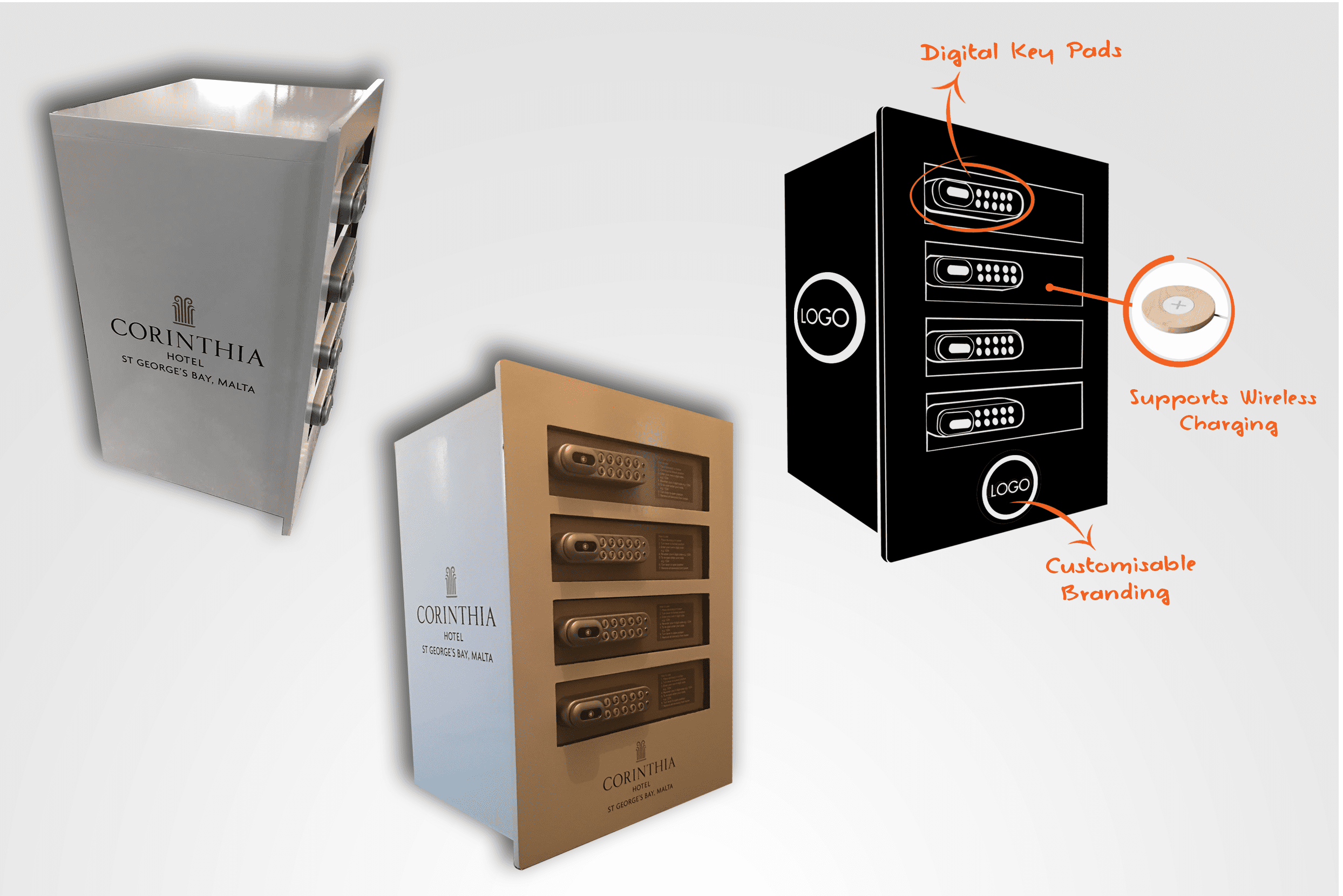
Yes. Many suppliers offer custom wraps, colours or logos. Branding costs extra and has a lead time. It is popular for corporate events and sponsor-funded installations.
12. Do charging lockers need an internet connection?
Only if they have monitoring, payment or remote management features. A basic locker with key or PIN access does not need internet. Connected lockers offer more functionality but add cost and complexity.
13. Who is responsible for maintenance?
In hire and rental agreements, the supplier usually maintains the equipment. In a purchase, the buyer is responsible. Check the contract or warranty terms before committing.
14. Can charging lockers be used outdoors?
Some models are designed for outdoor use with weatherproof construction and anchoring. Standard indoor units should not be used outdoors without protection. If your event is outdoors, confirm the rating with the supplier.
15. What happens if a locker stops working?
In hire and rental, contact the supplier for repair or replacement. In purchase, contact the supplier’s technical support or arrange a repair. Have a contingency plan for busy events: a backup unit or an alternative charging option.
16. Are charging lockers suitable for permanent venue installations?
Yes, for venues with regular footfall and a clear need. Permanent installation requires a power supply, a suitable location and a maintenance plan. Purchase is usually the right commercial route.
17. What is the difference between a charging locker and a charging station?
A locker has individual secure compartments where devices are stored and charged. A charging station is an open unit with cables or sockets where devices charge in the open. Lockers offer security; stations offer throughput.
18. How can I compare supplier quotations?
Compare what is included, not just the headline price. Check delivery, installation, support, insurance, branding and cancellation terms. Ask for itemised quotes and references.
19. Is phone charging locker hire suitable for corporate events?
Yes, particularly for large conferences or events where attendees are moving between venues. Branding is often a priority. The value depends on whether attendees need charging and whether alternatives are available.
20. When should a business buy rather than hire?
When the lockers will be used frequently (weekly or more), when the purchase price can be recovered within a reasonable period through avoided hire costs or generated revenue, and when the business is prepared for the maintenance and storage responsibilities.
Are Phone Charging Lockers Worth Paying For in 2027?
The answer is not a simple yes or no. It depends on your circumstances, and the right commercial route depends on your pattern of use.
Hire is the better option when you are running a one-off event or a small number of events per year, when you do not want the responsibility of ownership, and when the total hire cost is lower than the cost of buying and maintaining equipment you will rarely use. Festivals, exhibitions and conferences with a defined date are classic hire scenarios.
Rental is more appropriate when you need lockers for a season or a trial period, when you want to test demand before committing to a purchase, or when you want the supplier to handle maintenance but need the equipment for longer than a single event. It is the middle path: more commitment than hire, less risk than purchase.
Buying makes financial sense when you will use the lockers frequently and predictably, when you want control over branding and placement, and when the total cost of ownership over several years is lower than the cost of repeated hire or rental. Permanent venues with regular footfall are the strongest candidates.
The factors that determine value for money are utilisation, the price you pay per use, the alternatives available to your visitors, and whether you can measure the benefit. A locker bank that is used every day is good value. A locker bank that sits empty is not, regardless of how good the equipment is.
How to avoid paying for unnecessary capacity or features. Start with a realistic estimate of demand. Hire or rent a modest number of lockers for your first event or season. Track usage. Add capacity only when you have evidence that it is needed. Do not buy the biggest unit or the most feature-rich model unless you have a clear reason. The best locker is the one that gets used, not the one with the longest feature list.
If you are considering phone charging lockers for an upcoming event, the next step is to get quotes. Compare hire, rental and purchase options based on your actual usage pattern. Ask suppliers the questions in this guide. And if you are unsure, start small. A trial is cheaper than a mistake.